5 Lucky Plants That Attract Wealth and Peace
In banking, we talk a lot about “Assets” and “Liabilities.” An asset puts money in your pocket. A liability takes money out.
When I go to a client’s home for a Vastu audit, I apply this same logic to their decor. That expensive Italian leather sofa? It’s a liability—it depreciates every day. That massive 85-inch TV? Liability.
But plants? Plants are the only item in your home that physically appreciates. They grow. They breathe. They reproduce.
In Vastu Shastra, plants are not just “greenery.” They are living antennas. They connect your concrete apartment to the Earth element. They act as filters, trapping the negative dust of stress and releasing the fresh oxygen of Prana (Life Force).
However, just like the stock market, you have to pick the right stocks. I have seen homes filled with beautiful Cacti where the residents were constantly arguing (thorn energy). I have seen offices with dying Bonsai trees where the business had stopped growing (stunted energy).
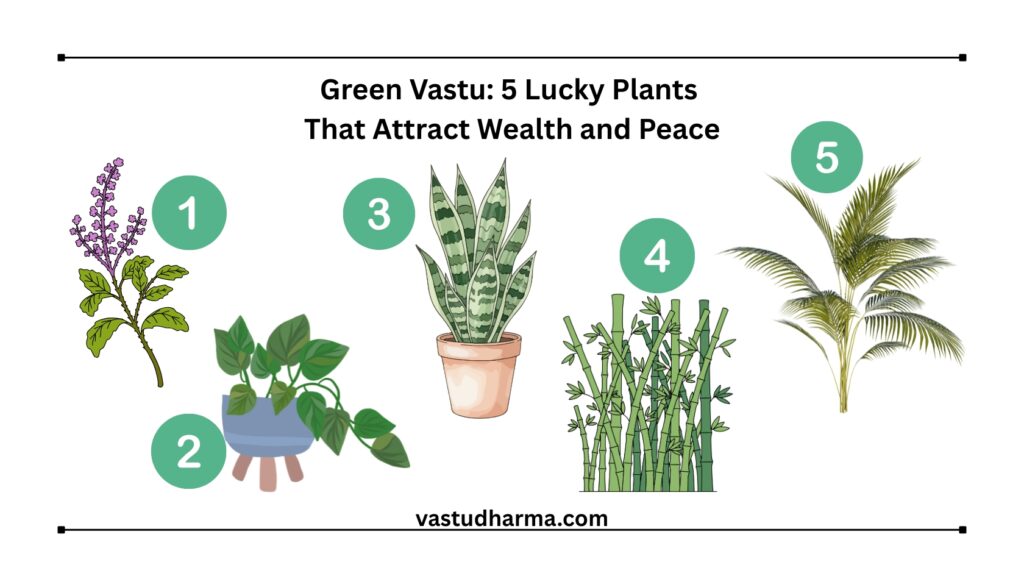
Today, I am going to share the Green Portfolio. These are the 5 essential plants that act as “Vastu Correctors” to attract wealth and peace in 2026.

The Science of “Green Energy” or “Lucky Plants”
Before we dig into the soil, let’s understand the logic. Why do plants work?
It isn’t magic. It is biology meeting energy.
Your home is filled with electromagnetic radiation (WiFi, 5G, TV screens). This creates positive ions—which, ironically, make us feel tired and stressed.
Plants release negative ions. When you balance the ions, your blood pressure drops, your focus sharpens, and your mood stabilizes.
From a Vastu perspective, plants represent the Wood Element.
- Wood feeds Fire. (Fire is the element of Cash Flow).
- Wood consumes Water. (Water is the element of Opportunity).
If you place a plant in the wrong zone, it can “drink up” your opportunities. If you place it in the right zone, it fuels your cash flow. Location is everything.
1. The Divine Protector: Holy Basil (Tulsi)
If you are an Indian, this is non-negotiable. But do you know why?
In the old days, every house had a central courtyard (Brahmasthan) open to the sky, with a Tulsi plant right in the middle. Today, we live in matchbox apartments. We don’t have courtyards.
The Vastu Role:
Tulsi is the most powerful generator of Oxygen and Ozone. It is considered an avatar of Goddess Lakshmi. It has a high vibration that naturally repels insects, bacteria, and—energetically speaking—negative spirits.
Where to Place It:
- The Best Spot: The North-East balcony or window. The North-East is the God Corner (Ishanya). Placing a Tulsi here keeps the “Head” of the house pure.
- The Alternative: The East or North.
The Banker’s Warning:
Never, ever place a Tulsi plant in the South of your home. The South is the direction of Fire/Death. Placing the delicate Tulsi there burns its energy. Also, strictly avoid placing it near a toilet or shoes. It is a deity; treat it with respect, or don’t keep it at all.
2. The Cash Flow Engine: The Money Plant
I know, it’s a cliché. Everyone has a Money Plant. But 90% of people place it incorrectly.
They assume “Money = North,” so they put it in the North.
This is a mistake.
The Money Plant (Epipremnum aureum) is a creeper. It grows fast and wild. In Vastu, it is associated with Lord Ganesha and the planet Venus. Venus rules luxury and comfort.
Where to Place It:
You must place the Money Plant in the South-East corner of your living room or office.
- Why? South-East is the Agni Kon (Fire Zone). Fire burns. But remember, “Wood feeds Fire.” By placing a green plant here, you are adding fuel to the fire of your cash flow.
The “Climbing” Rule:
Gravity matters. If your Money Plant vines are trailing down towards the floor, your bank balance will trend downwards.
Money must grow up. Use a moss stick or a thread to guide the vines upward. This symbolizes rising financial status.
3. The Stress Buster: Snake Plant (Sansevieria)
This is my favorite plant for modern city life. It is practically indestructible. You can forget to water it for two weeks, and it will still stand tall.
Its nickname is “Mother-in-Law’s Tongue” because of the sharp, pointy leaves. But don’t let the name scare you.
The Vastu Role:
While most plants release Carbon Dioxide at night, the Snake Plant performs a specific type of photosynthesis (CAM) that allows it to release Oxygen at night.
This makes it the only plant I recommend for the Bedroom.
Where to Place It:
- South or South-West Window: The South-West is the “Earth” zone. It needs heaviness and stability. The Snake Plant grows vertically and has thick, fleshy leaves. It acts as a “Sword” protecting the master bedroom from bad energy.
- The Desk: If you have a computer on your desk, place a small Snake Plant near it to absorb radiation.
4. The Opportunity Magnet: Lucky Bamboo
Let’s clarify something: The “Lucky Bamboo” you buy in gift shops isn’t actually bamboo. It’s a Dracaena. But in Feng Shui and Vastu, it works as a powerful conduit for energy.
The Vastu Role:
Bamboo is hollow inside. This hollowness allows Prana to flow through it easily. It teaches us resilience—it bends in the wind but doesn’t break.
Where to Place It:
- The East Zone: The East is governed by the Sun and represents Health and Social Connections. Placing a Bamboo plant here clears the air between family members.
- The Centre Table: If your living room feels heavy or arguments happen often, place a Bamboo plant in the center of the coffee table. It acts as a peacekeeper.
The Number Game:
- 3 Stalks: For happiness and long life.
- 5 Stalks: For wealth (The 5 elements).
- Avoid: 4 stalks. The number 4 sounds like “death” in Chinese culture and is avoided in Feng Shui.
5. The Air Purifier: Areca Palm
If you have an empty corner in your house that feels dark or stagnant, you need an Areca Palm.
In Vastu, corners are where energy gets stuck. If energy gets stuck, it turns into Sha Chi (Poison Arrows). A large, leafy plant softens this energy.
The Vastu Role:
The Areca Palm is a champion air purifier. It removes toxins like formaldehyde and xylene from indoor air. From a Vastu perspective, its large, fanning leaves circulate energy.
Where to Place It:
- South Corner: The South loves height. Since the Palm grows tall, it enhances the “Fame” energy of the South.
- Living Room Entrance: It looks welcoming and filters the energy of guests entering your home.
The “Do Not Enter” List (The Debt Traps)
Just as important as knowing what to buy, is knowing what to throw out. These three plants are Vastu disasters:
- Cactus:I don’t care how cute they look on Instagram. Thorns represent conflict. If you keep a cactus on your desk, you will face “prickly” situations with your boss. If you keep it in the bedroom, arguments with your spouse will increase.
- Bonsai:A Bonsai is a tree that has been genetically stopped from reaching its full potential. It is “stunted growth.” Do you want your career to be stunted? Do you want your children’s growth to be limited? No. Keep Bonsai out of the house.
- Cotton Plants:These are considered inauspicious (Snowy white cotton is often associated with grief in some traditions) and are dust magnets. They create “dead” energy.
A Banker’s Tip: The “Tending” Ritual
Buying the plant is only 10% of the job.
The other 90% is Maintenance.
In finance, if you ignore your portfolio, you lose money. In Vastu, if you ignore your plants, you lose luck.
- Yellow Leaves: These represent decay. If a leaf turns yellow, cut it off immediately. Don’t let it hang there.
- Dust: A dusty leaf cannot breathe. If the plant can’t breathe, your house can’t breathe. Wipe the leaves with a damp cloth once a week.
- Dead Plants: A dead plant is a corpse. It emits negative energy. If a plant dies despite your best efforts, thank it for absorbing the negativity in your home, and replace it immediately.
Start Small
You don’t need to turn your apartment into the Amazon Rainforest. Start with just two plants.
- Get a Money Plant for your South-East corner (for Wealth).
- Get a Snake Plant for your Bedroom (for Health).
Treat them like living members of your family. Talk to them. (Yes, really—it releases Carbon Dioxide which they love!). When you nurture nature, nature nurtures you back.
Is your home feeling heavy despite having plants?
Sometimes the issue isn’t the decor; it’s the direction. [Book a Personal Chart Analysis] with me, and let’s check if your entrance or kitchen is blocking your flow.
Shubh Vastu!
Which plant acts as a magnet for money according to Vastu?
While the Money Plant (Pothos) placed in the South-East is the traditional remedy for cash flow, the Crassula Ovata (Jade Plant) is known as the “Money Magnet” in Feng Shui and Vastu. placing a healthy Jade plant at the entrance of your office or business premises is believed to invite new clients and wealth opportunities.
Is it safe to keep plants in the bedroom?
Traditional Vastu advises against plants in the bedroom because most release Carbon Dioxide at night. However, there are exceptions. The Snake Plant (Sansevieria) and Aloe Vera release Oxygen even at night. You can safely keep these in the bedroom to improve air quality and sleep, provided they are kept in the South or South-West corner.
Which plants should be strictly avoided at home?
You should immediately remove Cacti (or any thorny plants like Rose inside the house), Bonsai (stunted growth), and Milky plants (plants that bleed white sap when cut, like Euphorbia). Additionally, never keep dried or dead flowers, as they represent death and decay.
Can I keep artificial or plastic plants?
From a Vastu perspective, plastic plants are “neutral.” They don’t give off positive energy, but they don’t give off negative energy either—unless they are dusty. A dirty plastic plant represents “stagnation.” If you must use them, keep them spotlessly clean. However, a live plant is always 100x better for raising the vibration of the home.
What is the best plant for the main entrance door?
The main door is where energy enters. Placing a Jasmine (Mogra) plant near the entrance is highly auspicious. Its fragrance attracts positive energy and soothes the nerves of anyone entering. Alternatively, tall Areca Palms on either side of the door act as excellent energy filters.
My Money Plant is dying. Is this a bad omen?
Don’t panic. A dying plant often means it has absorbed a hit of negative energy that was meant for you. It has done its job. Simply thank the plant, remove it from the house, and replace it with a fresh, healthy one. Do not try to nurse a rotting plant back to health inside the house.
Can I gift a plant to someone?
Yes, gifting a plant is excellent karma! It symbolizes giving life and growth. The best plants to gift are Lucky Bamboo (for resilience) or a Peace Lily (for harmony). Avoid gifting cacti or high-maintenance plants that might become a burden to the receiver.
Disclaimer: The information provided in this article regarding Vastu Shastra is for educational and cultural purposes only. Results from Vastu remedies are subjective and vary from individual to individual. Please exercise personal discretion.