Is Your Mandir Facing the Wrong Way?
You may be chanting the most powerful mantras—like the Gayatri Mantra or the Maha Mrityunjaya—with perfect pronunciation and deep devotion. But have you ever felt that despite your consistent prayers, the peace in your home remains fluctuating?
The missing piece might not be what you are praying, but where you are praying.
In Vastu Shastra, your home is viewed as a living entity, and the Puja Room (Mandir) acts as its spiritual powerhouse. It is the engine where cosmic energy is generated and distributed to every other room. If this “heart” of the home is placed in the wrong zone, or if the energy flow (Prana) is blocked by incorrect alignment, your spiritual progress can stall.
Today, we decode the essential rules of Mandir Vastu to ensure your prayers reach the divine without obstruction.

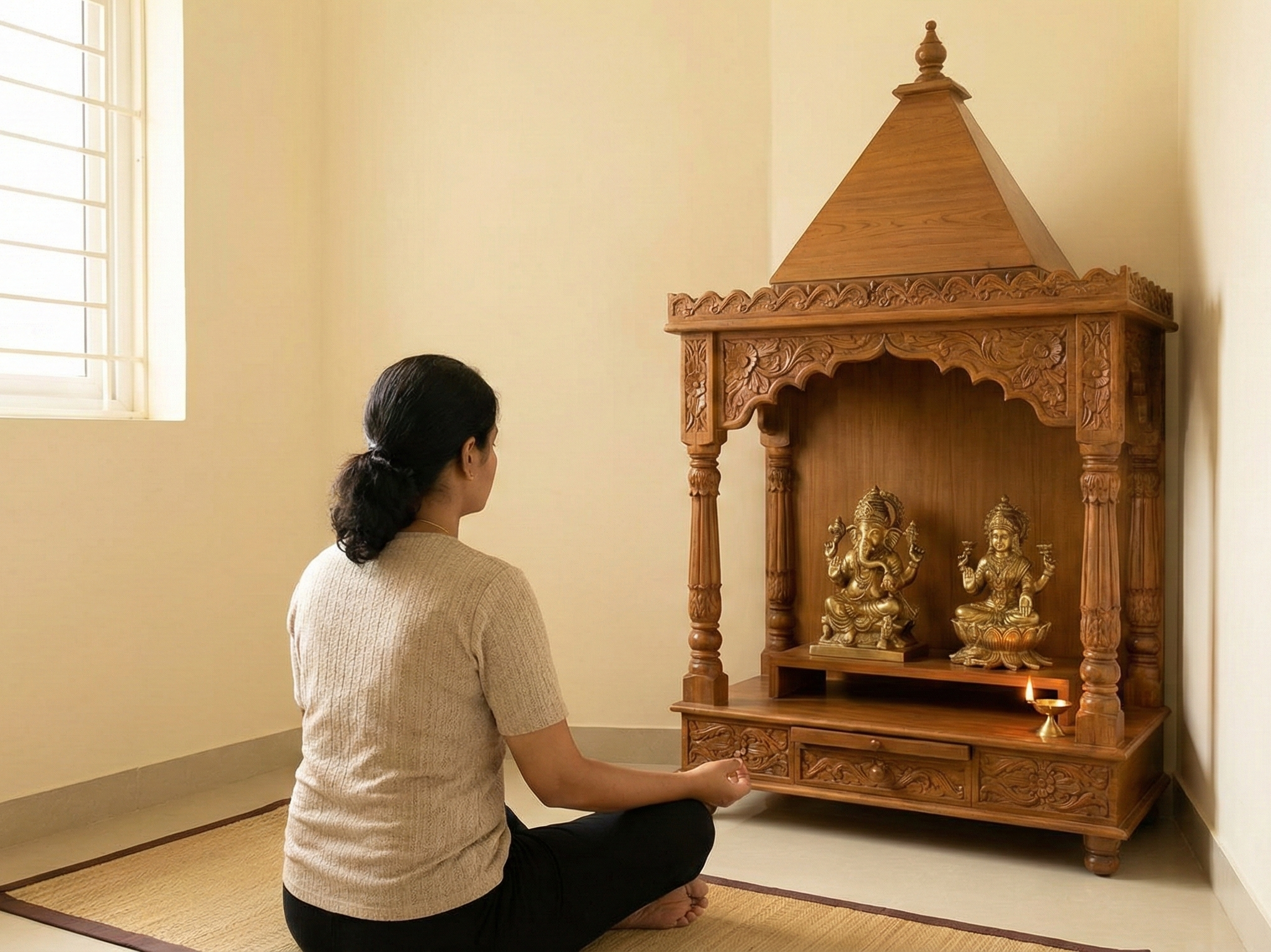
The Direction Dilemma: Location vs. Facing
The most common confusion in Vastu is distinguishing between where the temple should be located and which way you should face. Here is the definitive breakdown:
1. Location of the Room (The Placement)
- The Golden Spot: The North-East (Ishan Kona) is the most auspicious zone. This is where magnetic energy from the North meets solar energy from the East.
- The Alternatives: If the North-East is unavailable (e.g., it’s a bedroom or kitchen), place your altar on the East or North walls of your living room.
- The Prohibitions: Never place a Mandir in the South or South-West corners, or under a staircase. These areas have heavy, tamasic energies that clash with the lightness of worship.
2. Orientation (Devotee vs. Deity)
- For Enlightenment (Face East): ideally, the idols should face West so that you face East while praying. This aligns you with the rising sun and is best for wisdom and spiritual growth.
- For Wealth (Face North): You may also place idols facing South so that you face North. This is the direction of Kuber (Lord of Wealth) and is beneficial for material prosperity.
- The “Fierce” Exception: While most gods should face West/South, fierce deities like Hanuman, Kali, or Dakshinamurti are permitted to face South in specific temple architectures to channel their protective energy.
Structural & Design Guidelines (The Hardware)
Once you have identified the right location, the physical structure of your altar plays a crucial role in amplifying spiritual vibrations.
1. The Roof: The “Antenna” Effect If you are installing a standalone wooden temple, choose one with a Pyramid or Dome-shaped roof (gopuram).
- Why? Just like temple spires, a sloping roof acts as an antenna, capturing and concentrating cosmic energy from the universe into the focal point where the deity sits. Flat-roofed mandirs are less effective in channeling this energy.
2. The Doors: Welcoming the Divine A Mandir without doors is acceptable, but if you have them, they should ideally be two-shuttered (double doors) rather than a single panel.
- The Rule: The doors must always open outwards and should be able to open fully (180 degrees) without obstruction. This symbolizes the free flow of blessings into your life.
3. Materials: Conductors of Prana The material of the altar determines how well it holds energy.
- Best: Wood (especially Teak, Sheesham, or Rosewood) is the best conductor of spiritual vibrations. Marble (White or Yellow) is also excellent for purity.
- Avoid: Glass, acrylic, or metal tables. These materials do not retain the sattvic vibrations generated during chanting.
Idol Placement & Arrangement (The Software)
Even in the perfect room, the way you arrange the deities can either create harmony or subtle conflict. Follow these three rules to ensure a smooth flow of energy.
1. The “Breathing Room” Rule A common mistake is pushing idols flush against the back wall to save space.
- The Fix: Always leave a gap of at least 1 inch between the idol and the wall.
- Why? This allows the air and energy (Prana) to circulate freely around the deity, enveloping it completely. It symbolizes that the divine is independent and not “stuck” or supported solely by the wall.
2. Elevation & Respect Gods should never be placed directly on the floor.
- The Level: Place them on a raised platform (wooden or marble). Ideally, the feet of the deity should be at your chest or eye level when you are seated for prayer. This ensures you are looking up to the divine, not down, fostering a sense of reverence.
3. The “Face-Off” Rule In your enthusiasm to include many gods, be careful not to crowd them.
- The Prohibition: Ensure that no two idols are facing each other. For example, do not place Ganesha and Lakshmi on opposite walls looking at one another.
- The Impact: In Vastu, this “face-off” creates a clash of energies that can lead to friction or lack of consensus among family members. All deities should ideally face the devotee.
Atmosphere: Light, Color, and Purity
The physical structure is the body of the Mandir, but the atmosphere is its soul. To maintain high spiritual vibrations, pay attention to these three elements.
1. Color Palette: The Shades of Peace Your prayer room should visually induce a state of calmness (Sattva).
- Best Colors: Opt for White, Cream, Light Yellow, or Light Blue for the walls and altar cloth.
- Avoid: Dark, aggressive colors like Black, Grey, or angry Reds, as they can induce lethargy or restlessness during meditation.
2. Agni (Fire) Placement Lighting a lamp (Diya) is an essential part of daily worship.
- The Spot: Always place your Diya or Agni Kund in the South-East corner of the Puja platform.
- Why? In Vastu, South-East is the zone of Fire (Agneya Kona). Placing the lamp here aligns with the natural elements, ensuring health and removing negativity.
3. Critical “Don’ts” – Remove These Immediately Check your Mandir right now for these common Vastu defects:
- War Scenes: Never keep photos of the Mahabharata war or crying figures. They attract conflict into the household.
- Broken Idols: Any chipped or cracked idol (Khandit Murti) must be immersed in a river immediately. They stop generating positive energy.
- Clutter: Do not use the Mandir drawer to store scissors, medical bills, or general clutter. This blocks the flow of prosperity.
Conclusion
Your home temple is not just a corner for rituals; it is a sacred boundary that anchors the energy of your entire house. By making small, mindful adjustments—like moving the Diya to the South-East or ensuring your idols have that 1-inch breathing space—you can unlock a new level of peace and focus.
As you sit in your newly aligned Mandir tomorrow morning, try chanting the [Ganesha Pratah Smaran Stotram](link to Day 1 post) and observe the difference in your concentration.
Frequently Asked Questions (FAQ)
Can I place the Mandir in the kitchen?
In modern apartments, this is common. It is acceptable only if the Mandir is in the North-East corner of the kitchen and is kept covered with a curtain while cooking non-vegetarian food or during heavy cleaning.
Can we keep photos of deceased ancestors in the Mandir?
No. Ancestors (Pitru) deserve immense respect, but their energy is different from Deities. Their photos should be placed on the South wall of a different room, facing North. Do not mix them with the Gods in the Mandir.
What if the toilet is next to the Mandir?
This is a serious Vastu defect. If you cannot move the Mandir, ensure the wall sharing the toilet is treated with a thick wooden partition or a Vastu pyramid to block the negative energy.