

The Forgotten Factor in Real Estate
Imagine this scenario. You’ve finally found “The One.”
No, not a life partner—I’m talking about a plot of land. It’s in a developing area, the price is just right, and the broker tells you a new metro station is coming up just two kilometers away. You stand there, looking at the empty ground, imagining your future living room, the garden where your kids will play, and the balcony where you’ll sip your morning coffee.
You check the papers. Legal title? Clear. Zone? Residential. Price? Negotiable. You think you’ve done your homework.
But you missed something.
You forgot to look down.
In my years of consulting, I’ve seen smart people make this one specific mistake over and over again. They obsess over the direction the plot faces (everyone wants North or East-facing, right?), but they completely ignore the slope of the land.
In Vastu Shastra, specifically in the ancient text Vishwakarma Prakash, this is called “Plav.”
Think of Plav simply as the natural slant of the ground. It’s the answer to the question: If I pour a bucket of water here, which way will it run?
It seems like a tiny detail. You might think, “Oh, I’ll just level the ground with a bulldozer later.” But the natural energy flow of the earth isn’t that easy to trick. The slope of the land determines whether your home holds onto positive energy or drains it away like a leaky bucket.
I’m going to walk you through Chapter 1 of the Vishwakarma Prakash, the Bhumi Lakshan (Characteristics of Land). We aren’t going to get bogged down in complicated Sanskrit just yet. Instead, we are going to look at why the ground beneath your feet decides your financial and physical health before you even lay the first brick.

Where Should the Water Flow?
Before we get into the ancient verses, let’s talk about simple science and logic.
We live on a planet with a magnetic field (North Pole to South Pole) and a solar path (Sun rises in the East, sets in the West). Vastu Shastra is basically the manual for aligning your building with these two massive forces.
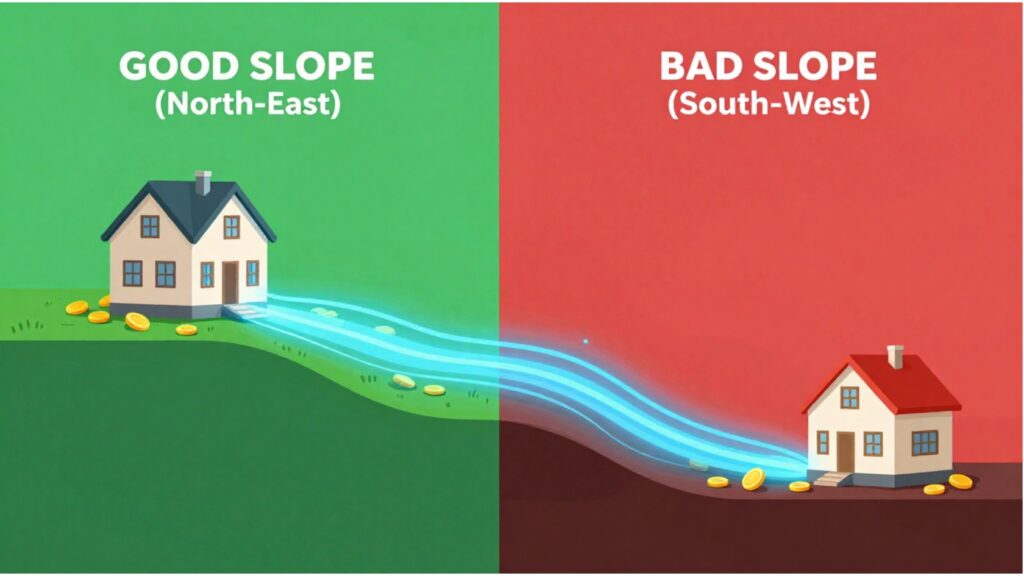
The “Golden Rule” of slope is surprisingly simple: You want to welcome the energy coming from the North and East.
Think of the North and East directions as the “inlet pipes” of cosmic energy. These are the directions of the Morning Sun (health) and the Magnetic North (wealth). To let this energy come in and settle in your home, the land needs to be lower in these directions.
Conversely, the South and West are the “outlet” or “barrier” directions. You want the land to be higher here to stop the good energy from escaping and to block the harsh afternoon heat (from the West) and negative magnetic pull (from the South).
The Bucket Test Here is the easiest way to visualize it. Imagine your plot of land is a flat tray.
- If you tilt the tray down towards the North-East, water pools there. In Vastu, this is like pooling luck and money.
- If you tilt the tray down towards the South-West, everything drains out. In Vastu, this represents money flowing out faster than it comes in.
So, the rule of thumb to memorize right now is:
- Down towards North/East = Good.
- Down towards South/West = Bad.
It sounds simple, but you would be shocked at how many “premium” gated communities are built on land that naturally slopes the wrong way.
What Vishwakarma Prakash Says
Now, let’s look at the source code. The Vishwakarma Prakash doesn’t mince words. It doesn’t say a bad slope is “unfortunate”; it uses much stronger language.
In Chapter 1, under the section for Bhumi Lakshan, Lord Vishwakarma outlines the effects of specific slopes. Let’s break them down into plain English.
The North Slope (Uttar Plav)
The text says: “Uttara plavam dhana-dhanya-sut-pradam.”
If you walk from the South side of your plot to the North side, are you walking downhill? If yes, you have Uttar Plav.
The text promises Dhana (Wealth) and Dhanya (Grains/Abundance). In the modern world, “grains” translates to food security and material comforts. The North is ruled by Kuber, the treasurer of the gods. A depression or slope toward the North acts like a bowl, ready to receive this wealth.
Real-life check: Look at some of the most prosperous cities or business districts. You will often find the terrain naturally slopes toward the North or Northeast.
The East Slope (Purva Plav)
The text reference: “Purva plavam vriddhikaram…”
This means a slope towards the East causes Vriddhi, which translates to “Growth.”
This is the direction of the rising sun. If your land slopes East, your home gets the very first rays of sunlight (Vitamin D and UV sterilization) without the harsh heat. This slope is fantastic for people who want name, fame, and career advancement. It pushes the inhabitants to be active and early risers.
The South Slope (Dakshin Plav)
Here is where the warnings start. The text says: “Dakshina plavam mrityu-rog-bhay-pradam.”
This is heavy. It translates to: “A slope towards the South brings death-like suffering (Mrityu), disease (Rog), and fear (Bhay).”
Why such scary language? If your land is low in the South and high in the North, you are essentially blocking the magnetic energy from entering (North is blocked) and opening the door to the draining energy of the South.
In my experience, homes with a heavy South slope often see the residents struggling with chronic health issues or sudden accidents. It feels like swimming upstream constantly.
The West Slope (Paschim Plav)
The text warns: “Paschima plavam kalah-shok-vinashanam.”
This translates to: “A slope towards the West causes strife (Kalah), grief (Shok), and destruction.”
The West is where the sun sets; it signifies the end of the day, or a decline in energy. If your land slopes West, your financial stability tends to “set” like the sun. You might make money, but you won’t keep it. It creates arguments in the family and a general sense of gloom.
| Slope Direction (Low Side) | Sanskrit Name | Effect on Residents | Verdict |
| North | Uttar Plav | Brings Wealth (Dhana) & Abundance (Dhanya). | ✅ Highly Auspicious |
| East | Purva Plav | Brings Growth (Vriddhi), Success & Fame. | ✅ Auspicious |
| North-East | Ishan Plav | Best for Knowledge & Prosperity. Combines benefits of North & East. | 🌟 The Gold Standard |
| South | Dakshin Plav | Causes Disease (Rog), Fear (Bhay) & Suffering. | ❌ Dangerous (Avoid) |
| West | Paschim Plav | Causes Strife (Kalah), Grief (Shok) & Financial Loss. | ❌ Inauspicious |
| South-West | Nairitya Plav | Causes Destruction of Wealth & Accidents. | ⚠️ Critical Defect |
How to Test Your Land (Practical Tips)
Now that you know the theory, how do you actually check the slope?
You might be thinking, “I’ll just look at it. I have good eyes.”
Here is a little secret from the construction world: Your eyes will lie to you.
Our eyes are easily tricked by the horizon, surrounding buildings, or even the way the grass grows. I’ve visited sites where the client swore the land was flat, but when we measured it, there was a two-foot drop towards the “wrong” corner.
You don’t need a degree in civil engineering to check this, but you do need to be methodical. Here are two ways to do it—the modern way and the traditional way.
The Visual “Horizon” Check
Stand exactly in the center of the plot (the Brahmasthan). Spin around slowly. Look at the boundary walls or the horizon.
- Does the land feel like it’s “rising” up behind you when you face North? That’s a good sign.
- Does the land feel like it’s “dropping” away when you look South? That’s a red flag.
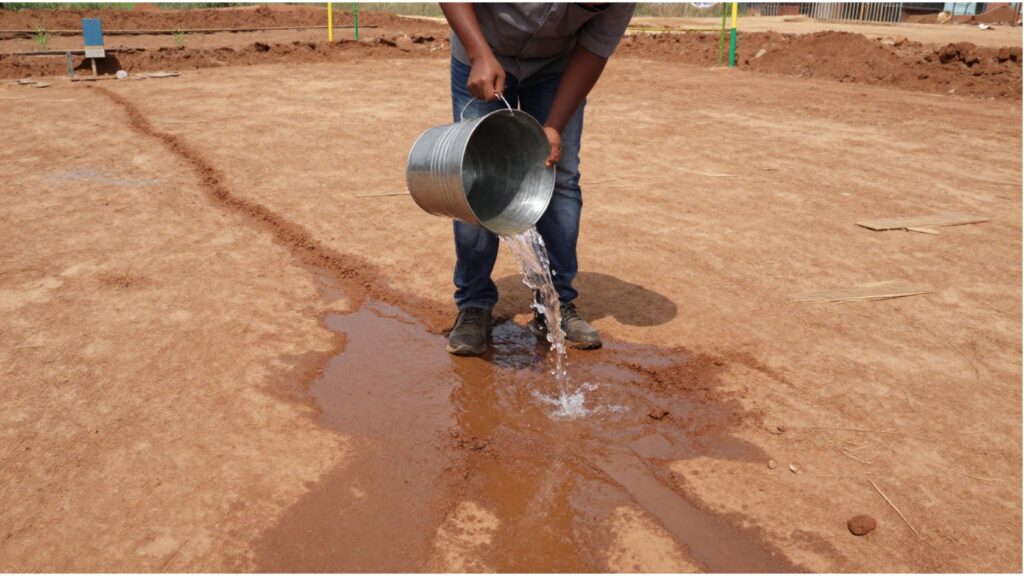
The “Bucket Test” (The Gold Standard)
This is the most reliable DIY method. It works best on an empty plot before construction starts.
- Wait for a clear day. You don’t want rain messing up your observation.
- Go to the center. Again, stand in the middle of the plot.
- Pour water. Take a large bucket of water and pour it slowly but steadily right in the center.
- Watch the flow. Don’t force it. Just watch where gravity takes the water.
- If it runs towards the North, East, or North-East: Congratulations! You have a winner.
- If it runs towards the South or West: You have a problem that needs fixing.
- If it pools in the center: The land is flat (neutral). This is okay, but you will need to create an artificial slope during construction.
Pro-Tip: If you are buying a built house (resale property), look at the rainwater drain pipes. Where does the rain from the roof go? If the main drainage outlet leaves the compound wall from the South-West corner, that is a major Vastu defect, even if the floor looks flat.
| Step | Action Required | Why? |
| 1. The Test | The Bucket Test: Pour water in the center of the plot. | To see the true gravitational flow, which eyes can miss. |
| 2. The Fix (Earth) | Cut & Fill: Dig from North/East, fill in South/West. | Physically reverses the magnetic flow of the land. |
| 3. The Fix (Walls) | Compound Walls: Make South/West walls higher & thicker. | Blocks negative energy drain and harsh solar heat. |
| 4. The Fix (Floors) | Internal Sloping: Ensure indoor floors slope slightly to NE. | Keeps the water element moving towards the positive zone. |
Can a Bad Slope Be Fixed? (Remedies)
Let’s say you’ve already bought the land. Or maybe you inherited a plot that slopes towards the South. Are you doomed?
Not necessarily. Ancient Vastu is rigid, but modern engineering gives us tools to fix things. However, fixing a slope is physical work—you can’t fix this with just a mantra or a crystal. You have to move earth.
Here are three ways to correct a negative slope (Plav):
A. The “Cut and Fill” Method
This is the most effective remedy.
- The Problem: Your land is high in the North and low in the South.
- The Fix: You need to dig up soil from the North and East sides (cutting) and dump it on the South and West sides (filling).
- The Result: You physically reverse the slope. Now, the South is heavy and elevated, and the North is light and depressed. This aligns perfectly with Vastu principles.
B. The Compound Wall Trick
If you cannot change the ground level (maybe it’s a rocky terrain), you manipulate the boundaries.
- Make the boundary wall on the South and West sides taller and thicker. Think of it as a dam blocking negative energy.
- Keep the boundary wall on the North and East sides lower and lighter (maybe use a wire fence or short grill).
- This creates a “virtual slope” where energy feels blocked from the South and open from the North.
C. Floor Level Management
Sometimes, the road outside is higher than your plot in the wrong direction. In this case, you must ensure that the Finished Floor Level (FFL) of your house is higher than the road.
- When building the house, keep the plinth (the base) high.
- Ensure that inside the house, the flooring slopes very slightly towards the North-East. Even a difference of one inch allows the water used for mopping to flow in the right direction.
A Serious Warning: If you have a plot on a steep hill or a mountain where the mountain is to your North and the valley is to your South, do not buy it. No amount of “cut and fill” can fight a mountain. The force of gravity and nature there is too strong. In such cases, it’s better to walk away.
Flow Over View
We live in an Instagram generation. We want homes with “views.” We want the sunset visible from the balcony.
But Vastu Shastra teaches us that a home isn’t just something to look at—it’s a machine for living. It processes energy.
The Slope (Plav) is the engine of that machine. If the slope is wrong, the engine runs in reverse. You might have the most beautiful kitchen and the most expensive furniture, but if your land is draining your energy towards the South-West, you will feel tired, stressed, and financially drained.
On the other hand, a simple, modest house built on a plot with a gentle North-East slope can become a powerhouse of prosperity. It supports you. It lifts you up.
So, the next time you go to look at a property, take a moment. Look down at your feet. Check the slope. Pour a little water if you have to.
Because while you pay for the land in square feet, the price you pay for the wrong slope is much, much higher.
Key Takeaways for Your Next Site Visit:
- North/East Slope = Good (Wealth & Health).
- South/West Slope = Bad (Loss & Struggle).
- Don’t trust your eyes; use the “Bucket Test.”
- If you own a bad plot, fix it physically by leveling the earth, not just with mental remedies.
FAQ: Common Questions About Land Slope & Vastu
Which direction slope is best for a house?
The best slope for a residential plot is North-East. This means the land should be highest in the South-West and lowest in the North-East. This specific slope allows the beneficial morning sunlight and magnetic energy to flow into the property, promoting health and financial growth.
Is a South-sloping plot really dangerous?
In Vastu, a South slope (where land is low in the South and high in the North) is considered a major defect known as Dakshin Plav. It is believed to drain energy, leading to health issues and financial losses. However, if you already own such a plot, it can be corrected by leveling the earth or building higher compound walls on the South side.
What is the difference between Shermukhi and Gaumukhi plots?
These terms refer to the shape of the plot:
Gaumukhi (Cow-Faced): Narrow at the front (entrance) and wide at the back. Best for Homes. It symbolizes stability and saving money.
Shermukhi (Lion-Faced): Wide at the front and narrow at the back. Best for Business. It symbolizes power and authority, perfect for shops or offices, but too aggressive for family living.
How can I test my plot’s energy before buying?
The most popular method is the “Water Pit Test” from the Vishwakarma Prakash. Dig a hole (1.5 ft deep), remove the soil, and then try to fill it back in.
Good: Soil overflows (indicates dense, supportive earth).
Average: Soil fits exactly.
Bad: Soil is insufficient to fill the hole (indicates loose, negative earth).
Can I buy a West-facing plot if it slopes to the East?
Yes! Many people confuse “Facing” with “Slope.” You can have a West-facing plot (where the road is to the West), but if the land itself slopes down towards the East (rear), it is still auspicious. The slope often matters more than the road direction.
What are the remedies for a plot with the wrong slope?
If you cannot change the land, use these physical remedies:
Earthwork: Cut soil from high positive zones (North/East) and fill the low negative zones (South/West).
Floor Levels: Ensure the finished floor level of the house is higher than the road.
Compound Walls: Build thick, heavy, and tall walls on the South and West sides to block negative flow.
About the Author Jagdish Vajpeyee is the founder of Vastu Dharma and a Vastu Shastra consultant with a specialized focus on Vedic Astrology. With a professional background in banking, Jagdish brings a unique, analytical approach to ancient wisdom, helping modern families and businesses correct their energy flow without unnecessary demolition. He is passionate about merging traditional Indian architecture with contemporary lifestyle needs.
Disclaimer
The information provided in this article is based on the ancient principles of Vastu Shastra and the Vishwakarma Prakash and is intended for educational and informational purposes only. While we strive to provide accurate interpretations of these traditional texts, the application of these principles can vary based on individual circumstances and specific site conditions.
- Not Professional Engineering Advice: The suggestions regarding land slope, soil testing, and structural remedies (such as “cut and fill” or compound wall construction) should not be attempted without consulting a qualified civil engineer, architect, or construction professional to ensure safety and structural integrity.
- Subjective Results: Vastu Shastra is a system of belief and traditional architecture. Results regarding prosperity, health, and well-being are subjective and cannot be scientifically guaranteed.
- Real Estate Decisions: This content should not be the sole basis for any real estate financial decisions. Always conduct due diligence regarding legal titles, government zoning, and market value before purchasing property.
Vastu Dharma assumes no liability for any actions taken or not taken based on the contents of this article. For specific Vastu analysis, we recommend a personalized consultation with a certified expert.
Please note: