
Have you ever woken up after a full eight hours of sleep feeling like you went ten rounds in a boxing ring? Your neck is stiff, your head is pounding, and you feel a strange sense of heaviness that you just can’t shake off with a cup of coffee.
You change your pillows. You buy a firmer mattress. You try lavender sprays and melatonin. Nothing works.
If this sounds familiar, look up.
If you are sleeping directly under an exposed structural beam, a soffit, or a sharp architectural bulkhead that cuts across your bed, you might have found the culprit. In the world of interior design psychology (and ancient practices like Feng Shui), this is a massive no-no. It’s often called the “cutting energy,” and it’s a notorious cause of restless sleep, chronic headaches, and even relationship tension.
Before you roll your eyes and call the contractor to tear the roof down, relax. You don’t need a renovation. You just need a “cure.”
I’ve seen this problem in countless homes, from charming old farmhouses with rustic timber beams to modern apartments with weird concrete bulkheads. The good news is that fixing the heavy energy of a beam is actually one of the easiest design problems to solve.
Here is how to stop that overhead beam from ruining your sleep.
1. The Invisible Weight: Why Beams Mess with Your Sleep
It sounds a bit “woo-woo” to say a piece of wood or concrete hanging on the ceiling can give you a headache. But there are two ways to look at this: the psychological angle and the energetic angle. Both lead to the same result: tension.
The Science of “Visual Tension”
Even when your eyes are closed, your brain is aware of your surroundings. We have a primitive part of our brain—often called the “lizard brain”—whose only job is to keep us safe. Its main priority is making sure nothing is going to fall on us while we are vulnerable and asleep.
When you sleep under a heavy, protruding beam, your subconscious mind perceives it as a threat. It’s the classic “Sword of Damocles” hanging over your head.
You might not consciously be worried about the roof collapsing, but your body reacts to that visual heaviness. You brace yourself. You tense your neck and shoulder muscles all night long without realizing it. That micro-tension builds up, and voilà—you wake up with a tension headache.
The Energy Angle (The “Kinked Hose” Theory)
If you subscribe to ideas about energy flow in a home, like Feng Shui, beams are seen as oppressors.
Think of energy (chi) in a room flowing like water through a garden hose. It should be smooth and gentle. An overhead beam is like someone putting a heavy boot on the hose. It kinks the flow. The energy hits the beam, compresses, and shoots downward in a sharp, pressurized way directly onto whoever is sleeping below.
Instead of being bathed in restful energy, you are being “hit” by pressurized energy all night. No wonder you feel beat up in the morning.
2. Are You a Victim of the “Beam Effect”?
How do you know if the beam is actually the problem, or if you just need to stop drinking espresso at 8 PM?
I remember helping a friend, Mike, who moved into a cool loft apartment. He loved the industrial vibe, especially the massive concrete support beam running right across the head of his bed. Within a month, he was complaining of constant migraines and waking up feeling groggy. He thought it was job stress. I suggested he sleep on his couch for three nights as an experiment. His headaches vanished.
Symptoms to Watch For
If the beam is crossing your body, pay attention to where it “cuts” you:
- Over the Head: Chronic headaches, migraines, stiff neck, restless thoughts, insomnia.
- Over the Chest/Stomach: Feeling pressure on your chest, digestive issues, or just a general feeling of anxiety.
- Over the Legs: Restless leg syndrome or waking up with cramps.
The “Relationship Splitter”
This is a very common scenario. If a large beam runs vertically down the center of your bed, separating you from your partner, it can create a subtle psychological divide. Over time, couples often report feeling disconnected or arguing more when sleeping under a dividing beam. It literally symbolizes a wall between you.
3. The “Move It” Strategy: The Best Solutions are Physical
The absolute best cure for an overhead beam is to get out from under it. If you can physically move your sleeping body away from that direct downward pressure, the problem is solved instantly.
The Pillow Swap (The Easiest Fix)
Sometimes, you don’t need to move the whole bed. Look at where the beam falls. Is it just clipping the top of your pillows?
Try pulling your bed away from the wall by about six to eight inches. Place your pillows lower down on the mattress so your head is completely clear of the beam’s shadow. You can fill that awkward gap behind the pillows with a long bolster or a rolled-up comforter so your pillows don’t fall into the abyss during the night.
If your head is clear, you’re usually in the clear.
The Bed Shift
If you have the space, just move the bed. Even shifting it a foot to the left or right so the beam isn’t directly centered over you can help immensely.
If moving the bed means it’s no longer centered on a wall and it looks weird, balance it out with furniture. Place a taller nightstand or a floor lamp on the wider side to visually fill the gap. Your sleep is more important than perfect symmetry.
4. The “Hide It” Strategy: Cures for When You Can’t Move the Bed
In many small apartments or oddly shaped rooms, moving the bed isn’t an option. It fits where it fits. If you are stuck sleeping under the beam, you need to soften its impact.
The goal here is to trick the eye and the mind into thinking the beam isn’t heavy or sharp.
Canopy Magic (The Psychological Shield)
This is my favorite solution because it’s cozy, romantic, and highly effective.
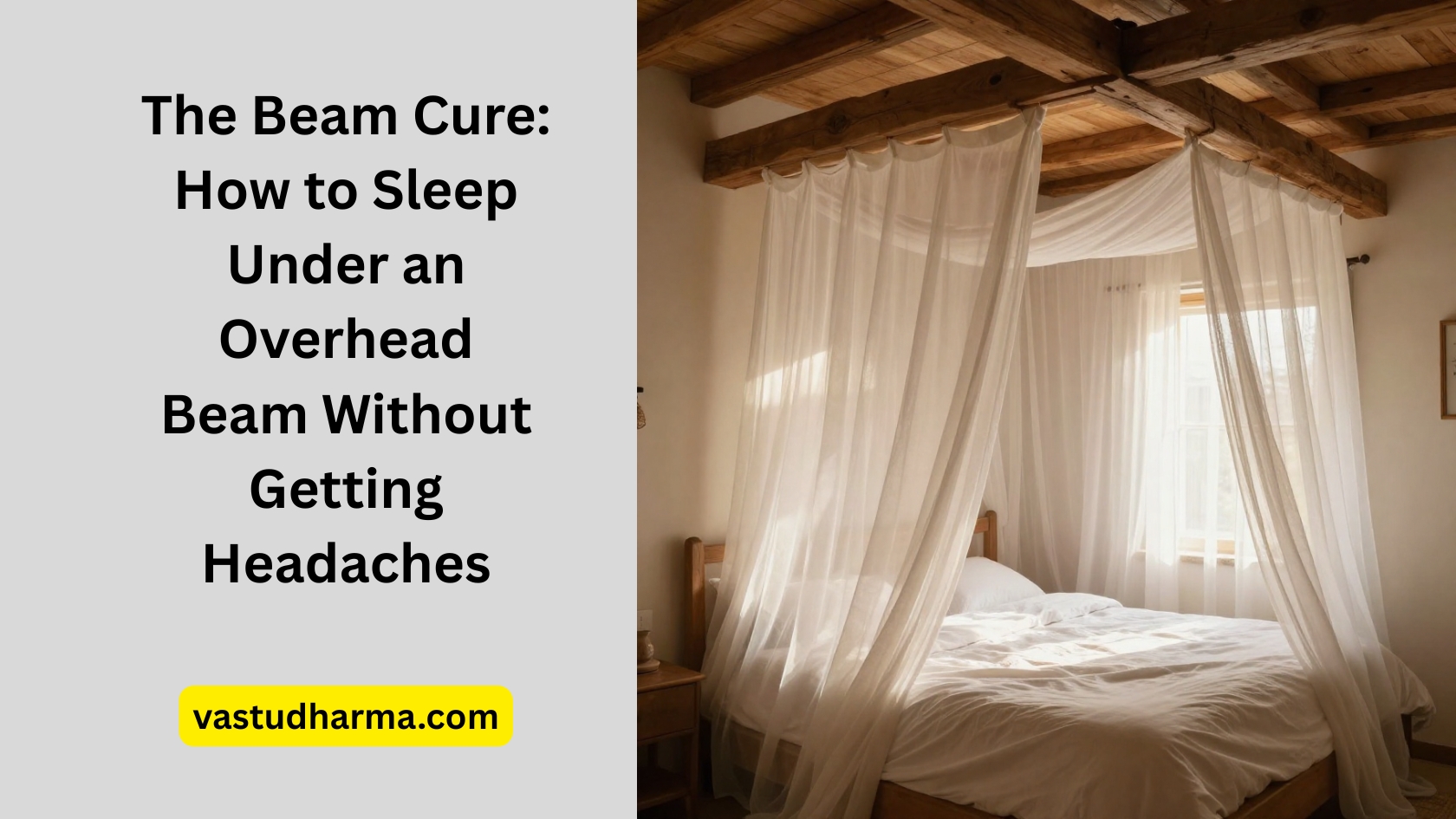
By draping fabric over your bed, you create a false ceiling. You are essentially creating a protective barrier between you and the beam. When you look up, you see soft, flowing fabric instead of hard wood or concrete.
You don’t need a four-poster bed to do this. You can mount curtain rods on the ceiling on either side of the beam and drape a light, airy fabric (like sheer linen or muslin) across it, letting it swoop down slightly. It softens the hard edges and makes you feel cocooned and safe.
The False Ceiling Hack
If you own your home and want a more permanent solution, consider drywalling over the beam to create a smooth, flat ceiling.
If that’s too expensive, look into “stretch ceilings.” This is a modern technique where a durable fabric membrane is stretched tightly across the ceiling below the beam. It looks just like a flat, painted ceiling, but installation is much cleaner and faster than drywall.
5. The “Deflect It” Strategy: Energetic and Visual Cures
These solutions are for those who want to be subtle or who believe in the energetic aspect of the problem. These “cures” are designed to lift the heavy energy and stop it from pressing down.
Lighting Up the Shadows
Heavy things look heavier when they cast deep shadows. A dark, shadowy beam feels ominous.
The fix is upward-facing light. Place LED strip lighting on top of the beam (if there’s a ledge) shining up onto the ceiling. Or, place floor lamps on either side of the bed and aim the light upward toward the beam.
By illuminating the beam from below, you visually “lift” it. You eliminate the heavy shadow underneath. It makes the structure feel lighter and less oppressive to your subconscious mind.
The Flute Trick (And Other Curious Cures)
If you talk to a traditional Feng Shui consultant, they will almost certainly suggest bamboo flutes.
It sounds strange, but here is the logic: You take two bamboo flutes and hang them on the beam, angled inward to shape the letter “A” (or the roof of a house).
Why? Bamboo represents upward growth and resilience. The hollow tubes are said to “lift” the chi upward. But on a practical level, placing angled objects on a straight horizontal beam breaks up the harsh, straight line. Your eye is drawn to the angled shape, not the oppressive flat line.
If flutes aren’t your vibe, you can achieve a similar effect by hanging a beautiful piece of textile art or a soft tapestry on the beam to break up its hard edge.
Common Mistakes People Make
When trying to deal with beams, I see people make two major mistakes that actually make the problem worse.
Mistake 1: Highlighting the Problem
I love rustic decor, but painting a ceiling beam dark black or espresso brown when your ceiling is white is a recipe for disaster in a bedroom.
Contrasting colors make the beam stand out. It adds visual weight. It draws your eye directly to the heavy thing hanging over you. If a beam is over a bed, paint it the exact same color as the ceiling. You want it to disappear, not star in the show.
Mistake 2: Hanging More Stuff From It
Never, ever hang a heavy chandelier or a ceiling fan directly from a beam that is already over your bed. You are just adding more heavy, dangling objects to the “threat list” that your lizard brain has to monitor all night. Keep the area above your bed clear.
Wrapping It Up: Sleep is Sacred
It’s easy to dismiss things like “beam energy” as superstition. But sleep is a deeply vulnerable state. Your environment dictates the quality of that vulnerability.
If you are waking up in pain, your body is trying to tell you something. Don’t ignore it. You don’t need to believe in ancient energy laws to understand that sleeping under a heavy, sharp object feels instinctively unsafe.
Try the pillow shift tonight. If that doesn’t work, look into a canopy or some clever lighting. The cure doesn’t have to be expensive or complicated; it just needs to make you feel safe when you close your eyes.
Actionable Takeaways:
- The Check: Lie in bed and look straight up. Is a heavy structural element crossing your head or chest?
- The Quick Fix: Pull your bed 6 inches from the wall and slide your pillows down so your head is not under the beam.
- The Cover-Up: Use sheer fabric draped over the bed to create a soft “false ceiling” barrier.
- The Lift: Use floor lamps angled upward to light the bottom of the beam, reducing heavy shadows.
- The Camouflage: Paint the beam the same color as your ceiling to make it visually recede.
- The Don’t: Do not hang ceiling fans or heavy lights from a beam located directly over your bed.
Frequently Asked Questions (FAQs)
Is it bad to sleep under a beam?
Yes. Psychologically, it creates subconscious tension because your brain perceives a heavy object hanging over you as a threat. Energetically (Feng Shui), it is believed to suppress positive energy flow, leading to restless sleep and health issues.
What are the symptoms of sleeping under overhead beams?
Common symptoms include waking up with headaches or migraines, stiff neck and shoulders, feeling groggy despite sleeping enough, and restless dreams. If the beam crosses your stomach, it may cause digestive issues.
How do you remedy a beam over a bed?
The best remedy is moving the bed so you aren’t directly under it. If you can’t move the bed, you can “cure” it by draping fabric to create a canopy, painting the beam to match the ceiling so it blends in, or using upward-facing lights to visually lift the heaviness.
Does painting a beam help with Feng Shui?
Yes. Painting a heavy beam the same color as the ceiling (usually white or a light neutral) helps it visually disappear. This reduces the visual weight and the subconscious tension it causes. Avoid painting beams over beds dark, contrasting colors.
About the Author Jagdish Vajpeyee is the founder of Vastu Dharma and a Vastu Shastra consultant with a specialized focus on Vedic Astrology. With a professional background in banking, Jagdish brings a unique, analytical approach to ancient wisdom, helping modern families and businesses correct their energy flow without unnecessary demolition. He is passionate about merging traditional Indian architecture with contemporary lifestyle needs.
Disclaimer: The information provided in this article is for educational and informational purposes only. Vastu Shastra is an ancient architectural and energetic system; while many individuals find value in its principles for creating a harmonious environment, these suggestions are based on traditional interpretations and personal research. This content is not intended to be a substitute for professional architectural, legal, financial, or medical advice. The author and this website do not guarantee specific outcomes—such as financial gain or health improvements—resulting from the application of these tips. Before making significant structural modifications to your home or basement, please consult with a licensed architect or structural engineer to ensure the safety and integrity of your property.