
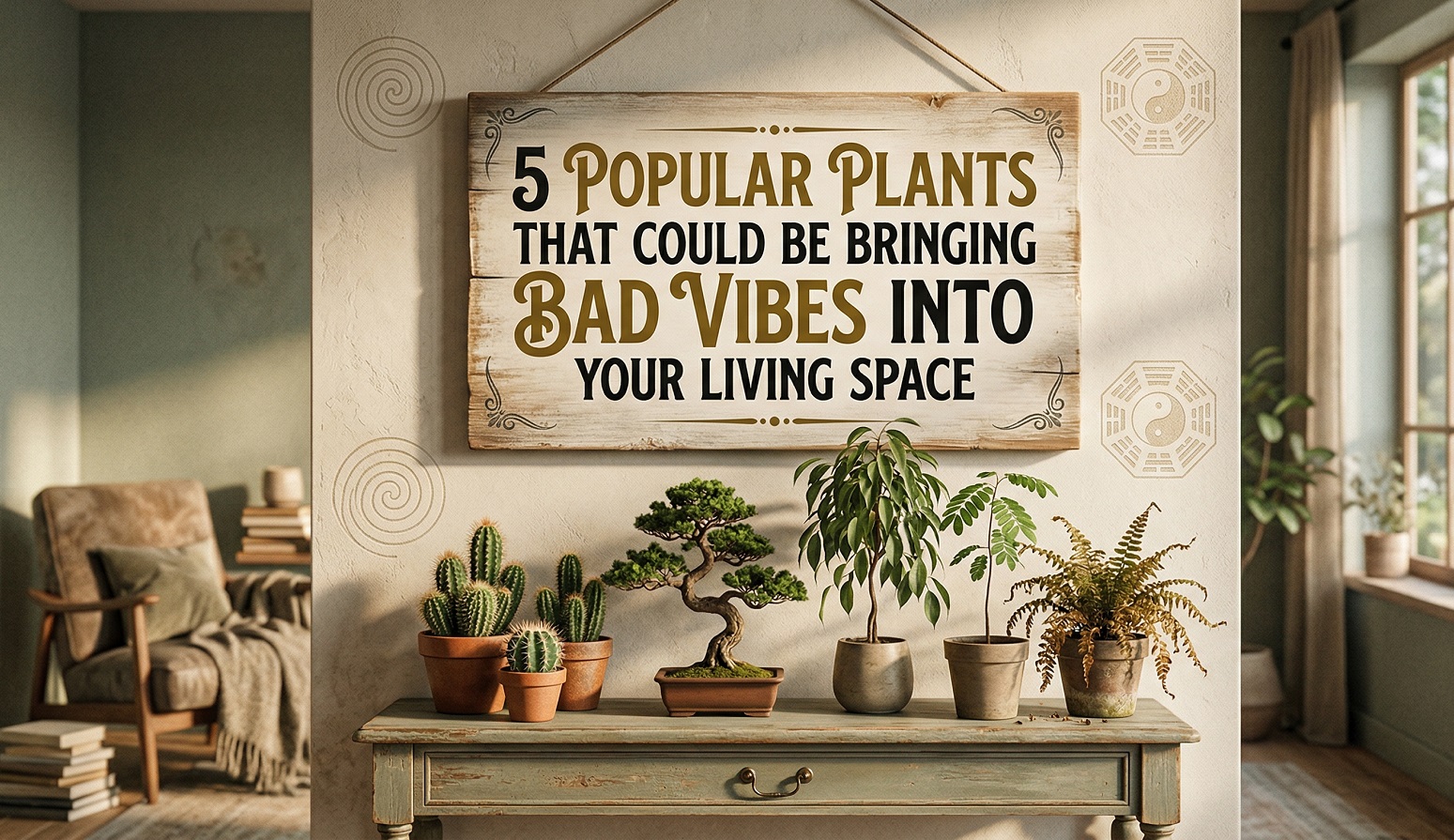
We’ve all been there. You go to a local nursery, see a stunning, exotic-looking plant, and think, “That would look perfect next to my sofa.” You bring it home, water it faithfully, and yet, something feels off.
In traditions like Vastu Shastra and Feng Shui, plants aren’t just decorations; they are living energy filters. Just as some filters trap dust and give you clean air, some plants are thought to “trap” negative emotions or radiate “sharp” energy that can lead to irritability, financial stress, or even bad dreams.
The Psychology of “Sharp” vs. “Soft” Energy
Think about it this way: if you’re walking through a dark room, would you rather bump into a soft, velvet curtain or a pile of toothpicks? Your subconscious mind is always scanning your environment for threats. When your home is filled with “sharp” or “dying” textures, your brain stays in a state of low-level “alert,” which prevents you from truly relaxing.
1. The Cactus: The Prickly Guard That Never Relaxes
The cactus is arguably the most popular “bad vibe” plant in history. They are trendy, nearly impossible to kill, and look great in minimalist photos. But here is the real-life problem: A cactus is a plant built for defense.
A Story of “Spiky” Relationships
I once knew a couple, Priya and Amit, who had a massive collection of rare cacti right in their living room. They loved the aesthetic. However, they noticed that their conversations were becoming increasingly “thorny.” They were snapping at each other over tiny things. An interior consultant suggested moving the cacti to the outdoor patio. Within a week, the atmosphere in the room felt lighter.
Why it happens: In energy science, the needles of a cactus act like tiny spears. They radiate Shako Chi (piercing energy). Keeping them in a place where you relax—like a bedroom or living room—is like having thousands of tiny “defensive” signals pointing at you all day.
Common Mistake: Placing a cactus on your work desk to “absorb radiation.” While they might handle the light well, the spiky energy can actually make you feel more stressed about your deadlines.
The Solution: Keep your cacti outdoors. They make excellent “gatekeepers” on a balcony or near an entrance because their defensive energy points away from your home, theoretically protecting it from outside negativity. If you must keep them inside, place them near a window you don’t sit close to.
2. The Bonsai: The Beauty of Stunted Growth
This one is controversial because Bonsai is a respected art form. These miniature trees are breathtakingly beautiful and require immense skill to grow. However, from a symbolic and energetic perspective, they carry a very heavy message.
The Symbolism of the “Stunted” Path
A Bonsai is a tree that has the DNA to be 50 feet tall, but it is kept small through constant pruning and root binding. Essentially, its growth is intentionally blocked.
If you are a professional like Jagdish, working hard to grow your career in banking or tech, you want your environment to represent expansion and abundance. Surrounding yourself with plants that represent “limited growth” can subconsciously mirror a feeling of being stuck in your career or personal life.
Common Mistake: Giving a Bonsai as a housewarming gift for a new business venture. While well-intentioned, it symbolically suggests that the business should stay “small and manageable” rather than growing into a giant.
The Solution: If you love the look of a tree indoors, go for a Money Tree (Pachira Aquatica) or a Fiddle Leaf Fig. These plants are known for their broad, upward-reaching leaves that symbolize growth, wealth, and “reaching for the sky.” If you already own a Bonsai and love it, keep it in an office or a dedicated “hobby room” rather than the center of your family life.
3. The Weeping Willow (and other “Drooping” Plants)
Have you ever noticed how your posture changes when you’re sad? You slouch, and your shoulders droop. Plants work the same way visually. Plants with leaves that naturally grow downward—like the Weeping Fig (when it’s unhealthy) or certain drooping vines—can create a “heavy” emotional atmosphere.
Real-Life Example: The “Heavy” Hallway
I visited a friend who had a long, dark hallway filled with overgrown, drooping vines that hung low enough to touch your head. Walking through that hallway felt like walking through a swamp. It felt draining. After she trimmed the vines and added some “upward” growing snake plants, the hallway felt like a gallery instead of a cave.
Why it happens: Upward-growing plants represent “Yang” energy (active, positive, growing). Downward-hanging plants represent “Yin” energy (passive, quiet, receding). While some Yin is good for sleep, too much of it in your main living areas can lead to feelings of lethargy or sadness.
The Solution: If you have hanging plants, ensure they are trimmed so they don’t look “sad” or “heavy.” Pair them with “architectural” plants that grow straight up, like a Snake Plant or a Peace Lily, to balance the energy flow.
4. The Tamarind Tree (Imli): The Ghost of the Garden
In many Indian traditions, specifically Vastu Shastra, the Tamarind tree is a big “no-no” for residential plots. While we all love the tang of tamarind in our food, having the tree itself near your home is said to be a magnet for negative vibrations.
A Neighborhood Tale
In my hometown, there was an old house with a massive Tamarind tree leaning right over the master bedroom. The family that lived there was constantly plagued by minor illnesses and a general sense of “heaviness.” When they finally moved to a new house without a Tamarind tree, they described the feeling as “a weight being lifted off their chests.”
Why it happens: Ancient wisdom suggests that Tamarind trees attract “unseen energies” or spirits. From a more practical, scientific perspective, these trees release high amounts of carbon dioxide and organic acids that can actually affect the air quality around them more than other trees, potentially making you feel sluggish if you’re constantly nearby.
Common Mistake: Buying a property just because it has a “lush, old Tamarind tree” for shade.
The Solution: If you already have one on your land, don’t panic. You don’t necessarily need to cut it down. Instead, Vastu experts suggest planting “balancing” trees like Neem or Tulsi (Holy Basil) between the Tamarind tree and your house to act as an energetic buffer.
5. Dead or Dying Plants: The Silent Energy Drains
This is perhaps the most common mistake of all. We’ve all done it—kept a brown, crispy fern in the corner for three months because we “hope it will come back to life.”
The “Stagnant” Life
Keeping a dead plant in your house is like keeping a broken clock or a pile of old, unpaid bills. It represents stagnation. I remember visiting a colleague who had a row of dried, dead flowers in a beautiful vase. She said they were “sentimental.” But every time she looked at them, she subconsciously thought about the past, rather than the future.
Why it happens: A dying plant is literally the absence of “Prana” or life force. It creates a vacuum in the room’s energy. If you are trying to manifest a new job or a new relationship, you cannot do it surrounded by things that represent the end of a cycle.
Common Mistake: Holding onto “lucky” plants (like a Lucky Bamboo) even after the stalks have turned yellow and mushy.
The Solution: If a plant is more than 50% dead, it’s time to say goodbye. Thank the plant for its service and move it to the compost bin. Replacing it with a fresh, vibrant plant immediately resets the “clock” of your room’s energy.
How to “Vibe-Check” Your Home
You don’t need to be an expert to know if your plants are working for you or against you. Here is a simple 3-step process to audit your greenery:
1. The “First Look” Test
Walk out of your front door, close your eyes, count to five, and walk back in. Look at the first plant you see. Do you feel a spark of joy, or do you immediately think, “I need to water that” or “That looks messy”? If the first emotion is guilt or stress, that plant is a “bad vibe” contributor.
2. The Texture Balance
Run your hand (carefully!) over your plants. A healthy home should have a mix of textures, but the majority should be soft, rounded leaves. If more than 30% of your plants are “poky” or “sharp,” your environment is too aggressive for relaxation.
3. The Height Rule
Try to have at least one plant in every room that grows upward. This draws the eye (and the energy) toward the ceiling, making the room feel larger and more hopeful.
Common Mistakes and Easy Fixes
| The Mistake | The Result | The Human-Like Fix |
| Thorny plants in the bedroom | Restless sleep or “sharp” dreams | Move them to the balcony or far corner of the kitchen. |
| Using artificial plants with dust | Stagnant, “fake” energy | If you use silk plants, wash them once a month. Dust is the enemy of good vibes! |
| Placing plants in the center of the room | Blocks the “flow” of movement | Keep the center (Brahmasthan) clear. Move plants to the North or East corners. |
| Keeping “sentimental” dried bouquets | Focuses energy on the past | Take a photo of the flowers to keep the memory, then let the physical flowers go. |
Your Home is a Living Ecosystem
At the end of the day, your home should be your sanctuary—a place where you recharge after a long day at the bank, the office, or the studio. While plants are amazing allies, we have to be mindful that we aren’t accidentally inviting “spiky,” “stunted,” or “drooping” energy into our most intimate spaces.
If you love your cactus, keep it! Just give it a job as a protector on your porch. If you love the art of Bonsai, cherish it in your study. The goal isn’t to live in a house with “rules,” but to live in a house that makes you feel light, expansive, and ready to grow.
Takeaways:
- Audit Tonight: Walk through your house and identify any dead leaves or “sharp” plants in the bedroom.
- Go Round: For your next plant purchase, look for something with round leaves, like a Jade Plant or a Rubber Plant.
- Clean the Air: If a room feels “heavy,” add a Snake Plant. They are virtually indestructible and are famous for clearing out both physical and energetic toxins.
Happy planting, and may your home always be filled with growth and good vibes.
Quick Vibe-Check Table
| Plant Type | Energy Signature | Best Placement |
| Cactus | Defensive / Sharp | Outdoors / Balcony |
| Snake Plant | Protective / Cleansing | Bedroom / Entrance |
| Bonsai | Restricted / Stunted | Hobby Room / Garden |
| Money Plant | Growth / Prosperity | North or East Corners |
| Aloe Vera | Healing / Vibrant | Kitchen (near light) |
Which plants are considered “unlucky” for a home?
Generally, plants with thorns or prickles (like Cacti), plants that produce a milky sap (like some Ficus or Euphorbia), and Bonsai trees are often cited as unlucky in Vastu and Feng Shui. These are believed to create “sharp” energy or represent stunted growth.
Can I keep a Cactus if I get it as a gift?
Yes, but placement is key. You don’t have to throw away a gift! To neutralize the “bad vibes,” move the cactus to a window sill, a balcony, or an outdoor garden. Avoid keeping it in the bedroom or the center of the living room where you spend most of your time.
Is it okay to keep artificial or plastic plants?
It depends. Artificial plants don’t provide the “living” energy (Prana) that real plants do, but they aren’t necessarily “bad luck.” The real danger is dust. If artificial plants become dusty and neglected, they create stagnant energy. Keep them clean and vibrant to avoid “dead” vibes.
Why is the Money Plant considered lucky?
The Money Plant (Pothos) is loved because its leaves are heart-shaped (representing love and harmony) and it grows rapidly upward (representing financial growth). In Vastu, keeping it in a green bottle in the North or East corner is said to attract prosperity.
What should I do if my plant is dying?
Remove it immediately. A dying or dead plant is a major source of negative energy. It symbolizes decay and lack of progress. If you can’t revive it within a week or two, it’s better to compost it and replace it with a healthy, vibrant one.
Are there specific plants that help with anxiety?
Yes. Plants with “soft” energy like Lavender, Peace Lilies, and Snake Plants are excellent. Snake plants are particularly popular because they release oxygen at night, improving sleep quality and reducing the physical triggers of anxiety.
About the Author Jagdish Vajpeyee is the founder of Vastu Dharma and a Vastu Shastra consultant with a specialized focus on Vedic Astrology. With a professional background in banking, Jagdish brings a unique, analytical approach to ancient wisdom, helping modern families and businesses correct their energy flow without unnecessary demolition. He is passionate about merging traditional Indian architecture with contemporary lifestyle needs.
Disclaimer: The information provided in this article is for educational and informational purposes only. Vastu Shastra is an ancient architectural and energetic system; while many individuals find value in its principles for creating a harmonious environment, these suggestions are based on traditional interpretations and personal research. This content is not intended to be a substitute for professional architectural, legal, financial, or medical advice. The author and this website do not guarantee specific outcomes—such as financial gain or health improvements—resulting from the application of these tips. Before making significant structural modifications to your home or basement, please consult with a licensed architect or structural engineer to ensure the safety and integrity of your property.