

Have you ever noticed how everyone eventually ends up in the kitchen during a house party? It doesn’t matter how big your living room is or how fancy your TV is; people naturally gravitate toward the smell of tempering spices and the warmth of the stove. In Vastu Shastra, we call the kitchen the “hearth” of the home. It is much more than just a place to boil rice or flip parathas—it is the primary source of Agni (Fire energy) for your entire family.
Think of your home as a living, breathing body. If the kitchen is functioning well, the “digestion” of the house—its health, wealth, and general mood—remains strong. But when the fire element is out of balance, things start to feel “off.” Maybe family members are falling ill more often, or perhaps you feel a strange sense of irritation every time you start cooking.
In this guide, we are going to dive deep into how you can balance that fire element to ensure your kitchen isn’t just feeding stomachs, but also nourishing the soul and health of everyone under your roof.
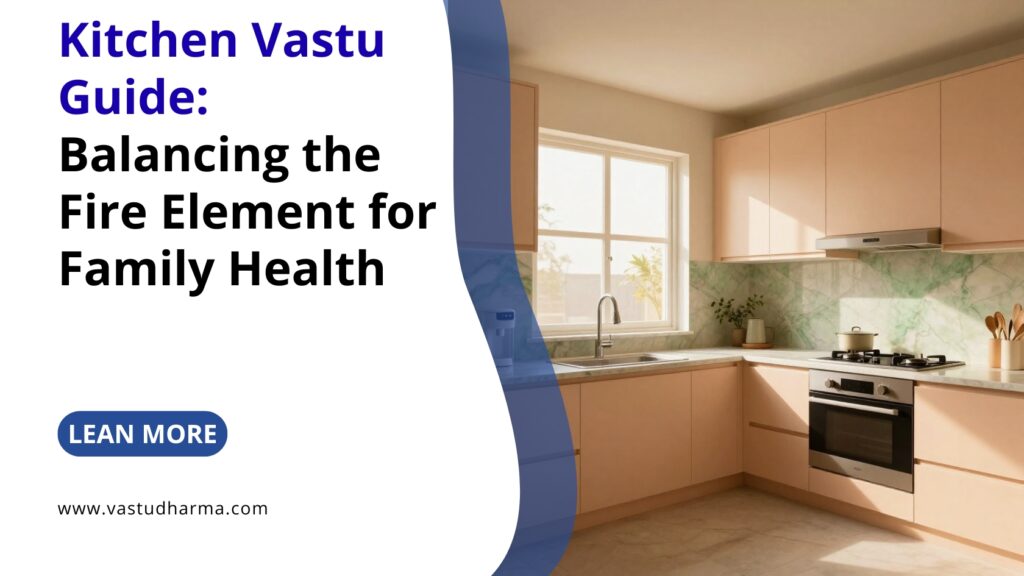
Why South-East is the “Golden Zone”
When we talk about Vastu, the first question is always: “Where should the kitchen be?” In the world of energy, direction is everything. The most recommended spot for a kitchen is the South-East corner of the home.
The Story of the “Drained” Household
I remember visiting a friend, Sunita, a few years ago. She was an incredible cook, but she felt exhausted all the time. Her kids were picky eaters, and her husband was constantly dealing with acidity. When we looked at her floor plan, her kitchen was located in the North-East.
In Vastu, North-East is the zone of Water and Wisdom (the Ishan corner). By placing a heavy fire (the stove) there, she was essentially trying to light a match in a puddle. The energies were clashing. Once she made some small “remedy” changes and eventually moved her cooking station toward the South-East, the “vibe” of the house shifted. The family felt more energetic, and the constant digestive issues began to fade.
Why South-East?
This direction is governed by Lord Agni. It’s the direction where the sun’s rays are most beneficial for killing germs and keeping the space dry and hygienic.
- The Science: South-East gets the right amount of morning sunlight, which is vital for a space where food is handled.
- The Alternative: If South-East isn’t an option for you, the North-West is the next best thing. It’s a neutral zone that won’t “drown” your fire.
Practical Tip: If your kitchen is already built in a “wrong” direction, don’t panic. You don’t always need to tear down walls. Sometimes, placing a small Vastu pyramid or changing the color of the tiles can act as a “buffer” for the energy.
The Fire and Water Battle: Solving the Sink-Stove Conflict
This is the most common mistake I see in modern apartments. Because space is tight, builders often place the kitchen sink right next to the cooking stove. To a designer, it looks efficient. To a Vastu expert, it looks like a battlefield.
Why They Can’t Be Friends
Fire and Water are opposite forces. Fire is transformative, hot, and upward-moving. Water is flowing, cool, and downward-moving. When they are placed side-by-side:
- Health issues: It can lead to “hot and cold” temperaments in the family.
- Financial “leakage”: Just as water puts out fire, this placement can “drown” your ability to grow wealth.
The “Sibling” Analogy
Think of the stove and the sink like two siblings who love each other but fight the moment they sit next to each other in the back seat of a car. To keep the peace, you just need a little bit of a “buffer” between them.
Common Mistakes & Solutions:
- The Mistake: Having the stove and sink on the same counter, less than 2 feet apart.
- The Solution: Ideally, they should be on different walls (L-shaped kitchen). If they must be on the same counter, place a wooden partition, a small pot of green plants, or even a green marble strip between them. Green represents the Wood element, which acts as a mediator—Water feeds Wood, and Wood feeds Fire. It turns a conflict into a cycle of growth!
Colors that Cook Up Health: The Palette of Success
Have you ever walked into a kitchen that felt cold and sterile? Or maybe one that felt strangely dark and heavy? Colors aren’t just for decoration; they carry “vibrations.” In a Vastu-aligned kitchen, we want colors that “feed” the fire without making the room feel like an oven.
The “No-Go” Colors
The biggest mistake people make in 2026 is following the “Modern Minimalist” trend of using Total Black or Deep Blue for kitchen counters and cabinets.
- Black/Blue: These are the colors of the Water element. Using them in a kitchen is like throwing a wet blanket over your family’s health energy. It can lead to feelings of depression or lethargy.
- Dark Grey: Too much grey can make the cook feel uninspired and tired.
The “Healing” Colors
To keep the family healthy and the vibes high, lean into the “Warm” palette:
- Yellows and Creams: These are fantastic because they represent the earth and sun. They keep the space bright and aid in digestion.
- Oranges and Reds: Use these as accents (maybe in the tiles or containers). They stimulate the appetite and keep the “Agni” strong.
- Light Green: As mentioned before, green is the bridge between elements. A light pistachio or mint green kitchen feels fresh and promotes healing.
A Real-Life Fix
I once helped a client who had a very dark, granite-heavy kitchen. She complained that she hated spending time there. We didn’t change the granite (it was too expensive), but we added bright yellow jars, a warm light strip under the cabinets, and painted the walls a soft cream. Suddenly, the “weight” of the room lifted. She started enjoying cooking again, and her kids noticed that the food even “tasted better.”
The Importance of the Facing Direction
Imagine you’re cooking a big Sunday meal. You’re at the stove for an hour or more. In Vastu, the direction you face while cooking isn’t just about ergonomics; it’s about the energy you are “infusing” into the food.
The Story of the “Grumpy Chef”
I once knew a man named Rajesh who loved to cook, but he always ended up feeling drained and irritable by the time the meal was ready. His stove was placed against a wall so that he had to face South while cooking. In Vastu, facing South while working with fire can lead to a “short fuse” or unnecessary anger.
When he rearranged his kitchen slightly so that he faced East, everything changed. East is the direction of the rising sun—the direction of new beginnings and positive energy. He felt more creative, and his family noticed he wasn’t “snapping” at them as much during dinner.
Why Facing East is Best
When you face East, you are aligning yourself with the Earth’s natural rotation and the most beneficial solar rays.
- The Benefit: It brings peace of mind to the person cooking, which is vital because the mood of the cook affects the energy of the food.
- Avoid Facing West: This can lead to health issues for the cook over time.
- Avoid Facing South: As mentioned, this can lead to stress and financial pressure.
Practical Tip: If your stove is fixed and you have to face the “wrong” way, place a small mirror on the wall in front of you so that it “reflects” the East or North direction back at you.
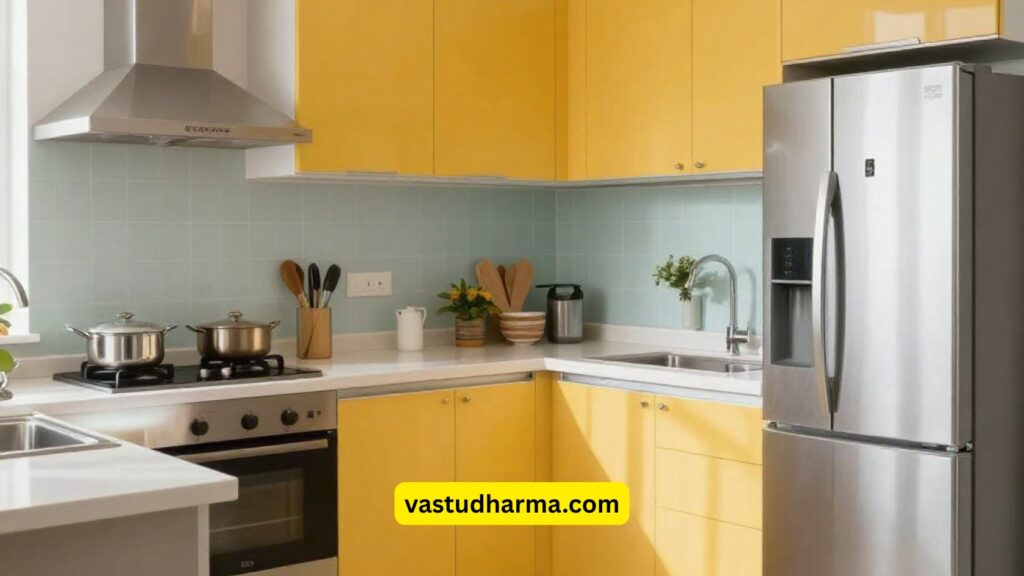
Placing the Fridge and Microwave
A kitchen isn’t just about the fire on the stove; it’s also about where we keep our food fresh and how we use modern technology. Balancing the “Hot” (oven/stove) with the “Cold” (refrigerator) is key.
Refrigerator Placement
The fridge is a heavy object that uses electricity to create cold. Because it’s heavy, the best spot for it is the South-West or West part of the kitchen.
- The Mistake: Placing the fridge in the North-East corner. Since North-East should be light and open, a heavy fridge there can “block” the flow of wealth and clarity.
- The Solution: If your fridge is in the North-East, try moving it just a few feet toward the West wall.
The Microwave and Oven
Since these are high-heat electronic items, they belong in the South-East area, close to the stove.
- Keep your distance: Try to keep at least a foot of space between the fridge (cold) and the oven (hot). Placing them directly touching each other creates a “clash” of energies that can lead to frequent appliance breakdowns.
The “Hidden Vastu” of Your Spice Box and Storage
Vastu isn’t just about walls and windows; it’s also about how you organize the small things. The “Masala Dabba” (spice box) is actually a powerhouse of energy.
The Magic of the Spice Box
In Vastu, spices represent different planets and elements. For example, Turmeric (Jupiter) brings health and wisdom, while Chillies (Mars) bring energy.
- Keep it full: A half-empty spice box or grain jar symbolizes “scarcity.” Make it a habit to refill your containers before they hit the bottom. It signals to the universe that your home is a place of abundance.
- Storage Direction: Store heavy grains (rice, flour, pulses) in the South or West walls of the kitchen. This provides “stability” to the house.
The “Broken” Energy Mistake
One of the biggest health-drainers in a kitchen is keeping chipped plates or cracked mugs. We often think, “Oh, it’s just a small crack, it’s fine.” But in Vastu, a crack is a “leak.” It leaks the positive energy out of your food.
- The Solution: If it’s broken, let it go. Replacing a chipped bowl is a small price to pay for the “unbroken” health of your family.
A Kitchen that Heals
Your kitchen is the heart of your home’s health. By balancing the fire element, you aren’t just following old rules; you are creating a workspace that supports your body and your mind. When the fire (stove) is in its right place, the water (sink) is respectful of its boundaries, and the cook faces the rising sun, the food prepared there becomes a form of medicine.
Remember, Vastu is about harmony, not fear. Start with one small change—perhaps moving your spices or changing a lightbulb—and notice how the energy shifts in your home.
Actionable Takeaways
- Refill the Jars: Don’t let your grain or spice containers sit empty; keep the “abundance” flowing.
- Check the Sink: If the sink is right next to the stove, place a small green plant or a wooden board between them tonight.
- Morning Light: Open the kitchen windows every morning to let the old air out and the fresh “Prana” (life force) in.
- Face the East: Try to adjust your stance so you face the morning sun while preparing your meals.
Here is a simple, one-page Kitchen Vastu Audit Checklist. You can use this to walk through your kitchen and identify exactly where the energy is flowing well and where it might need a little “tune-up.”
🟢 The “Fire & Health” Kitchen Audit
| Area of Audit | The Vastu Goal | Status (✅/❌) | Simple Fix if “❌” |
| Location | Is the kitchen in the South-East? | Use a Vastu copper strip or light a small red bulb in the SE corner. | |
| The Stove | Does the cook face East while cooking? | Place a small mirror on the wall to reflect the East/North. | |
| Fire vs Water | Is there at least 2 feet between stove and sink? | Place a wooden board or a green plant between them. | |
| Colors | Are the walls/counters Cream, Yellow, or Peach? | Add yellow jars or warm lighting to “brighten” the vibe. | |
| Electricals | Are the Fridge/Micro in the South or West? | Move heavy items away from the North-East corner. | |
| Storage | Are grain/spice containers full and clean? | Refill your jars today; abundance attracts abundance! | |
| Ventilation | Are there windows/exhaust in the East/North? | Keep windows open for 15 mins every morning. | |
| Broken Items | Are all plates, mugs, and jars un-chipped? | Discard any cracked items immediately to stop “energy leaks.” |
How to use this list:
- Don’t try to fix everything at once. Vastu is a journey. Start with the “Fire vs Water” conflict or the “Broken Items” check.
- Focus on the “Agni” (Fire). Ensure your stove is clean and working perfectly. A clogged burner is considered “stagnant wealth” energy.
- The “Salt” Cleanse. Once a week, wipe your kitchen counters with water mixed with a pinch of sea salt. This is a classic “space clearing” technique to remove any negative vibes that accumulate during a busy week.
Final Thought
A happy cook makes healthy food. Beyond the directions and the colors, the most powerful Vastu “remedy” is a smile while you are stirring the pot. Your intention is the most potent ingredient in your kitchen.
In Vastu, we don’t just pick colors that look good; we pick colors that “feed” the element of that direction.
🎨 The Vastu Color Palette by Direction
| Kitchen Location | Ruling Element | Ideal Color Palette | Why this works? |
| South-East (Best) | Fire | Orange, Peach, Terracotta, Light Pink | These “Warm” tones fuel the fire element without making the space feel aggressive. |
| North-West (Good) | Air | White, Cream, Silver, Light Grey | Air supports fire. These “Metal” and “Space” colors keep the kitchen feeling breezy and clean. |
| East | Air/Wood | Light Green, Pistachio, Mint, Light Brown | Green represents the wood that feeds the fire. It brings a “healing” energy to your cooking. |
| West | Space | White, Silver, Grey, Blue (Accents only) | West is the direction of gains. Bright whites keep the energy sharp and professional. |
| North-East (Challenging) | Water | Lemon Yellow, Cream, Gold | Since Water and Fire clash here, Yellow (Earth/Jupiter) acts as a mediator to stabilize the energy. |
| South-West (Heavy) | Earth | Yellow, Beige, Sand, Biscuit | Earth colors bring stability. Use these to “ground” the fire if the kitchen is in the corner of stability. |
| North (Challenging) | Water | Light Green, Cream | Avoid blue here. Use Green to bridge the gap between the North’s Water and the Stove’s Fire. |
💡 How to Apply These Colors
You don’t need to repaint the entire room to see a shift. Here is how to layer these colors effectively:
- The Countertops: This is the “foundation.” If your kitchen is in the South-East, a Green marble or Granite is actually very balancing. Avoid Black or Navy Blue countertops if possible.
- The Cabinets: This is the largest visual area. Use the “Ideal Palette” from the table above for your cabinet laminates or paint.
- The Backsplash: This is a great place for “Pop” colors. If you have a neutral kitchen, use your directional color (like Orange or Green) in the tiles behind the stove.
- The Floor: Keep the floor as neutral as possible—Beige, Cream, or off-white tiles work in almost every direction because they represent the Earth element, which supports everything.
Common Mistake: The “Dark Kitchen” Trap
A very common trend in modern 2026 interior design is the “All-Black” or “Dark Charcoal” kitchen. While it looks sleek, Vastu-wise, it can be quite heavy. Dark colors absorb light and energy, making the cook feel tired. If you have a dark kitchen, try to offset it with Warm LED under-cabinet lighting and a few bright yellow or orange decorative jars.
🔍 Kitchen Vastu: The Top Questions Answered
Can I use a black granite platform in my kitchen?
This is one of the most debated topics. Technically, Vastu experts suggest avoiding black or dark blue for the platform because these colors represent the Water element, which “extinguishes” the fire of the stove.
The Fix: If you already have black granite, don’t worry. You can balance it by using yellow or green canisters on the counter, or placing a small green marble slab under the gas stove.
My kitchen is in the North-East. Is that bad?
In Vastu, the North-East is the “Water” corner (Ishan), and the kitchen is “Fire.” Having a kitchen here is often considered a major imbalance that can lead to health issues or stress.
The Fix: Since you likely can’t move the whole kitchen, use lemon yellow paint on the walls and place a Vastu copper pyramid on the ceiling or above the door to help neutralize the clashing energies.
Where should I keep my drinking water (filter/pitcher)?
Water should always be placed in the North or North-East part of the kitchen. This keeps the water “energetically cool” and fresh.
Common Mistake: Never place your water filter directly above or right next to the gas stove. It creates that “Fire vs. Water” conflict we talked about earlier.
Is it okay to have a kitchen under a bathroom or staircase?
Ideally, no. Having a toilet above a kitchen is considered very unhygienic in an energetic sense (negative energy “dripping” down). A kitchen under the stairs can make the cook feel “suppressed” or stuck.
The Fix: If you’re stuck with this layout, stick a yellow light in the kitchen and keep the ceiling spotless. For the bathroom issue, you can place a Vastu energy partition or a salt bowl in the bathroom to absorb the negativity.
Does the position of the kitchen door matter?
Yes! The door should ideally open in the North, East, or North-West. It should never face the toilet door directly. If it does, keep the toilet door closed at all times and maybe hang a crystal ball or a wind chime between the two doors to break the energy flow.
About the Author Jagdish Vajpeyee is the founder of Vastu Dharma and a Vastu Shastra consultant with a specialized focus on Vedic Astrology. With a professional background in banking, Jagdish brings a unique, analytical approach to ancient wisdom, helping modern families and businesses correct their energy flow without unnecessary demolition. He is passionate about merging traditional Indian architecture with contemporary lifestyle needs.
Disclaimer: The information provided in this article is for educational and informational purposes only. Vastu Shastra is an ancient architectural and energetic system; while many individuals find value in its principles for creating a harmonious environment, these suggestions are based on traditional interpretations and personal research. This content is not intended to be a substitute for professional architectural, legal, financial, or medical advice. The author and this website do not guarantee specific outcomes—such as financial gain or health improvements—resulting from the application of these tips. Before making significant structural modifications to your home or basement, please consult with a licensed architect or structural engineer to ensure the safety and integrity of your property.