
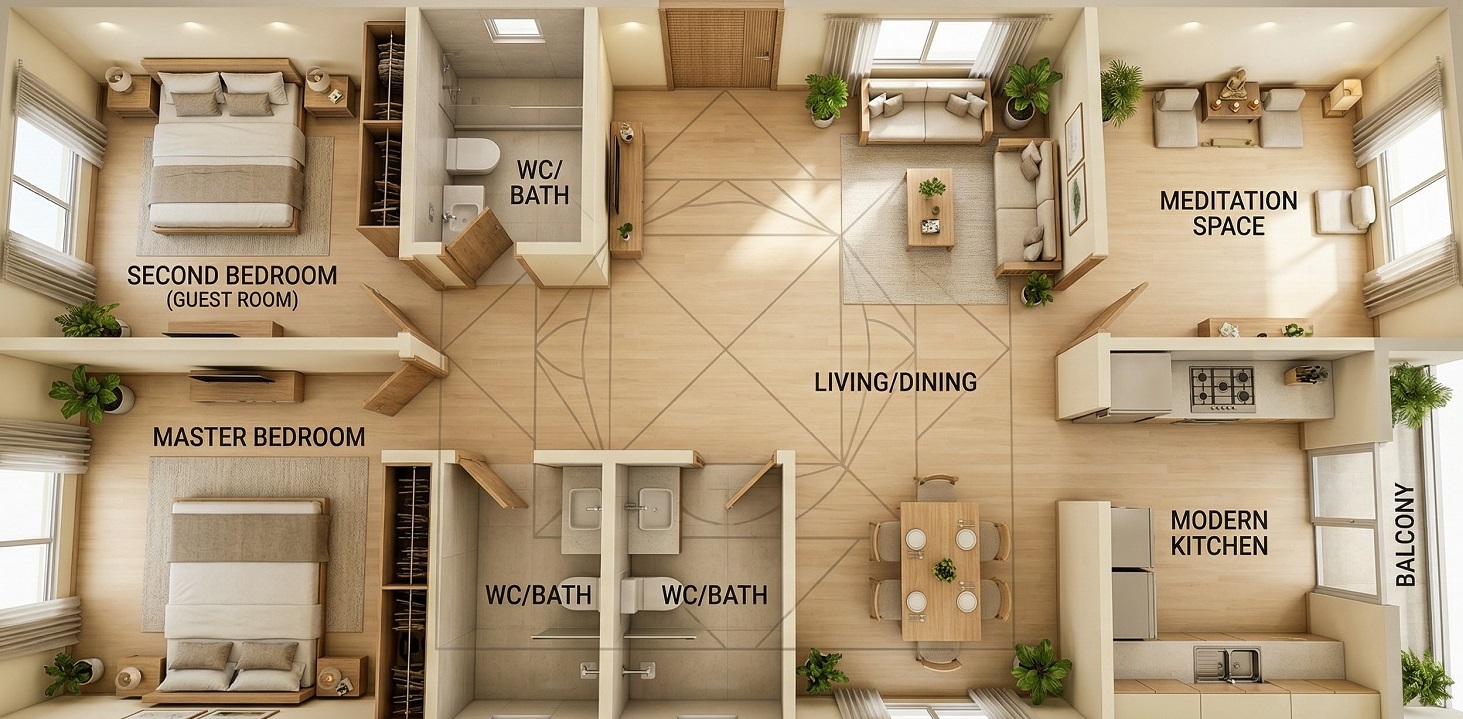
Buying an apartment is probably the biggest check you will ever write. It’s not just about square footage, the “clubhouse” amenities, or how close it is to the metro station. It’s about how you feel when you finally turn the key and walk inside after a long day at work.
I remember my cousins, Neha and Rahul. They bought a gorgeous 14th-floor apartment last year. It had floor-to-ceiling windows and a view that belonged on a postcard. But within three months, they felt drained. They were arguing more, their sleep was ruined, and even their indoor plants kept dying.
When I visited, I realized the problem instantly. Their main entrance was in the “Southwest” zone, and the kitchen was squeezed into the North. In Vastu terms, they were literally “burning” their wealth and “blocking” their peace.
We fixed what we could with simple remedies, but Neha told me something that stuck: “I wish I had a simple checklist before I signed the papers. I looked at the tiles and the view, but I forgot to look at the energy.”
That’s why I’m writing this. Whether you are a firm believer in ancient sciences or just someone who wants a home with “good vibes,” this checklist is for you.
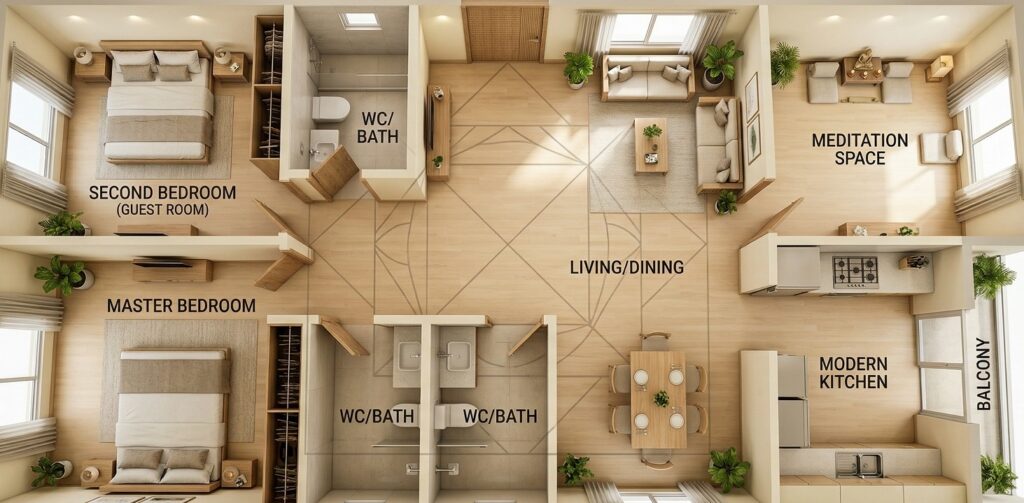
What is Vastu for Apartments? (And Why It’s Different)
In the old days, Vastu was simple. You had a square plot of land, you built a house in the center, and you followed the rules of the Vastu Purusha Mandala (the metaphysical plan of a building).
But let’s be real: buying an apartment in 2026 is different. You don’t own the land; you own a slice of air inside a giant concrete structure. You can’t move the walls, and you certainly can’t move the front door once it’s built.
Vastu for apartments is the art of choosing the “right slice” of that building. It is the science of aligning your living space with the laws of nature—specifically the five elements: Earth, Water, Fire, Air, and Space.
Think of it like this: If you go for a run against a heavy wind, you get tired quickly. If the wind is at your back, you run faster with less effort. Vastu is simply making sure the “natural winds” of energy in your home are at your back, supporting your health, finances, and relationships.
The History: From Palaces to High-Rises
Vastu Shastra isn’t a religious ritual; it’s an architectural legacy that’s over 5,000 years old. It was developed by sages who were essentially the world’s first civil engineers and environmental psychologists. They studied how the sun moves from East to West, how magnetic fields affect the human brain, and how wind patterns change the temperature of a room.
Historically, the Vishwakarma (the master architects) used these principles to build temples and palaces that have stood for centuries. They knew that a building isn’t just a dead structure; it’s a living organism that “breathes.”
In a modern high-rise, the “History” of the land still matters. Even if you are on the 20th floor, the history of what was on that ground before the building went up affects the “vibe.” This is why modern Vastu experts focus so much on the Brahmasthan (the center) and the Main Entrance—they are the primary ways your apartment “inhales” energy from the environment.
How It Works:
The Science of the “Eight Directions”
If you strip away the fancy terms, Vastu is basically environmental psychology. It’s about how your surroundings influence your brain waves and energy levels.
Think about your phone’s GPS. For it to work, it needs to sync with satellites in space. Your home is the same; it needs to “sync” with the Earth’s magnetic field and the Sun’s path.
In an apartment, we look at the eight directions and the five elements (Earth, Water, Fire, Air, and Space). Here is the simple “logic” behind why certain rooms go in certain places:
- The Northeast (Water Zone): This is where the sun’s soft, ultraviolet rays hit first in the morning. It’s scientifically proven to be the most “pure” area. That’s why we put the meditation room or a water feature here. It’s about clarity.
- The Southeast (Fire Zone): This is where the sun is at its hottest in the late morning. It’s the perfect place for a kitchen. The “fire” of the sun aids the “fire” of your stove.
- The Southwest (Earth Zone): This is the most stable, heavy part of the home. It’s away from the morning’s direct heat and the evening’s harsh rays. This is why it’s the “Master” zone—for stability and deep sleep.
- The Northwest (Air Zone): This area is all about movement and change. It’s great for a guest room or a parking spot (movement of vehicles).
When these elements are in the right spot, the “vibe” of the house feels balanced. When they aren’t—like putting a water tank (Water) in the kitchen area (Fire)—you get “clashes” that manifest as stress or arguments in the family.
The Real-World Benefits (What’s In It For You?)
I’ve had readers ask me, “Will Vastu make me a millionaire overnight?” My answer is always: No. Vastu doesn’t replace hard work. But what it does is remove the “friction” from your life.
When you live in a Vastu-compliant apartment, you’ll notice a few distinct shifts:
Better Quality of Sleep
When your head is pointed in a direction that aligns with the Earth’s magnetic pull (typically South or East), your brain enters a deeper REM cycle. You wake up feeling like you actually slept, rather than dragging yourself to the coffee machine.
Financial Clarity
Ever feel like money comes in but vanishes before you can save it? In Vastu, the North is the zone of “Opportunities.” If this area is cluttered or has a toilet, you might find that while you’re earning well, you’re missing out on growth opportunities or facing unexpected repairs.
Harmony in Relationships
The Southwest corner governs the “bond” between family members. When this corner is heavy and stable, the “captain” of the house feels grounded, leading to fewer misunderstandings and a more peaceful dinner table.
Problems & Myths:
In my 15 years of doing this, I’ve seen some pretty wild “Vastu advice” that does more harm than good. Let’s bust a few myths so you don’t lose sleep over them.
Myth 1: “Everything Needs to Be Broken Down”
This is the biggest fear people have. They think if the kitchen is in the wrong place, they have to tear down the walls. Wrong. In 2026, we have “Vastu Corrections.” We use colors, specific metals (like brass or copper strips), and even certain crystals to “neutralize” a negative zone without touching a single brick.
Myth 2: “North-Facing is the ONLY Good Direction”
I see people rejecting beautiful West-facing apartments all the time. Here’s a secret: A well-designed West-facing flat can actually bring more fame and business success than a badly designed North-facing one. Every direction has a “positive entry point” (called a Pada). It’s about the exact spot of the door, not just the general direction.
Myth 3: “Vastu is a Religion”
Vastu is no more a religion than Gravity is. You don’t have to be of a certain faith for the sun to rise in the East or for magnetic North to exist. It’s a science of living in harmony with the planet we live on.
Myth 4: “Mirror Placement Doesn’t Matter”
Some people think mirrors are just for checking your hair. In Vastu, mirrors are “virtual doors.” They double the energy of whatever they reflect. If they reflect a cluttered storeroom, they double the “heaviness.” If they reflect a beautiful view or a dining table, they double the “abundance.”
Now we’re getting into the “insider” territory. After 15 years of walking through construction sites and finished penthouses, I’ve realized that Vastu isn’t just about the compass; it’s about the unspoken rules of how a space interacts with your body and mind.
The 3 “Golden Pillars” of Apartment Hunting
If you’re standing in a sample flat right now, ignore the fancy Italian marble for a second. Look for these three things that most people miss:
The “Center” Check (Brahmasthan)
In an apartment, the center is the “lungs.” If the builder has placed a heavy pillar, a toilet, or a kitchen stove right in the dead center of the flat, walk away. A “congested” center leads to health issues and a feeling of being trapped in life. You want the center to be as open and airy as possible.
The Shape of the Flat
Modern architecture loves “L-shaped” or “U-shaped” apartments because they look edgy. From a Vastu perspective, these shapes mean certain directions are “cut off.” If the Northeast corner is “cut,” you might struggle with mental peace. Always aim for a Square or Rectangular layout. It’s the most stable geometric shape for human energy.
The “View” From the Main Door
When you stand at your main door looking out, what do you see? If you see a dark staircase, a trash chute, or the neighbor’s door directly facing yours (clashing energies), it creates a “block.” You want the energy outside your door to be as bright and welcoming as the energy inside.
Case Study:
A few years ago, I met a high-level executive named Amit. He had just moved into a massive 4BHK. He was physically fit, but he told me, “I feel like I’m running on a treadmill that’s going too fast. I’m successful, but I have zero peace.”
When I audited his home, I found two major “energy leaks”:
- His home office was in the Northeast, but he sat facing a solid wall with his back to the door. This made him feel “vulnerable” and paranoid about his job security.
- His master bed was in the Northwest, the zone of “Air” and movement. No wonder he felt like he couldn’t settle down!
The Fix: We didn’t move him to a new house. We simply shifted his desk so he faced East with a solid wall behind him (for “support”). We then moved his bedroom to the Southwest (the Earth zone) to ground his energy.
The Result: Three months later, Amit called me. He hadn’t just found “peace”—he had actually negotiated a better contract because he felt more confident and “grounded” during his meetings.
Step-by-Step Checklist:
Print this out or save it on your phone. When you walk into a potential new home, check these off:
Phase 1: The Entrance (The “Face” of the Home)
- [ ] Is the door in the North, East, or Northeast? (The “best” zones).
- [ ] Does the door open clockwise? (This encourages the natural flow of energy).
- [ ] Is the entrance well-lit and free of shoe racks? (Don’t let the first thing energy hits be “stinky shoes”).
Phase 2: The Kitchen (The “Health” Center)
- [ ] Is it in the Southeast? (The Fire quadrant).
- [ ] Is the cook facing East while cooking? (This ensures the food is infused with positive solar energy).
- [ ] Is the sink (Water) away from the stove (Fire)? (Preventing “clashes”).
Phase 3: The Bedrooms (The “Recovery” Zone)
- [ ] Is the Master Bedroom in the Southwest? (For stability and authority).
- [ ] Can the bed be placed so your head points South? (Aligning with Earth’s magnetic field).
- [ ] Are there no mirrors reflecting the bed? (Mirrors reflecting a sleeping body can cause restlessness).
Phase 4: The Bathrooms (The “Elimination” Zone)
- [ ] Are they in the West or Northwest? (Avoid Northeast or Southwest toilets at all costs).
- [ ] Is the commode facing North or South? (Never East or West).
FAQs: Everything You’ve Been Wondering About
What if my dream apartment is South-facing? Should I reject it?
Real talk: No, you don’t have to. While North and East are easier to manage, a South-facing flat can bring great success if the main door is in the “positive” part of the South (the 3rd or 4th pada). Just ensure the South and West walls are thicker or have heavy furniture against them to balance the energy.
Can I have a toilet in the Northeast corner?
This is one of the few “hard nos” in Vastu. The Northeast is the “head” of the home. Putting a toilet there is like putting a burden on your mental clarity and health. If you’ve already bought the flat, you’ll need a strong Vastu remedy like copper wires or specific salts, but ideally, avoid it.
Does the floor number matter?
Technically, Vastu is about the ground, but in a high-rise, the energy changes as you go up. Lower floors are more connected to “Earth” energy (stability), while higher floors have more “Air” energy (movement/social). Pick what fits your personality!
Is an “L-shaped” flat okay if I use mirrors?
Mirrors can “virtually” complete a missing corner, but they aren’t a 100% fix. If you buy an L-shaped flat, you’re essentially living in a space with a “missing limb.” It’s better to choose a square or rectangular layout whenever possible.
Where should the balcony be?
Ideally, balconies should be in the North, East, or Northeast. You want the morning sun to flood your home. A balcony in the Southwest can let in harsh “afternoon” heat, which can lead to irritability and health issues.
What color should I paint my new living room?
Avoid dark, brooding colors like navy blue or black. Stick to creams, off-whites, light yellows, or very pale greens. These colors reflect light and keep the “Prana” (life force) moving freely.
Can I put my Puja room in the bedroom?
It’s not ideal. A bedroom is for rest and intimacy; a Puja room is for high-vibration spiritual work. If you have no choice, keep the Mandir in the Northeast of the room and use a curtain to close it when you sleep.
My kitchen is in the North. Is that a disaster?
North is the zone of Water (and Wealth). Putting a Fire (Kitchen) there can lead to “clashing” energies—often manifesting as unexpected expenses. A simple fix? Paint the kitchen walls a light green or yellow and keep a small citrine crystal near the stove to harmonize the elements.
Should I worry about the “View” from my balcony?
Vastu is about what you see. If your balcony looks out over a graveyard, a hospital, or a massive pile of junk, it will subconsciously affect your mood. Look for views of greenery, water, or open sky.
Do I need to do a “Bhoomi Puja” for an apartment?
Since you didn’t build the structure, you don’t do a Bhoomi Puja. Instead, you do a Vastu Shanti and a Griha Pravesh. This “cleanses” the space of any negative energy left behind by laborers or previous owners and welcomes the “Vastu Purusha” into your home.
Making Your House a Home
Buying an apartment is a journey. It’s easy to get lost in the sea of floor plans, RERA numbers, and bank loans. But remember, at the end of the day, you aren’t just buying real estate; you’re buying a container for your life’s memories.
Vastu is not meant to scare you or make your life difficult. It’s a tool—a “user manual” for your home. If you find a flat that ticks 70% of the Vastu boxes, you’re doing great! No home is 100% perfect. The goal is to create a space that feels like a “battery charger” for your soul.
Your Action Plan:
- Trust your gut: If a flat feels “heavy” the moment you walk in, no amount of Vastu fixes will change that first impression.
- Focus on the big three: Entrance, Kitchen, and Master Bedroom. If these are in the right zones, you’ve won 80% of the battle.
- Cleanse before you move: Before you bring in your furniture, do a simple space-clearing with rock salt and incense.
Congratulations on this new chapter of your life! May your new home be filled with laughter, health, and more “good vibes” than you ever imagined.
Ready to start your hunt? Which part of the checklist are you going to look for first—the entrance direction or the kitchen layout? Let me know in the comments!
Actionable Takeaway for Your Blog Readers:
The 5-Minute “Vastu Compass” Test: Next time you visit a site, open the compass app on your phone. Stand in the center of the living room. If the “N” points toward your main door or your balcony, you’ve found a winner! If it points toward a toilet… well, now you know what to ask the agent about.
About the Author Jagdish Vajpeyee is the founder of Vastu Dharma and a Vastu Shastra consultant with a specialized focus on Vedic Astrology. With a professional background in banking, Jagdish brings a unique, analytical approach to ancient wisdom, helping modern families and businesses correct their energy flow without unnecessary demolition. He is passionate about merging traditional Indian architecture with contemporary lifestyle needs.
Disclaimer: The information provided in this article is for educational and informational purposes only. Vastu Shastra is an ancient architectural and energetic system; while many individuals find value in its principles for creating a harmonious environment, these suggestions are based on traditional interpretations and personal research. This content is not intended to be a substitute for professional architectural, legal, financial, or medical advice. The author and this website do not guarantee specific outcomes—such as financial gain or health improvements—resulting from the application of these tips. Before making significant structural modifications to your home or basement, please consult with a licensed architect or structural engineer to ensure the safety and integrity of your property.