
Ghee vs. Oil Lamp: I still remember my grandmother’s evening ritual. Every day, just as the sun began to dip below the horizon, she would wash her hands, pull a small brass diya from the shelf, and carefully prepare the wick.
One evening, I asked her why she was so insistent on using pure cow ghee instead of the vegetable oil we used for cooking. She smiled and said, “A lamp isn’t just for light, beta. It’s for the air you breathe and the thoughts you think. Ghee feeds the soul; oil clears the path. You need to know when to use which.”
At the time, I thought it was just an old-fashioned preference. But after years of studying Vastu, talking to lifestyle experts, and experimenting in my own home, I realized she was talking about vibrational frequency. In 2026, our homes are filled with artificial blue light, humming gadgets, and the “static” of high-stress work-from-home lives. Lighting a lamp—a diya—is one of the simplest ways to hit the reset button. But the big question remains: Should you reach for the jar of ghee or the bottle of oil? Let’s dive into the “why” behind this ancient choice.
The Science of the Flame: Ghee vs. Oil Lamp
To understand the difference, we first have to look at what a lamp actually is. In spiritual and scientific terms, a lamp is an energy converter. It takes a physical fuel (ghee or oil) and converts it into heat, light, and a specific electromagnetic frequency.
- The Ghee Lamp (Niranjan): Traditionally, this uses clarified butter made from cow’s milk. In Vastu and Ayurveda, ghee is considered Sattvic—the purest form of energy. When ghee burns, it is said to release a “sweet” and high-frequency vibration that interacts with the Agni (fire) element in our bodies.
- The Oil Lamp (Deepak): This usually refers to sesame oil (Til), mustard oil, or even castor oil. Oil lamps are considered more Rajasic or Tamasic depending on the oil used. They are “heavy” hitters—meant for cleansing and grounding.
While both provide light, they act like different types of music. Ghee is like a calm, meditative flute—it lifts the mood and brings peace. Oil is more like a rhythmic drum—it drives away shadows and creates a protective “shield” around the space.
More Than Just a Tradition
The debate of Ghee vs. Oil isn’t new. It’s been part of the Vedic tradition for thousands of years. Ancient texts like the Shiva Purana and various Agamic scriptures spend a surprising amount of time discussing the “fuel” for lamps.
The Age of Ghee
In ancient India, cow ghee was called “liquid gold.” It wasn’t just food; it was a sacred substance. The ancients believed that a ghee flame has the unique ability to attract Sattvic (pure) particles from the atmosphere. This is why, in major temples and during important life milestones like weddings, ghee is the only fuel allowed. It was a symbol of abundance and spiritual clarity.
The Rise of Oil
Oil lamps became popular because they were practical and accessible. Sesame oil, in particular, was discovered to have a very strong “cleansing” property. Historically, oil lamps were lit at the entrance of homes or in public spaces. The goal wasn’t necessarily “enlightenment” but protection. They were the “guards” that kept negative energies (and literal insects!) away from the living quarters.
As our lifestyles shifted from open courtyards to enclosed apartments, the choice of fuel started to matter even more. In a closed room, the soot and aroma of what you burn stay with you. That’s why understanding the “personality” of ghee and oil is the first step to changing the energy of your home.
The “Subtle” Physics of the Flame
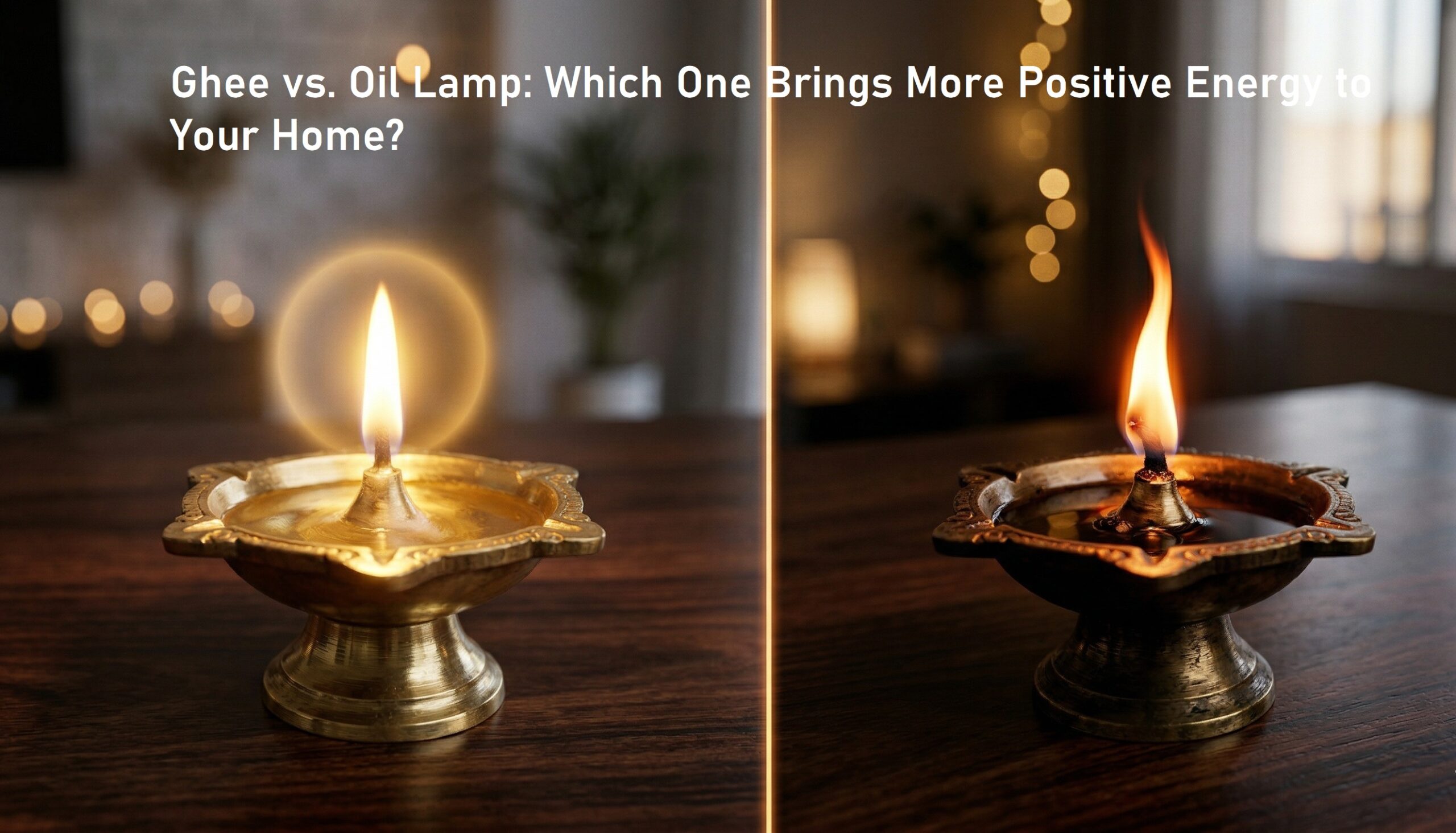
Have you ever noticed that a ghee flame looks different from an oil flame? If you look closely, a ghee flame is usually more golden, steady, and has a very tiny “blue” center. An oil flame (especially sesame or mustard) tends to be a bit more reddish-orange and can flicker or crackle more often.
In Vastu and spiritual science, this isn’t just about the fuel; it’s about wavelengths.
- The Upward Pull (Ghee): Ghee is lighter and more refined. When it burns, the energy it releases is said to move in a “circular” and “upward” motion. It’s like a spiritual vacuum cleaner that pulls in Sattva (purity) from the atmosphere and radiates it out.
- The Shielding Effect (Oil): Oil is denser. Its energy moves in a more “linear” and “protective” way. It’s designed to create a boundary. This is why oil lamps are traditionally placed at the main entrance of a house—they act as a filter for any “heavy” or negative energy trying to walk through the door with you.
Think of it like air conditioning vs. an air purifier. Ghee purifies the “soul” of the room, while oil conditions the “environment” to keep it safe.
Why Your Choice Matters Tonight
In our high-tech, 2026 lives, we are constantly bombarded by EMFs (Electro-Magnetic Fields) from our routers and phones. Lighting a lamp provides a “counter-frequency.” Here is what you’ll actually feel:
Benefits of the Ghee Lamp (The “Peace Maker”)
- Mental Clarity: If you’re a student or someone who works a high-stress job, a ghee lamp near your desk can help reduce “brain fog.” The subtle aroma of burning ghee has a grounding effect on the nervous system.
- Attracting Prosperity: In Indian tradition, Goddess Lakshmi is said to be “attracted” to the glow of a ghee lamp. Practically speaking, a peaceful, focused mind is much better at making smart financial decisions!
- Better Sleep: Lighting a ghee lamp for 10 minutes before bed (and then safely extinguishing it) can “settle” the energy of a bedroom, making it easier to drift off.
Benefits of the Oil Lamp (The “Bodyguard”)
- Clearing Negativity: If there’s been a lot of arguing, sickness, or “heavy” moods in the house, a sesame oil (Til) lamp is your best friend. It’s known for its ability to “consume” negative vibrations.
- Health & Vitality: Mustard oil lamps, specifically, are great for clearing the air of physical impurities and are often lit during changes in season to keep the household healthy.
- Protection: It creates a “Vastu shield.” If your house faces a busy, noisy street or a “negative” landmark (like a hospital or graveyard), an oil lamp at the window or door acts as an energetic buffer.
Let’s Bust the Confusion
Because this is such an ancient topic, there are a lot of “scary” myths floating around on the internet. Let’s look at the facts.
Myth 1: “Mixing Ghee and Oil is Double the Luck”
The Reality: Actually, this is a big “No” in traditional Vastu. Mixing them is like trying to play two different songs at the same time—it creates “noise” instead of “harmony.” Stick to one fuel per lamp for the best results.
Myth 2: “Vegetable Cooking Oil is the Same as Sacred Oil”
The Reality: Refined vegetable oils (like sunflower or soy) are highly processed. They don’t have the same “pranic” value as cold-pressed sesame or mustard oil. If you’re going to use oil, go for Sesame (Til) or Mustard for the best energy.
Myth 3: “A Diya Must Burn All Night to Work”
The Reality: In a modern apartment, leaving a flame unattended is a fire hazard. The “energy reset” happens within the first 15–20 minutes of lighting the lamp. It’s better to light it for a short, safe time with full intention than to leave it burning while you’re worried about your curtains!
Myth 4: “The Direction Doesn’t Matter”
The Reality: It really does! A lamp facing East promotes health and peace. A lamp facing North is great for wealth and success. Avoid facing your lamp South unless it’s for a very specific ancestral ritual.
The “Secret” of the Wick
After 15 years of observing these rituals, I’ve found that the wick (Baati) is just as important as the fuel. It’s the bridge between the physical and the spiritual.
- The Single Wick: Represents a focused mind. Great for students or when you’re meditating.
- The Two Wicks Joined (Jot): Represents the harmony of the family—specifically the bond between husband and wife.
- Cotton vs. Red Thread: Most people use cotton, which is excellent for everyday peace. But if you’re looking for a boost in energy or power (like before a big job interview), experts often suggest a wick made of Moli (red sacred thread) with an oil lamp.
The “Soot” Secret
If your ghee lamp is leaving a lot of black soot on the wall, your ghee isn’t pure. Pure cow ghee burns incredibly clean. If you see heavy smoke, it’s a sign of impurities—which actually adds “heaviness” to the room instead of clearing it.
The “Stressful” 20th Floor Apartment
I worked with a client named Kavita in early 2025. She lived in a high-rise in Bangalore. Even though she had a beautiful home, she felt “scattered.” She was burning scented candles every evening, but the vibe still felt artificial and “cluttered.”
The Change: I suggested she stop the candles for a week. Instead, I told her to light a Sesame Oil lamp at her main door for 20 minutes when she got home from work (to “shed” the office stress) and a Ghee lamp in her living room while she relaxed.
The Result: Within four days, Kavita noticed a shift. “The air feels… thicker, but in a good way,” she told me. “Like the room is hugging me.” By using oil to clear the day’s stress and ghee to invite peace, she created a balanced energy cycle that no scented candle could replicate.
How to Light Your Diya for Maximum Energy
If you want to do this right tonight, follow this simple routine:
- Clean the Lamp: Never light a lamp that has old, burnt-out wick crust or sticky residue. Clean it with a bit of lemon or pitambari.
- Choose Your Fuel: * Use Ghee if you want peace, clarity, or are doing a prayer.
- Use Sesame Oil if you feel heavy, tired, or want to clear out “bad vibes.”
- Placement: * Place the lamp on a small plate (never directly on the floor).
- Face the wick East (for health/peace) or North (for wealth).
- The Intention: As you light the flame, don’t just think about the matchstick. Spend 10 seconds thinking: “May this light remove the darkness from my home and my mind.” 5. Safety First: In 2026, we have smoke detectors and breezy balconies. Always keep the lamp away from curtains and blow it out gently if you are leaving the room.
FAQs: Your Top 10 Questions Answered
Is it okay to use an electric “Diya” instead?
It’s fine for decoration, but it doesn’t have the same “elemental” effect. The fire element (Agni) and the vaporization of the ghee/oil are what actually change the room’s energy.
Which oil is best if I can’t find Sesame?
Mustard oil is the next best thing for clearing negativity. Avoid generic “vegetable” or “refined” oils if possible.
Should the Diya be made of clay, brass, or silver?
Clay (Mitti): The most grounding. Great for temporary use.
Brass: Very common and creates a steady, “positive” vibration.
Silver: Excellent for peace and attracting prosperity (lunar energy).
Can I light a lamp in the bedroom?
Yes, but use Ghee. An oil lamp is too “active” for a sleeping space.
What is the best time to light it?
Sandhya Kaal—the twilight hour when day meets night. This is when the energy of the Earth is in transition and most receptive to change.
I’m allergic to smoke. What should I do?
Use a very small wick and A2 Cow Ghee. It produces almost zero smoke compared to oils.
Can I use a Diya for aromatherapy?
You can add a drop of sandalwood or jasmine oil to your ghee, but don’t overdo it. The pure smell of ghee is powerful enough on its own.
What if the flame goes out on its own?
Don’t panic! It’s usually just a draft or a short wick. Just relight it with a positive thought. It’s not a “bad omen” like the movies suggest.
Can I use the same lamp for both Ghee and Oil?
Technically yes, but wash it thoroughly in between. You don’t want the residues to mix.
How many lamps should I light?
Even one is enough. Vastu isn’t about the quantity; it’s about the quality of your intention and the purity of the fuel.
Light Your Way to a Better Home
We live in a world that is loud, bright, and often overwhelming. Sometimes, the most “high-tech” thing you can do for your mental health is to go “low-tech.”
Whether you choose the Sattvic peace of Ghee or the Protective strength of Oil, you are making a choice to take control of your environment. You are telling the universe that your home is a sacred space.
Your Actionable Takeaway: Tonight, at sunset, turn off your phone for 10 minutes. Light a simple ghee lamp. Sit near it. Don’t “do” anything. Just watch the flame. You’ll be surprised at how quickly the “noise” of the day fades away.
About the Author Jagdish Vajpeyee is the founder of Vastu Dharma and a Vastu Shastra consultant with a specialized focus on Vedic Astrology. With a professional background in banking, Jagdish brings a unique, analytical approach to ancient wisdom, helping modern families and businesses correct their energy flow without unnecessary demolition. He is passionate about merging traditional Indian architecture with contemporary lifestyle needs.
Disclaimer: The information provided in this article is for educational and informational purposes only. Vastu Shastra is an ancient architectural and energetic system; while many individuals find value in its principles for creating a harmonious environment, these suggestions are based on traditional interpretations and personal research. This content is not intended to be a substitute for professional architectural, legal, financial, or medical advice. The author and this website do not guarantee specific outcomes—such as financial gain or health improvements—resulting from the application of these tips. Before making significant structural modifications to your home or basement, please consult with a licensed architect or structural engineer to ensure the safety and integrity of your property.