
Living Room Vastu: Where to Put Sofa, TV and Main Couch to Avoid Daily Fights
If arguments always start in the living room, it is not always about what was said. In Vastu, the living room is the social battery of your home. Everyone brings outside energy into it, and if the seating makes you face the wrong direction or the TV heats up the wrong zone, small talks turn into tension.
This is not about expensive renovation. It is about where you put heavy things, where you face while sitting, and where you put heat-producing electronics.
Quick Answer – The 30-Second Placement Formula
For a peaceful living room, remember this:
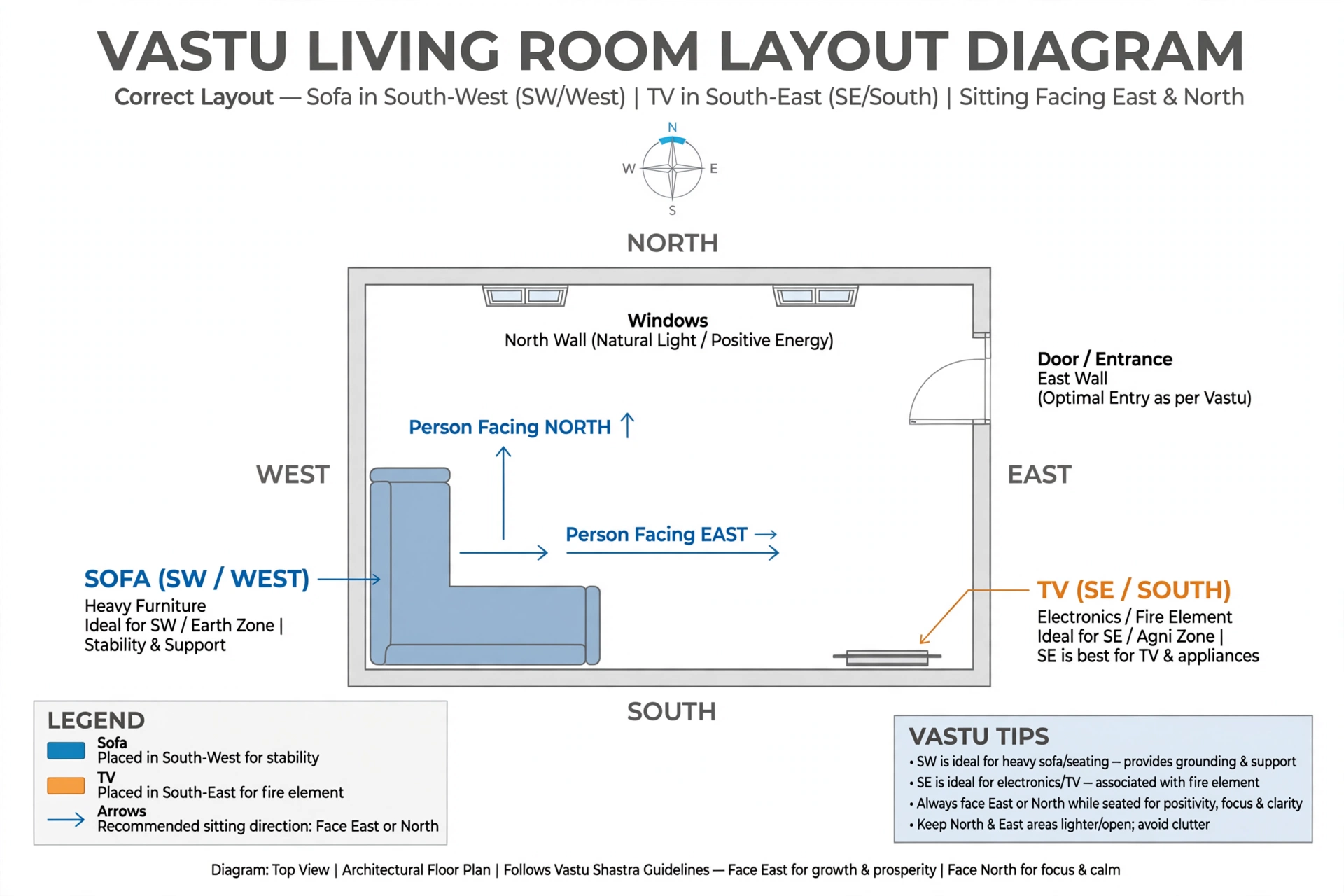
- Main sofa / couch: Place it against the South or West wall, ideally with its corner in the South-West. You should face East or North while sitting on it.
- TV / TV unit: Place it on the South-East or South wall. Never on the North-East wall.
- Centre: Keep the centre of the living room light and open. No heavy centre table directly over the exact centre point (Brahmasthan).
- What to remove from the living room: Mirror directly facing the sofa, thorny plants like cactus, beam directly above head of main sofa, dark North-East corner.
If you only do these four things, most daily friction linked to the living room layout reduces.
Why Your Living Room Decides Whether You Fight or Connect
Unlike the kitchen which is fixed to the fire element (South-East) or the pooja room which is fixed to water energy (North-East), the living room has no single fixed zone in classical texts. The Mayamata describes it as the sabha griha – the assembly space. Its ideal zone depends on where your main entrance is, because it has to receive guests without them walking through private zones.
The other reason is elemental. Your sofa is heavy, it represents Earth element. Your TV and electronics generate heat, they represent Fire element. When Earth sits in Water zone, or Fire sits in Water zone, you create conflict. That conflict is felt as restlessness, someone always wanting to leave the conversation, or arguments that start from nowhere.
Ideal Living Room Zone Depends on Your House Facing
If you are buying or can choose, this table helps:
| Home Facing | Ideal Living Room Zone | Why It Works |
|---|---|---|
| North Facing | North or North-East, near entrance | Sits in wealth (Kubera) and clarity (Ishaan) zones, most welcoming |
| East Facing | North or North-East | Gets morning light, keeps North-East active and bright |
| West Facing | North or North-East | Keeps North-East as the most open zone, away from evening heat in West |
| South Facing | South or South-East | Near the entrance wall, handles the dynamic energy of South |
Notice the pattern: in 3 out of 4 cases, North or North-East is best. South-facing homes are the exception. If your living room is already built elsewhere, do not worry – the internal furniture rules matter more than the zone for existing flats.
Sofa Direction As Per Vastu – The Most Important Rule
This is where most homes go wrong. Vastu cares about two things: where the sofa is placed and where you face while sitting on it.
Where to place the main sofa and couch:
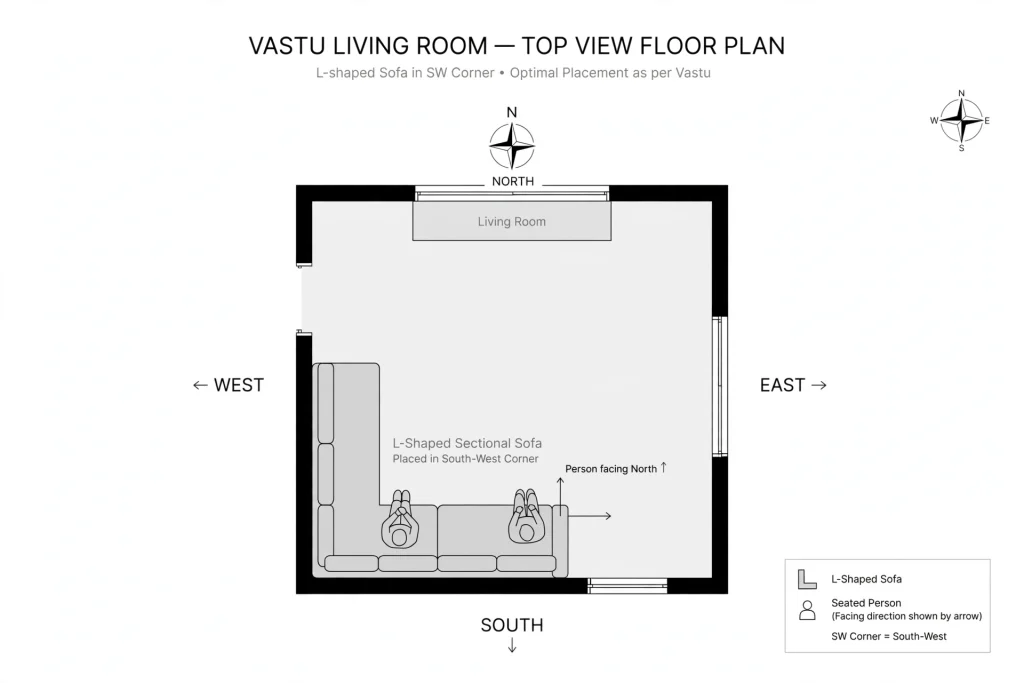
Place the heaviest sofa against the South-West wall. The second choice is West wall, third is South wall. The logic is simple: South-West is the Nairitya zone, ruled by Earth element. Heavy, stable furniture grounds this zone. When you put heavy furniture in the North-East (water zone), you feel heavy and stuck in conversations.
Avoid placing the main sofa in the centre of the room or against the North-East wall.
Which direction should you face while sitting?
The head of the family or the person who uses the living room most should face East or North while seated.
- Facing East: Aligns with solar energy. Better for clarity, calm discussion, decision making. Best if you often have important family discussions in the living room.
- Facing North: Aligns with Kubera’s zone. Better for wealth, career conversations, guest relations.
What to avoid: Avoid the main, daily-use seat facing directly South. Occasional guest chairs can face any direction, but your regular seat should not. South-facing seating is associated with restlessness and confrontational energy during long conversations.
For L-shaped and U-shaped sofas:
Indian flats almost always have an L-shape. Put the corner of the L in the South-West corner of the living room, with one arm along the South wall and one along the West wall. This keeps the heaviest mass in the Earth zone and automatically gives you East or North facing on the longer arm. The shorter arm can be used for guests.
For U-shape, keep the base of the U against the South or West wall, open side facing North or East.
The “Back to Main Door” Mistake:
Never place your main sofa such that your back is directly to the main entrance while you are sitting. It creates a subconscious feeling of being exposed. People do not relax, they keep turning back. If your layout forces it, place a tall plant or a console table behind the sofa as a soft buffer, or move the sofa 90 degrees.
TV Direction As Per Vastu
This is the most searched question, and the most violated.
Best wall for TV: South-East or South wall.
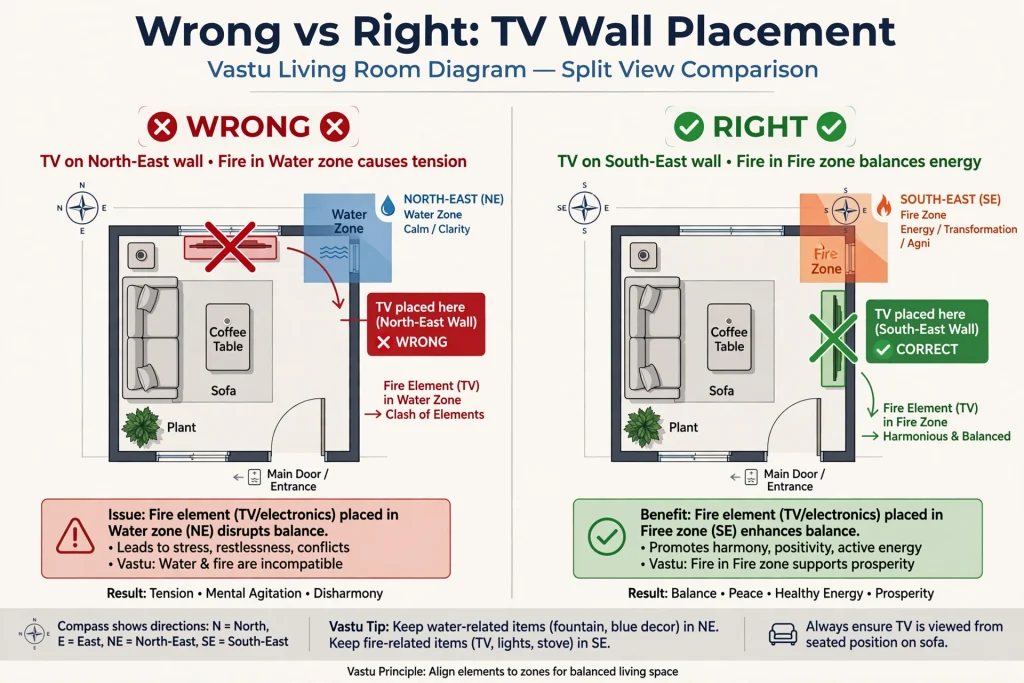
TV, set-top box, gaming consoles and soundbars generate heat. In modern Vastu interpretation, they are treated as Fire element, similar to Agni. South-East is Agneya Kona, the fire zone ruled by the element of fire. Putting fire in fire zone balances it. South is also acceptable as it is also a heat-tolerant zone.
Why you should never put TV in North-East:
North-East is Ishaan Kona, the water and clarity zone. It is meant to be the lightest, brightest, calmest corner. When you mount a heat-generating screen there, you create a direct Fire-Water conflict. In practical terms, families with TV in North-East often complain that the living room never feels peaceful even when TV is off, and that area becomes the darkest cluttered corner with wires.
If your TV is already in North-East and you cannot move it due to wiring in a rental, keep the corner very well lit with a warm lamp, keep wires concealed and clustered, and do not keep the TV on standby all night – switch off at plug.
Electronics, Wi-Fi Router, AC and Speakers
Do not scatter electronics across all walls. Cluster them.
- Wi-Fi router, set-top box, inverter: Keep them in the South-East corner of the living room, not in North-East.
- AC: Best on West or South wall, with airflow towards East or North. Avoid AC directly above the main sofa blowing cold air straight down on head.
- Speakers / Home Theatre: Heavy speakers in South-West or West is fine. Keep the subwoofer off the North-East floor.
The principle: concentrate Fire element in its own zone instead of spreading small heat sources everywhere.
Centre Table, Brahmasthan and Clutter Flow
Every home has a centre point called Brahmasthan. It is the navel of the Vastu Purusha. Even if your living room is only a part of the home, its own centre also needs breathing space.
- Do not place a very heavy stone or marble centre table exactly over the centre of the living room. Keep it slightly shifted to South-West of centre.
- Leave at least 3 feet of open walking path between sofa and TV unit. An overcrowded living room blocks flow. That blockage is felt as people interrupting each other.
- Repair broken sofas, wobbly tables, torn cushions. Broken furniture in a social space is considered stagnant energy and affects mood.
Colours, Lighting and Curtains That Reduce Tension
Colour in Vastu follows element of the zone where your living room sits:
- If living room is in North / North-East: Light blue, light green, off-white, cream. Avoid dark red or black as main wall colour.
- If living room is in South / South-East: Cream base with peach, light terracotta or warm beige as accent. Avoid dark blue and black.
- If living room is in South-West: Beige, light brown, sand tones. Avoid bright blue.
Two lighting rules that directly affect fights:
- North-East corner should never be the darkest corner. If it is, put a floor lamp or warm wall light there. A dark North-East creates heaviness.
- Avoid harsh white tube lights directly above main seating. Use warm white (3000K) with layered lighting – one ceiling, one corner lamp. Harsh light makes conversations feel like interrogations.
Curtains: Light, sheer curtains for day time in East and North windows. Heavy blackout curtains only in West if you get harsh evening sun. Dark, heavy curtains all day block beneficial morning light.
7 Things in Your Living Room That Trigger Daily Fights
From my consultations, these 7 show up repeatedly in homes where people say “we fight a lot in the hall”:
1. Mirror directly facing the main sofa: In Vastu, mirror doubles whatever it reflects. If it reflects people arguing or stressed, it doubles that energy. Place mirrors only on North or East wall, and never such that the main sofa is reflected while you are sitting.
2. Cactus, thorny plants or bonsai in the living room: Thorns are associated with prickly energy. Keep them in outdoor balcony or garden. Inside living room, use money plant, areca palm, or tulsi in balcony.
3. Beam directly above the main sofa or head: A structural beam creates downward pressure. People sitting under it report headaches and irritation. Remedy: false ceiling panel to cover it, or drape fabric canopy, or move sofa by even 1 foot so beam is not directly over head.
4. Sharp-edged furniture pointing at seating: Triangle coffee table with sharp corner pointing at sofa, or open shelf with sharp edge at head height. Choose rounded edges for centre table.
5. Photo art that shows loneliness, war, crying, or single person: Replace single-person art with pair imagery – two birds, couple in abstract, landscape with sunrise. Lone warrior or sad abstract art in living room sets a lonely tone.
6. Toilet door opening directly into living room: Very common in 1BHK flats. Keep door always closed, place a small plant or screen between, and keep toilet well ventilated so smell does not enter social zone.
7. Wires and remote clutter on centre table: Electronic clutter in centre creates fire energy in the middle of the room. Use one basket for all remotes, conceal wires behind TV panel.
Small Flat & Rental Hacks – No Demolition Fixes
You cannot break walls in a rented flat in Pune or Mumbai. Do this instead:
- Compass app test: Stand in centre of living room, check directions with compass app. Mark SW corner with a small tape. That is your heavy zone.
- Pivot without buying new: Move existing 3-seater to SW/West wall. You get correct facing without spending.
- TV fix without drilling: If TV is in NE and landlord fixed the wall panel there, use a low wooden unit in SE and place TV on it, leave the NE panel for books or light decor.
- Virtual South-West: If your SW corner has a window or balcony door and you cannot place sofa there, place a heavy bookshelf or wardrobe in SW to ground the Earth element.
- Light the NE: One Rs. 800 floor lamp in NE corner can change the feel more than repainting.
- Use rugs to define Brahmasthan: A light-coloured rug with open centre visually keeps centre light even if you have a centre table.
Worked Example – 2BHK East-Facing Flat in Pune
Living room in North zone, entrance in North-East. Existing layout: Sofa on North wall facing South (main seat faces South – not ideal), TV on North-East wall, centre table heavy marble exactly in centre, cactus on side table.
Corrected without demolition:
Sofa moved to South wall, now faces North. TV moved to South-East wall unit. Centre table shifted 1.5 feet South-West of centre, replaced cactus with money plant in North corner, added warm floor lamp in North-East. Result: host now faces North (Kubera), TV heat moves to Agneya, North-East becomes light and open. Family reported less evening irritability after TV time.
Common Mistakes Checklist
Use this before you rearrange:
- Main sofa facing South?
- TV on North-East wall?
- Mirror facing sofa?
- Heavy sofa in North-East?
- Beam directly above head of regular seat?
- Centre completely blocked with heavy table + clutter?
- North-East corner dark or heavy?
- Thorny plant / bonsai inside living room?
- Toilet door opens directly into living room and stays open?
- Back of main sofa faces main door?
If you tick 3 or more, start with sofa and TV placement. That alone is 70% of the remedy.
9. FAQ Section
1. What is the best direction for sofa as per vastu?
The main sofa should be placed against the South-West or West wall, so that when you sit, you face East or North. This grounds heavy furniture in the Earth zone and gives you beneficial facing directions.
2. Where should TV be placed in living room as per vastu?
Place TV on the South-East or South wall. South-East is the fire zone (Agneya Kona), ideal for heat-generating electronics. Avoid North-East wall as it creates fire-water conflict and makes the room feel tense.
3. Which direction should we face while sitting in living room?
Face East or North while sitting on your regular seat. East supports calm, clear conversations. North supports wealth and social harmony. Avoid making your daily seat face directly South.
4. Is L-shaped sofa good as per vastu?
Yes. Place the corner of the L in the South-West corner, with arms extending along South and West walls. Ensure the longest and most-used section lets you face East or North. Avoid L-shape blocking the centre.
5. Can I place sofa against North or East wall?
For guest seating, yes. For the main heavy sofa where family sits daily, it is better to avoid North-East. If you have no choice in a small flat, make the sofa light and keep South-West heavy with a bookshelf or storage unit.
6. What should not be kept in living room as per vastu?
Avoid thorny plants like cactus, broken furniture, mirrors facing the main sofa, photos showing loneliness, sadness or war, and very dark colours as dominant wall colour.
7. Where should mirror be placed in living room?
Place mirrors on North or East wall only, where they reflect light and make the room feel larger. Never place a mirror on South or South-West wall, and avoid one that directly reflects the main sofa during conversations.
8. What is Brahmasthan in living room?
Brahmasthan is the exact centre point of your home or room. It should remain as light and open as possible. Avoid heavy centre tables, clutter or storage directly over it.
9. My TV is fixed in North-East by builder. What is the remedy?
Keep the North-East well lit with a warm lamp, conceal all wires, avoid leaving TV on standby, and keep the area clean and light. When you can, move TV to South-East using a separate TV unit instead of wall panel.
10. Which colour is best for living room as per vastu to avoid fights?
Use light and welcoming colours: off-white, cream, light beige, light green or light blue depending on your living room zone. Keep the palette light overall, avoid black, deep maroon or dark navy as main wall colours.
11. Can we keep dining table in living room as per vastu?
Yes, if you have a combined hall. Place dining area in West or North-West part of the living room, not in North-East. Ensure dining chairs face East or North while eating.
Disclaimer: The information provided on vastudharma.com is for general informational and cultural purposes only, based on traditional Vastu Shastra principles. While we strive to offer well-researched and practical insights, this content should never serve as a substitute for professional architectural, structural engineering, financial, psychological, or medical advice. Any application of the Vastu guidelines, remedies, or structural changes suggested in our articles is undertaken entirely at your own risk and discretion, and vastudharma.com makes no warranties or guarantees regarding specific outcomes—such as health improvements, financial gain, or personal success—derived from implementing these practices.