
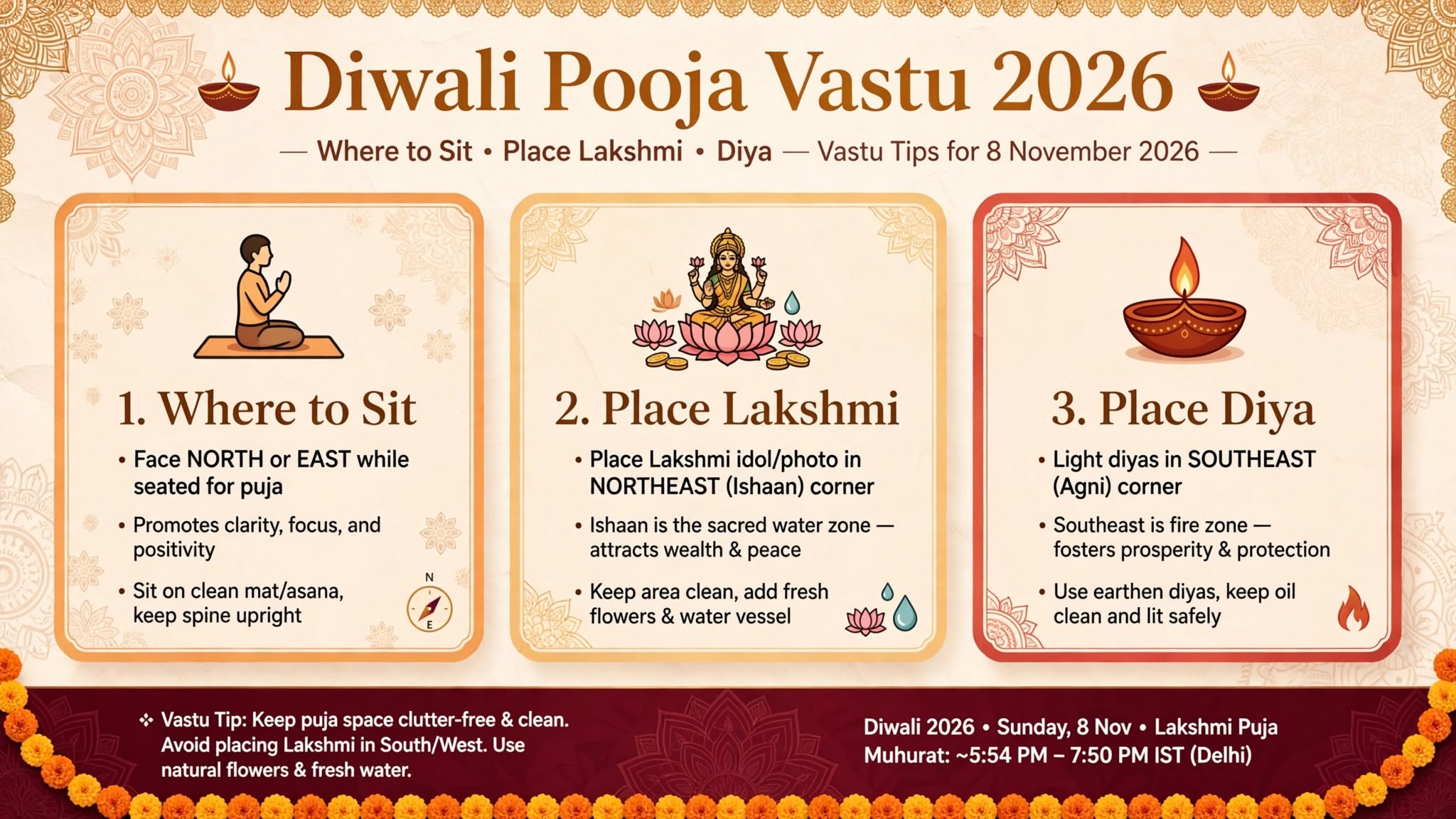
Every year the same three questions flood Diwali evening: Which way should I sit? Where exactly does Lakshmi go? And which diya do I light first? Families spend days on cleaning, rangoli and sweets, then lose confidence in the last ten minutes before the pooja because every relative, WhatsApp forward and YouTube video says something different.
This guide settles it. It brings together the mainstream Vastu Shastra guidance on Diwali pooja, explains why each rule exists, flags the places where sources genuinely disagree, and gives you a simple fallback if your flat does not follow the “ideal” layout. Whether you live in an independent house or a 1BHK flat in Pune, Mumbai, Bengaluru, Dallas or London, you can apply it tonight.
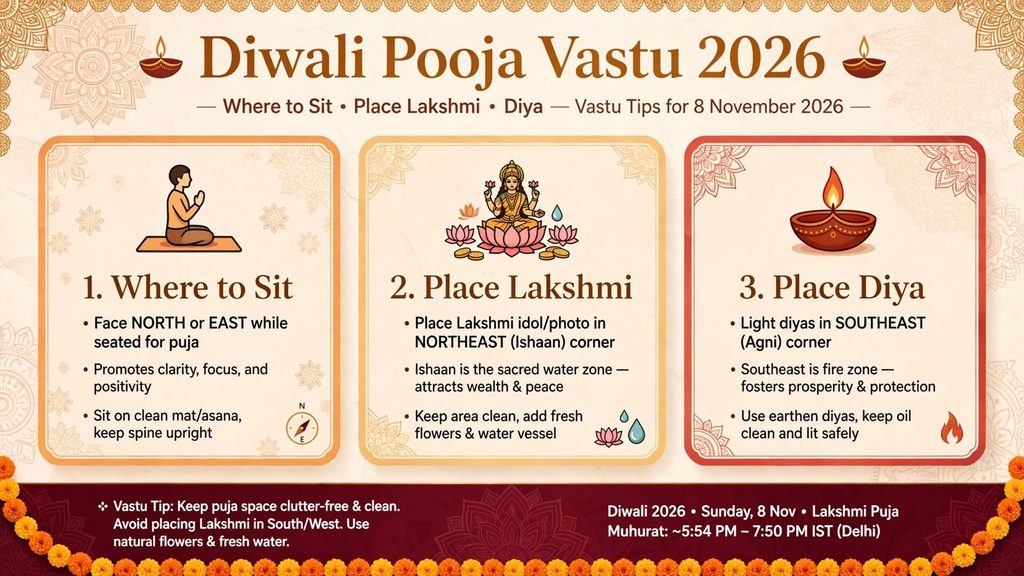
Quick Answer (for busy readers)
- Where to sit: Face east (best) or north while doing the pooja.
- Where to place Lakshmi: In the north-east (Ishan) corner of the pooja space, on a clean raised chowki with a red or yellow cloth. If the north-east is not possible, use the north (Kubera’s direction), then the east.
- Where to light the first diya: In the pooja space, in front of Lakshmi–Ganesh, in the north-east, before any other lamp in the house. Then light diyas at the main entrance, near the tulsi, and in other zones.
- Which way should the diya face: North or north-east for wealth, east for health. Avoid a south-facing wick.
Buy now: 30-Day Vastu Declutter & Energy Reset – 1BHK/2BHK Edition 83 Pages +4 Bonus
Diwali 2026 Date and Lakshmi Pooja Muhurat
Diwali (Lakshmi Puja) falls on Sunday, 8 November 2026, on Kartik Amavasya. The wider five-day festival runs from Dhanteras on 6 November to Bhai Dooj on 10 November.
For New Delhi, widely quoted Drik Panchang timings are:
| Item | Time (New Delhi, IST) |
|---|---|
| Lakshmi Puja muhurat | 5:54 PM – 7:50 PM |
| Pradosh Kaal | 5:31 PM – 8:09 PM |
| Nishita Kaal (late-night option) | 11:44 PM – 12:36 AM (as reported by one outlet) |
Important: muhurat timings shift by city (and by a few minutes between sources, depending on the calculation method). Check your local panchang or your family pandit for exact timings where you live, and for NRIs, use your own city’s sunset-based timing rather than India’s. The Vastu rules below apply no matter which muhurat you choose.
Step Zero: Prepare the Space Before You Position Anything
In Vastu, direction rules only work on a clean, uncluttered space. Before you place a single idol:
- Clear the north-east corner. Traditional Vastu treats Ishan as the most sacred zone of the home. Remove broken electronics, heavy luggage, old newspapers and damaged items from it.
- Mop with rock salt water. Many Vastu practitioners recommend mopping with rock salt (sendha/sea salt) water a few days before Diwali and especially on the day, as salt is believed to absorb stagnant energy.
- Keep the whole house bright. On Lakshmi Puja evening, keep the lights on, the main door clean and the entrance decorated with rangoli, toran and flowers.
- Do not compromise cleanliness for direction. If your layout makes a “perfect” direction impossible, a clean, calm, well-lit pooja area beats a cramped one forced into the right compass point.
Where to Set Up the Diwali Pooja: Direction Hierarchy
Vastu ranks directions for the pooja space like this:
- North-East (Ishan Kon): best. Associated with divine energy and the morning sun.
- East: Second choice, linked with new beginnings and vitality.
- North: Third choice, the direction of Kubera, the treasurer of the gods, so it carries a natural association with money and savings.
- Avoid: A pooja space in the south, in a bedroom corner under a beam, or next to or under a staircase or toilet wall.
If you are in a rented flat or apartment and the north-east is a bedroom or kitchen, do not rearrange the house for one night. Set up the chowki in the north or east part of your living room instead.
Where to Sit During Diwali Pooja
Rule: the worshipper faces east (best) or north.
East is the direction of the rising sun, linked with vitality and clarity. North is Kubera’s direction, linked with wealth and prosperity. Most Vastu sources agree on this part, so it is the safest rule to follow.
Practical tips for seating:
- Sit on a clean aasan (woollen, cotton or kusha), never directly on the bare floor.
- Keep the head of the household in the main seat, with other family members seated beside or just behind, also facing the same direction.
- Keep your back straight and avoid sitting with your back to the main door.
- Keep footwear away from the pooja area and keep your head covered if your family tradition requires it.
Where to Place Lakshmi (and Ganesha): The Direction Confusion, Solved
This is where most articles contradict each other. Some say “idols should face east,” others say “idols should face west.” Both lines appear online, and both can be right because they describe two different things.
The rule that matters: you (the devotee) must face east or north. That automatically decides which way the idols look.
- If you sit facing east, the idols go in the west part of the pooja space and look west, towards you. Many Vastu guides describe this as the best setup for drawing blessings.
- If you sit facing north, the idols go in the south part of the pooja space and look south, towards you.
- If your family follows the “north-east corner, idols facing east” method, check where you will sit: you must still end up facing east or north, so adjust your seat rather than the rule.
Because sources genuinely differ, the best approach is: pick the setup that lets you sit facing east or north, and keep the idols in the north-east zone of the room as far as space allows. If your family or pandit has a kula tradition for idol direction, follow it.
Lakshmi–Ganesh placement checklist
- Chowki or platform: Place a clean, raised wooden chowki and cover it with a red or yellow cloth. Idols should never sit directly on the floor.
- Gap from the wall: Leave a small gap (roughly an inch or more) between the idols and the wall behind them.
- Order: A commonly followed convention is Ganesha on Lakshmi’s right, with the idols not facing each other directly. Families differ, so follow your own tradition if it is different.
- Kalash: Place a kalash filled with water, with mango leaves and a coconut on top, near the idols, and keep it on the north-east side.
- Lakshmi’s posture: Many Vastu guides advise a seated Lakshmi (on the lotus) for the home, as it is associated with wealth staying, rather than a standing posture.
- Condition of idols: Do not use cracked, chipped or broken idols. Immerse or retire old, damaged ones respectfully, per your tradition.
- Extras: Place your Shri Yantra, new account books, cash and jewellery near the chowki as per Diwali custom. Clean the idols before the pooja.
Where to Light the First Diya
The first lamp of Diwali is not just decoration. In Vastu and Hindu practice it marks the beginning of the pooja and invites the deity.
The first diya goes in the pooja space. Light it in front of Lakshmi–Ganesh, in the north-east zone of the pooja area, on a stable stand or plate (not directly on the floor), before you light any other diya in the house. Most Vastu-tradition writers on Diwali diya placement agree on this point.
Akhand diya (the all-night lamp)
Many families light an akhand diya, a lamp meant to burn through the night. If you do:
- Light it first and place it at the centre or north-east of the pooja altar.
- Use ghee or mustard/sesame oil. Ghee is the traditional first choice, but it can solidify; oil lasts longer and is easier to refill.
- Keep an extra wick beside it, and refill the oil before you go to sleep.
- If the flame goes out, simply relight it. Do not panic. Intention matters more than a perfect flame.
A note on conflicting advice
A few Vastu writers say the first diya (especially a four-wick chowmukhi clay lamp) should go in the south-east, which is the Agni (fire) corner, or at the north or east entrance. Treat these as the second-stage placements. The widely agreed order is:
- Pooja space (north-east): first diya, before Lakshmi–Ganesh.
- Main entrance (north or east): a diya or a set of four, to welcome Lakshmi in.
- Near the tulsi plant, or in the kitchen if you have no tulsi, as tulsi is linked with Lakshmi.
- North or north-east corners of the home for wealth energy.
- Near water sources (water tank or storage), which Vastu traditions associate with dispelling negativity.
Which Direction Should the Diya Face?
| Goal | Wick/flame direction |
|---|---|
| Wealth and prosperity | North or north-east |
| Health and wellbeing | East |
| Avoid | South (considered inauspicious for lamps) |
One tradition stands separate: some families light a single diya facing south on Diwali night as a remembrance for ancestors (Yama’s direction). This is an ancestor-ritual practice, not a Vastu placement for wealth, so keep it distinct from the wealth diyas.
Other diya rules worth following
- Oil or ghee: Use ghee, or mustard or sesame oil. Avoid sunflower oil, as many Vastu sources recommend.
- Wicks: Use clean cotton wicks. One or two wicks per diya is typical.
- Number: Many families light an odd number of diyas (11, 21, 31, 51 or 108), a common tradition.
- Do not blow out a diya with your mouth. Let it burn out or use a snuffer.
- Do not place diyas on the bare floor or on cluttered ledges.
Quick Reference: Diwali Pooja Vastu Layout
| Element | Best placement |
|---|---|
| Pooja space | North-east (then east, then north) |
| Worshipper’s seat | Facing east (best) or north |
| Lakshmi–Ganesh idols | North-east zone, on a raised chowki; idols positioned so you face east or north |
| First diya | In front of Lakshmi–Ganesh, in the pooja space |
| Akhand diya | Centre or north-east of the altar |
| Second diya | Main entrance (north or east side) |
| Third diya | Near the tulsi or kitchen |
| Kalash | North-east side of the chowki |
| Wick direction | North, north-east or east |
If Your Home Doesn’t Fit the Ideal Layout
1BHK or apartment: Choose the north or east wall of the hall. A small table or chowki is enough.
South-facing or west-facing flat: Vastu guides generally say the pooja space can still be in the north-east, east or north of the house, regardless of which way the main door faces.
Corner chowki not possible: Place the chowki against a wall in the north or east side of the room and make sure you face east or north.
NRIs abroad: Use the same compass rules for your home. Use a compass app to find north and east, and follow your local muhurat.
Common Diwali Pooja Vastu Mistakes to Avoid
- Sitting facing south or placing the pooja space in the south
- Placing idols directly on the floor or tight against the wall
- Using broken or chipped idols
- Letting the north-east corner stay cluttered
- Lighting diyas with a south-facing wick (for wealth intent)
- Using adulterated ghee or cheap sunflower oil
- Leaving the house dark on Lakshmi Puja evening
- Sleeping early and letting the akhand diya die with no refill
- Treating Vastu as a replacement for effort: Vastu is a supportive tradition, not a financial plan
Diwali Night Vastu Checklist
- Clean the house and mop with rock salt water.
- Clear the north-east corner.
- Decorate the main entrance with rangoli, toran and lights.
- Spread red or yellow cloth on a raised chowki.
- Place Lakshmi–Ganesh in the north-east zone.
- Place the kalash and your Shri Yantra.
- Sit facing east or north on an aasan.
- Light the first diya in front of the deities.
- Complete the pooja during your city’s Lakshmi Puja muhurat.
- Light diyas at the entrance, tulsi, and key corners.
- Keep the house well lit through the evening.
Frequently Asked Questions
Which direction should I sit for Diwali pooja?
Face east, which is best, or north. Both are widely recommended in Vastu.
Which direction should Lakshmi face?
There is no single universal rule, because it depends on where you sit. The consistent principle is that the devotee faces east or north, so the idols are positioned to look towards you.
Where should I keep Lakshmi and Ganesha?
In the north-east zone of your pooja space on a clean raised platform. If that is not possible, use the north or east.
Where should the first diya of Diwali be lit?
In the pooja space in front of Lakshmi and Ganesha, before lighting diyas elsewhere in the house.
Which direction should the diya face on Diwali?
North or north-east for prosperity, and east for health. Avoid a south-facing wick, except for the separate ancestor-remembrance tradition.
Is ghee compulsory for Diwali diyas?
No. Ghee is traditional, but mustard or sesame oil is accepted. Cleanliness and sincerity matter more than the material.
What is the Diwali 2026 Lakshmi Puja time?
Diwali is on Sunday, 8 November 2026. For New Delhi, the widely cited muhurat is 5:54 PM to 7:50 PM. Check your local panchang for your city.
Can I do Lakshmi pooja in a rented flat?
Yes. Choose a clean north or east side of the living room and follow the sitting direction rule.
Final Thoughts
Diwali Vastu does not need to be complicated. Remember three things: you face east or north, Lakshmi sits in the clean north-east on a raised seat, and the first diya burns in front of her before any other lamp. Everything else is refinement.
A clean home, a calm mind and a sincere pooja are the real foundation of the festival. Vastu simply helps you arrange the space to support them.
Disclaimer: Vastu Shastra is a traditional belief system. The guidance here reflects widely shared Vastu and Hindu ritual practice and is offered for cultural and informational purposes. Practices vary by region and family tradition. For personalised guidance, consult a qualified Vastu expert or your family pandit.
Want a personalised Vastu check for your home layout? Explore the Vastu reports and consultations on vastudharma.com.