
30-Day Vastu Declutter & Energy Reset for 1BHK and 2BHK Homes
A practical, room-by-room Vastu decluttering guide for modern Indian apartments — just 20 minutes a day for 30 days.
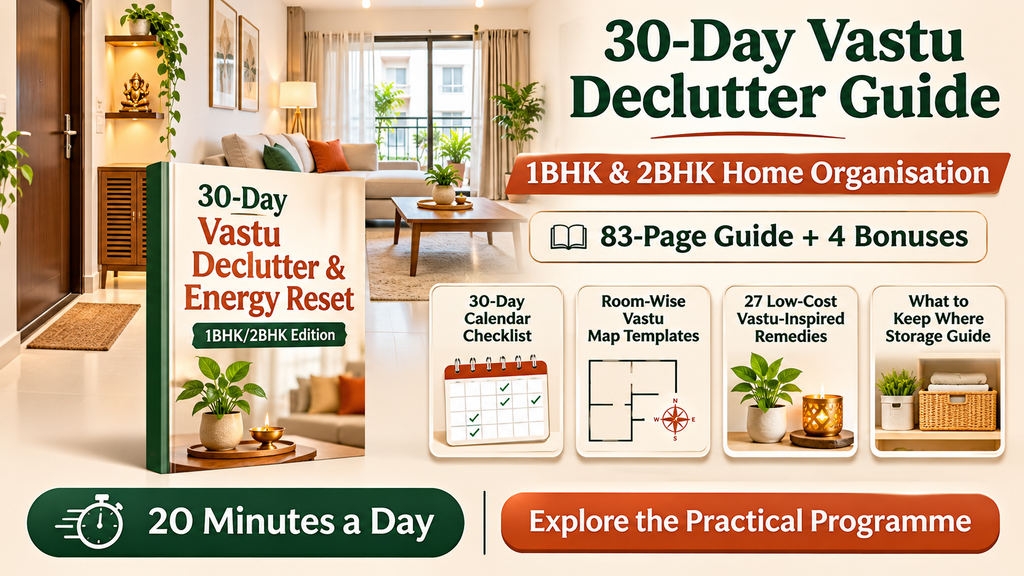
83-Page Digital Guide + 4 Bonus Toolkits | Designed for 1BHK & 2BHK Flats | No Demolition Required
GET THE 30-DAY VASTU DECLUTTER GUIDE →
Is Your Home Feeling Cluttered, Crowded, or Difficult to Organise?
A home should be a place where you can relax, spend time with family, and enjoy everyday life.
But in many Indian apartments, especially compact 1BHK and 2BHK flats, keeping everything organised can feel like a never-ending task.
Shoes accumulate near the main entrance. Kitchen cabinets overflow with old containers. Wardrobes become packed with clothes you rarely wear. Unused belongings take over the space under your bed.
Even when you clean regularly, the house may still feel crowded.
And if you’re interested in Vastu Shastra, you might also wonder whether the arrangement of furniture, storage, and everyday household objects follows traditional Vastu principles.
The good news? You don’t necessarily need expensive renovations, major construction changes, or a bigger home to improve the way your living space functions.
Sometimes, a practical decluttering routine is the best place to begin.
That’s why we created the 30-Day Vastu Declutter & Energy Reset — 1BHK/2BHK Edition.
This 83-page digital guide combines everyday home organisation with traditional Vastu-inspired suggestions, helping you work through your apartment one manageable task at a time.
Instead of attempting to reorganise your entire home in one exhausting weekend, you follow a simple, structured 30-day plan.
Just 20 minutes a day.
One small area at a time.
One more organised home.
START YOUR 30-DAY HOME RESET →
What Is a Vastu Declutter and Energy Reset?
Vastu Shastra is a traditional Indian system concerned with the arrangement and use of spaces, directions, and the relationship between built environments and the five elements.
In traditional Vastu, different directions are associated with particular qualities and activities.
For example:
- North-East (Ishanya): Traditionally associated with clarity, prayer, and contemplation.
- South-East (Agneya): Associated with the fire element and commonly discussed in relation to kitchens.
- South-West (Nairutya): Traditionally associated with stability and grounding.
- North-West (Vayavya): Associated with movement and change.
- Centre (Brahmasthan): Often discussed as an important area for openness and circulation.
These are traditional interpretations rather than scientifically established laws governing health, luck, or financial outcomes.
A Vastu-inspired decluttering routine applies these ideas to ordinary household decisions while prioritising hygiene, comfort, safety, and practical storage.
For instance, you might clear the entrance, reorganise a cluttered kitchen cupboard, remove broken household items, or make your bedroom easier to maintain.
The purpose is simple: create a home that feels more orderly, comfortable, and manageable while respecting your interest in traditional Vastu principles.
Why Decluttering Matters in Small Indian Flats
Most modern apartments have limited storage space.
A 1BHK might accommodate a family, a home office, several storage cabinets, and daily household essentials in just a few rooms.
A 2BHK offers more space, but it can also collect more belongings over time.
Common challenges include:
- Overloaded kitchen lofts and cupboards
- Shoe racks blocking the entrance
- Unused items hidden under beds
- Crowded balconies and utility areas
- Piles of paperwork and old electronics
- Wardrobes full of unworn clothing
- Difficult-to-clean corners
- Household items stored without a clear system
Clutter can make everyday cleaning, finding belongings, and moving around your home more difficult.
A realistic decluttering plan can help reduce these frustrations by giving each area a clear purpose.
However, knowing what to organise is only part of the challenge.
The bigger question is: where should you start, and how can you maintain your progress?
That’s where a structured 30-day programme becomes useful.
Introducing the 30-Day Vastu Declutter & Energy Reset
The 30-Day Vastu Declutter & Energy Reset — 1BHK/2BHK Edition is a practical digital guide created for people who want to improve their living spaces without spending heavily on furniture, renovations, or Vastu consultations.
The guide follows a simple principle:
20 minutes a day × 30 days = a more manageable approach to decluttering your home.
Each daily session is divided into manageable time blocks:
- Minutes 0–5: Assess the area and prepare.
- Minutes 5–15: Complete the main decluttering activity.
- Minutes 15–20: Reorganise, clean up, and review your progress.
The programme takes you through four phases, covering important spaces and common storage challenges in Indian homes.
It also includes recommendations for rented flats, where permanent structural changes may not be possible.
What You Receive
Your digital package includes:
1. An 83-page main guide
A structured resource covering Vastu-inspired home organisation, a 30-day action plan, and maintenance routines.
2. Four bonus toolkits
Printable checklists, directional reference maps, budget-friendly suggestions, and practical household storage guidance.
3. Apartment-friendly recommendations
Designed around the realities of modern 1BHK and 2BHK flats, including rental properties and builder-designed layouts.
4. Small, achievable daily tasks
A guided programme intended to fit into a busy household routine.
EXPLORE THE COMPLETE DIGITAL PACKAGE →
Your 30-Day Vastu Decluttering Journey: What Happens Each Week?
The programme is organised into four distinct phases, so you always know which area deserves your attention.
Phase 1: Days 1–7 — Clarity and Fresh Beginnings
Focus: Main entrance, living room, and North-East corner
Your entrance is the first space you encounter when returning home.
If shoes, packages, bags, or other items accumulate near the door, the entrance can quickly become inconvenient.
Traditional Vastu also places importance on the main entrance and North-East direction.
During the first seven days, the programme focuses on creating a more organised beginning to your home.
Activities include reviewing entrance clutter, organising frequently used living-room items, and inspecting the North-East area.
A simple example: Start by removing unnecessary items from your shoe rack. Separate regularly used footwear from pairs that need cleaning, repair, donation, or disposal.
Keep the passage clear and ensure the door can open fully.
These small steps make the entrance easier to use without requiring structural modifications.
Phase 2: Days 8–15 — Kitchen Organisation and the Fire Element
Focus: Kitchen, South-East zone, lofts, refrigerator, and cooking area
The kitchen is one of the busiest parts of an Indian home.
Between daily cooking, grocery storage, utensils, spices, and appliances, cupboards can become crowded surprisingly quickly.
In traditional Vastu, the South-East is associated with Agni, the fire element.
The guide explores this association alongside practical kitchen organisation.
During this phase, you work through storage areas, review unused containers, and look at the arrangement of kitchen essentials.
A simple example: Choose one kitchen shelf and remove everything from it.
Check containers for damage, sort usable items, clean the shelf, and arrange frequently used essentials where they are easy to reach.
Always follow appliance ventilation and fire-safety requirements. There is no need to reposition heavy or fixed appliances simply to follow a directional preference.
Phase 3: Days 16–23 — Bedroom Comfort and Stability
Focus: South-West zone, bedroom, wardrobe, and under-bed storage
A bedroom should be comfortable, easy to maintain, and suitable for rest.
Yet it often becomes an unofficial storage room for luggage, old clothing, paperwork, and items that don’t have a designated location.
Traditional Vastu associates the South-West with stability.
The third phase uses this as a theme for organising bedrooms, wardrobes, and personal belongings.
You’ll explore practical decisions about what to keep, relocate, donate, or discard.
A simple example: Review clothing that has not been used for a year.
Decide which garments remain useful, which need repair, and which can be donated.
If you use under-bed storage, keep the area clean, dry, and organised rather than automatically treating all storage beneath the bed as harmful.
The goal is to create a more comfortable and manageable sleeping space.
Phase 4: Days 24–30 — Flow, Maintenance, and Completion
Focus: North-West area, bathrooms, remaining clutter, and long-term habits
The final phase brings the programme together.
You review spaces that may have received less attention, including bathrooms, utility corners, and secondary storage areas.
Traditional North-West Vastu associations are introduced alongside ordinary cleaning and organisational activities.
The guide also discusses optional traditional observances associated with Amavasya and Lakshmi.
These cultural and spiritual practices can be approached according to personal beliefs; they are not requirements for successful decluttering.
By Day 30, the aim is to establish a practical system that can continue beyond the programme.
Remember: a home reset is not about creating a perfectly arranged house. It’s about making daily life easier.
Get 4 Practical Bonus Toolkits Along With the Main Guide
The package includes four additional resources designed to help you apply and maintain what you learn.
Bonus 1: Printable 30-Day Calendar Checklist
Stay organised throughout the programme.
Following a 30-day routine is easier when you have a simple way to track progress.
This printable calendar provides a visual reminder of your daily tasks.
Keep it on your refrigerator, noticeboard, or inside your household planner.
Mark completed activities and keep track of what still needs attention.
Bonus 2: Room-Wise Vastu Map Templates
Understand directional references for different flat layouts.
Many apartment owners and tenants are unsure how traditional Vastu directions apply to their homes.
The bonus includes room-wise map templates for East-, West-, and North-facing layouts.
Use these as general references when reviewing the placement and organisation of household objects.
Remember that the actual directions of your flat must be established accurately. A template cannot replace a correctly oriented floor plan.
Bonus 3: 27 Low-Cost Vastu-Inspired Remedies Without Demolition
Explore budget-friendly changes for everyday apartment living.
Not every traditional Vastu suggestion is practical in a modern flat.
This bonus focuses on 27 low-cost recommendations, presented with an emphasis on simple adjustments rather than structural work.
The toolkit is particularly relevant for tenants and people who cannot alter walls or fixed room layouts.
The suggestions are described as costing under ₹200 each, although actual expenses depend on what you already own and local prices.
Bonus 4: What to Keep Where — Household Storage Guide
Make everyday organisation decisions simpler.
Where should you store cleaning supplies?
How can you organise steel, plastic, and glass household items?
What should you consider when placing a broom, dustbin, or prayer items?
This bonus discusses common storage questions and provides room-wise reference guidance.
Use the ideas alongside your household’s space constraints, safety requirements, and personal preferences.
GET THE 83-PAGE GUIDE + ALL 4 BONUS TOOLKITS →
Who Is This Guide Designed For?
This guide may be especially useful for:
1BHK apartment owners: People looking to organise compact living spaces with limited storage.
2BHK families: Households managing belongings across bedrooms, living areas, kitchens, and utility spaces.
People living in rented flats: Tenants interested in practical adjustments without knocking down walls or modifying permanent structures.
Busy working professionals: Individuals who prefer short daily tasks instead of spending an entire weekend decluttering.
New homeowners: People planning their storage systems while settling into a recently purchased apartment.
Vastu enthusiasts: Readers who want to explore traditional Vastu concepts through everyday home organisation rather than extensive renovations.
You do not need advanced knowledge of Vastu Shastra to begin.
What Makes This Guide Different From a General Vastu Book?
Traditional Vastu books often discuss ideal room locations, building orientation, architectural planning, and directional principles.
These can be interesting, but many recommendations are difficult to apply after a flat has already been constructed.
A family living in a rented apartment cannot simply relocate the kitchen, bathroom, or entrance.
This programme takes a different approach.
It starts with the home you already have.
Instead of concentrating on major structural alterations, it focuses on actions you can realistically take, such as improving storage, clearing walkways, reviewing unused belongings, and creating repeatable routines.
| Typical Vastu Reference Book | 30-Day Vastu Declutter Guide |
|---|---|
| General principles and directions | Day-by-day practical activities |
| May discuss ideal building layouts | Focuses on existing 1BHK/2BHK flats |
| Often requires reader interpretation | Organised into 20-minute sessions |
| May discuss structural placement | Emphasises non-demolition adjustments |
| Primarily for reading and reference | Includes printable tracking resources |
The programme doesn’t promise to correct every architectural Vastu concern.
Its value is in helping you organise your home using a structured, Vastu-inspired approach.
Can You Follow This Programme in a Rented Apartment?
Yes. The programme is designed with renters in mind.
Many tenants have no permission to alter walls, plumbing, kitchen platforms, or electrical installations.
Fortunately, ordinary decluttering does not require such changes.
You can often improve a rented apartment by reorganising shelves, removing unwanted items, clearing circulation paths, and maintaining clean storage areas.
For example, if a bathroom is located in the North-East of your flat, you don’t need to assume that demolition is necessary.
Focus first on ventilation, cleaning, drainage, and practical maintenance. Treat optional traditional recommendations as cultural preferences, not guaranteed solutions to architectural concerns.
You should always obtain the property owner’s permission before making permanent modifications.
A Simple 20-Minute Decluttering Activity You Can Try Today
Before beginning the complete programme, try this short activity near your main entrance.
Minutes 0–5: Observe
Look at your entrance from both inside and outside the home.
Identify objects that obstruct movement or make the area harder to clean.
Minutes 5–15: Sort
Gather loose footwear, shopping bags, old deliveries, and other misplaced belongings.
Return frequently used items to their designated locations.
Separate things that require disposal, donation, or repair.
Minutes 15–20: Reset
Wipe surfaces, arrange essential belongings, and check that the entrance remains easy to use.
Avoid placing storage objects where they obstruct emergency access.
This is a small example of the practical approach used throughout the 30-day programme.
Imagine applying a similar method to the kitchen, wardrobe, bedroom, living room, and utility areas over an entire month.
Instead of asking yourself, “How will I organise my whole house?”, you simply concentrate on today’s task.
How to Maintain Your Home After the 30 Days
The programme also introduces a practical maintenance routine.
10 minutes daily: Return misplaced items, clear frequently used surfaces, and check priority areas.
One hour weekly: Review shelves, wardrobe spaces, kitchen storage, and household items that require attention.
You can adapt these routines according to your household size, schedule, and physical ability.
A successful home organisation system is one that you can maintain realistically.
Frequently Asked Questions
1. Is this guide suitable for both 1BHK and 2BHK flats?
Yes. It has been developed specifically for common storage and organisation challenges in 1BHK and 2BHK Indian apartments.
2. Do I need to consult a Vastu expert before using it?
No. The guide is intended for general self-guided home organisation and an introduction to traditional Vastu-inspired ideas. Complex architectural or structural questions may require appropriately qualified professional advice.
3. How much time do I need every day?
The programme is structured around approximately 20 minutes per day. Some tasks may take longer depending on the amount of clutter in your home.
4. Will I need to break walls or renovate my flat?
No. The programme focuses on non-demolition approaches, practical organisation, and simple household adjustments.
5. Is it useful for West-facing or East-facing flats?
Yes. The guide is intended for flats with different orientations, and the bonus map templates include East-, West-, and North-facing examples.
6. Does the guide include kitchen and bedroom organisation?
Yes. The 30-day plan includes kitchen storage, lofts, wardrobes, bedrooms, under-bed areas, and other everyday household spaces.
7. What exactly is included in the purchase?
The package is advertised as an 83-page main guide plus four bonus toolkits: a printable calendar, room-wise map templates, 27 budget-friendly remedies, and a household storage reference.
8. Can I follow the plan if my flat has Vastu-related limitations?
Yes. The programme is designed for existing apartments, including those with fixed bathrooms, kitchens, and entrances. It cannot change structural features, but it can help you explore practical ways to organise the space.
9. Will the programme bring wealth, good luck, or guaranteed positive energy?
No such outcomes can be guaranteed. Traditional Vastu associates particular arrangements with symbolic qualities, but there is no reliable scientific basis for promising financial, health, or supernatural results from decluttering. The practical objective is a cleaner, more organised, and easier-to-manage home.
10. Is this a physical book or a digital product?
This is a digital guide with accompanying bonus toolkits, not a printed book. Check the checkout page for the currently available delivery and access details.
Begin Your 30-Day Vastu-Inspired Home Reset
A more organised home doesn’t have to begin with expensive furniture, complex renovations, or a complete change to your daily routine.
It can begin with one shelf.
One cupboard.
One corner.
And just 20 minutes of focused attention.
The 30-Day Vastu Declutter & Energy Reset — 1BHK/2BHK Edition provides a structured way to bring these small actions together.
With an 83-page main guide, a 30-day activity plan, and four supporting toolkits, you’ll have a practical resource to refer to as you organise your apartment.
Your Digital Package Includes
- 83-page Vastu Declutter & Energy Reset Guide
- Complete 30-Day Room-by-Room Action Plan
- Printable 30-Day Calendar Checklist
- Room-Wise Vastu Map Templates
- 27 Low-Cost Vastu-Inspired Remedies
- What to Keep Where — Household Storage Guide
Designed for modern Indian apartments. Suitable for homeowners and renters. No demolition required.
Ready to Begin?
BUY NOW — GET THE 30-DAY VASTU DECLUTTER GUIDE + 4 BONUSES
The purchase link opens our SuperProfile product page.
About VastuDharma
VastuDharma.com explores traditional Indian Vastu concepts and practical ways to apply them thoughtfully in modern homes.
Our aim is to make home organisation and Vastu-inspired living easier to understand for apartment owners, tenants, and families.
Disclaimer: Vastu Shastra is a traditional cultural system. The advice in this guide is intended for informational, organisational, and personal-interest purposes. It does not guarantee changes in wealth, health, relationships, fortune, or other life outcomes. Always prioritise building safety, hygiene, and professional advice where appropriate.