
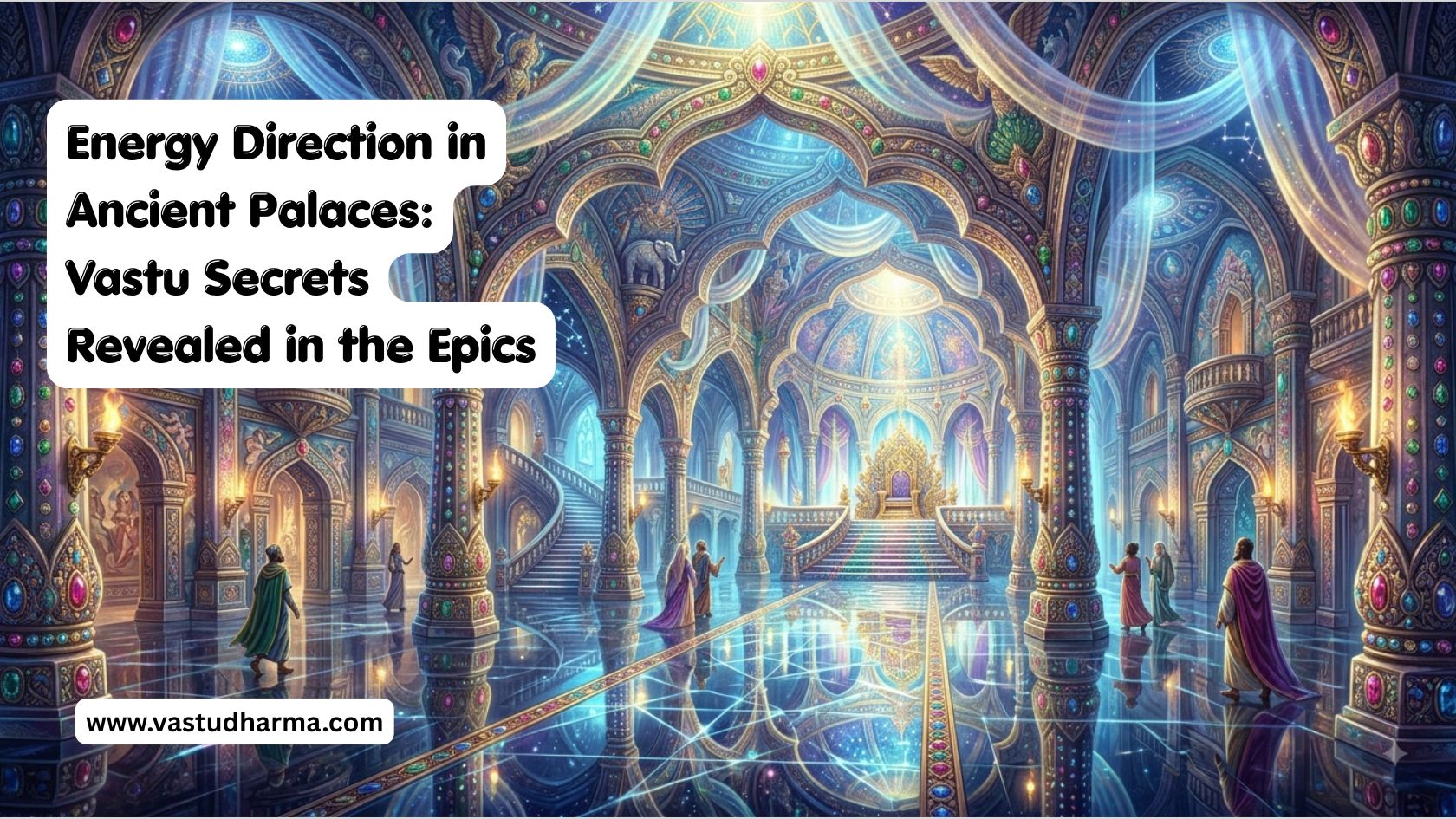
Most Vastu Shastra content explains the eight directions in the abstract — a diagram, a list of deities, a rule about which room goes where. What’s less commonly discussed is that the two great Indian epics, the Ramayana and the Mahabharata, contain some of the most vivid palace descriptions in classical literature, and at least one of them comes bundled with a legend explicitly about a directional flaw and its consequences.
This article looks at three palaces across the epics — Ayodhya, Indraprastha’s Maya Sabha, and briefly, Ravana’s Lanka — through the lens of directional energy: the eight-direction framework (Ashta Dikpala) that underlies Vastu Shastra. The goal isn’t to claim the epics are Vastu manuals. It’s to show that the same instinct for treating direction as meaningful — not neutral, not arbitrary — runs through this literature, and to extract what’s genuinely useful from it for a modern home.
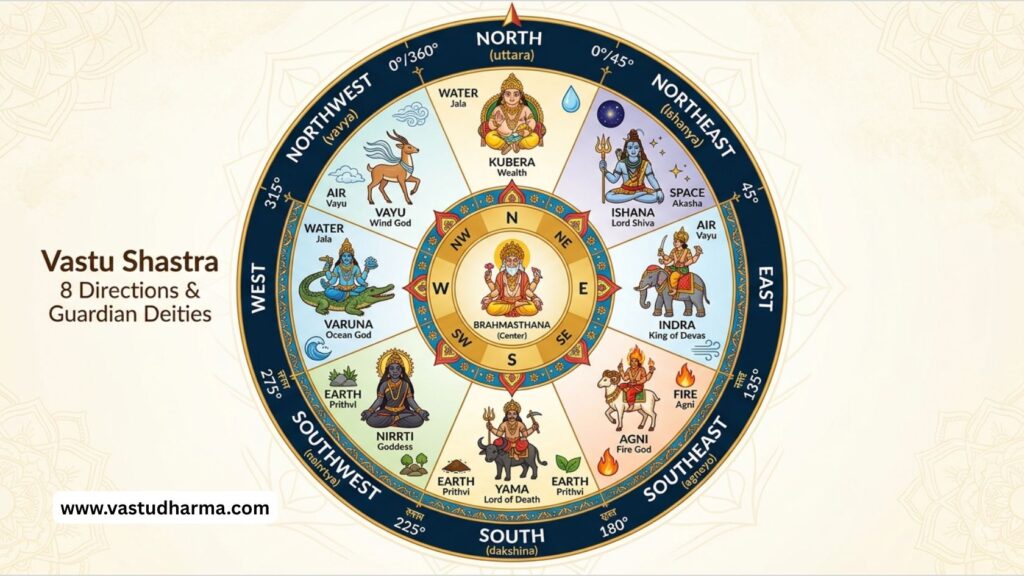
In Vastu Shastra, each of the eight directions is governed by a guardian deity (an Ashta Dikpala) associated with a specific element and quality — Indra in the east (energy, growth), Agni in the southeast (fire), Yama in the south (discipline, mortality), Nirriti in the southwest (stability, ancestry), Varuna in the west (water, introspection), Vayu in the northwest (movement, air), Kubera in the north (wealth), and Ishana in the northeast (wisdom, clarity). The epics reflect this same directional thinking in their palace descriptions: Ayodhya’s fortified, multi-gated design; the Maya Sabha’s dazzling but centrally flawed layout, where a water feature placed in the Brahmasthan is popularly linked to the discord that led to the Mahabharata war; and Lanka’s wealth without the same disciplined structure. The throughline across all three: direction and center matter, and getting the center wrong outweighs almost any other flaw.
The Eight Directions: The Energy Grid Behind Every Epic Palace
Before looking at specific palaces, it helps to have the directional framework itself clearly in view, since it’s the lens the rest of this article uses.
| Direction | Guardian (Dikpala) | Associated Element/Quality | Traditional Vastu Placement |
|---|---|---|---|
| East | Indra | Growth, energy, the rising sun | Main entrances, living areas |
| Southeast | Agni | Fire | Kitchen |
| South | Yama | Discipline, boundaries | Less-used rooms, storage |
| Southwest | Nirriti | Stability, earth, ancestry | Master bedroom |
| West | Varuna | Water, introspection | Dining areas, bathrooms |
| Northwest | Vayu | Air, movement | Guest rooms |
| North | Kubera | Wealth | Cash/valuables storage, treasury |
| Northeast | Ishana | Wisdom, clarity, water | Prayer room, meditation space |
This eight-direction system, layered onto the Vastu Purusha Mandala grid with the Brahmasthan at its center, is the underlying structure that Vastu Shastra applies to everything from a single room to an entire city. It’s this same structure — direction as meaningful, center as sacred — that shows up, in narrative form, across the epics.
Three Palaces, Three Directional Stories
Ayodhya: Direction as Discipline
Ayodhya’s description in the Valmiki Ramayana, covered in more depth in our companion article on [Vastu principles from Ayodhya], emphasizes fortified gates positioned deliberately around the city, a central royal road, and functional zoning by community. The directional logic here is disciplined rather than dazzling — gates, walls, and roads oriented with clear intent, reflecting the eastern, growth-oriented energy of Indra’s domain and the orderly, boundary-respecting quality of Yama’s south. Nothing about Ayodhya’s description suggests spectacle for its own sake; the emphasis throughout is order, proportion, and protection.
Indraprastha’s Maya Sabha: Direction as Spectacle — and Its Cost
The Mahabharata’s Sabha Parva describes something very different: a palace built not by human architects but by Mayasura, an asura craftsman, at Krishna’s request, for the Pandava king Yudhishthira. The Maya Sabha is famous for its illusions — floors polished to look like still water, and a pool so convincingly disguised as solid ground that Duryodhana, visiting the palace, stepped into it and fell in, fully clothed, in front of the assembled court. Draupadi’s laughter at that moment is traditionally cited as one of the humiliations that hardened Duryodhana’s resentment toward the Pandavas, feeding the chain of events that led to the Kurukshetra war.
What’s less widely told outside Vastu circles is a popular directional reading of that same episode: that the palace’s most consequential flaw wasn’t the illusion itself, but where it was placed. In this reading, the water feature sat at or near the Brahmasthan — the geometric and energetic center of the plot, which Vastu Shastra treats as sacred and requires to be kept open, still, and undisturbed. Water at the center, rather than water contained appropriately toward the northeast, is considered one of the more serious Vastu doshas (flaws) a structure can carry, since it destabilizes the entire energetic balance of the space rather than affecting one zone alone. Popular retellings connect this specific flaw to the discord that unfolded from that palace — not as a scientifically verifiable claim, but as a widely repeated moral-architectural legend within Vastu tradition.
Worth stating plainly: the Mahabharata’s own text does not use Vastu terminology or explicitly name the palace’s water feature as a “Brahmasthan flaw” — that specific framing comes from later Vastu-tradition retellings and popular Vastu literature, not from the Sanskrit epic itself. It’s included here because it’s a genuinely significant and widely circulated part of Vastu folklore, not because it’s presented as literal historical fact. Readers deserve that distinction clearly stated.
Lanka: Wealth Without the Same Directional Discipline
Ravana’s Lanka, as described across the Ramayana, is a city of extraordinary wealth — golden buildings, abundant treasure, powerful fortifications. What’s comparatively absent from its description, relative to Ayodhya, is the same emphasis on disciplined zoning, humble center, and functional order. Lanka reads as opulent and formidable, but not as an example of restraint or balance the way Ayodhya does. Vastu tradition’s broader teaching here isn’t that Lanka was “badly built” in an engineering sense — the epic describes it as a marvel — but that wealth and grandeur without directional and energetic discipline is, in the tradition’s own moral logic, unstable rather than lasting.
The Maya Sabha’s Brahmasthan Lesson, in Plain Terms
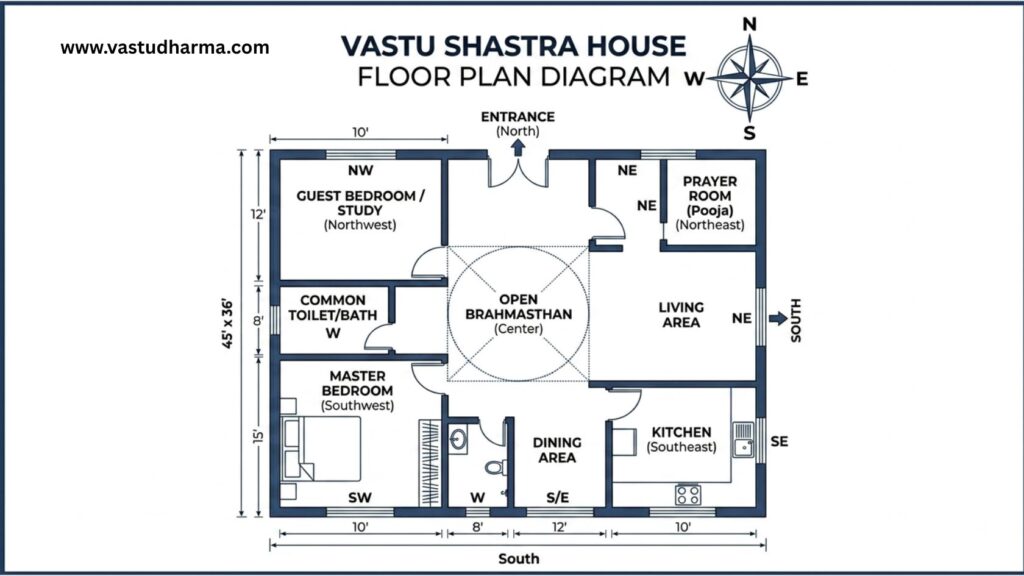
Strip away the epic drama, and the practical Vastu teaching behind the Maya Sabha legend is simple and genuinely useful: the center of a home or plot is not a place for surprises. Whatever specific form it takes — a water feature, a heavy structural element, a staircase, a toilet — placing something disruptive or ill-suited at the Brahmasthan is considered to unsettle the whole space, not just that one corner. The epics dramatize this idea; modern Vastu practice operationalizes it as one of its most consistently repeated rules.
Applying Directional Energy Principles to a Modern Home
- Keep the center (Brahmasthan) open and calm. No heavy furniture, no water features, no staircases or toilets positioned there — echoing the Maya Sabha’s cautionary legend.
- Place water intentionally, not decoratively. Water features belong in the northeast (Ishana’s domain), where they’re considered to support clarity and calm — not in the center or in the south.
- Let the east and northeast carry your “growth” spaces. Main entrances, living rooms, and prayer or study corners benefit from Indra’s and Ishana’s energy — echoing Ayodhya’s eastward-oriented order.
- Give the southwest weight and stability. The master bedroom and heavier storage traditionally sit here, under Nirriti’s domain — the anchor of the home.
- Reserve the north for wealth-related items. Cash, valuables, and lockers are traditionally placed here, in Kubera’s domain.
- Don’t let grandeur substitute for balance. Lanka’s lesson isn’t “avoid beauty” — it’s that scale and wealth don’t compensate for poor directional discipline.
Common Mistakes When Reading Vastu Into Epic Architecture
- Presenting the Maya Sabha’s “Brahmasthan flaw” as a direct quote from the Mahabharata. It isn’t — it’s a later, widely circulated Vastu-tradition interpretation of the episode, and should always be labeled as such.
- Treating Lanka’s wealth as a Vastu “failure” in an engineering sense. The epic describes Lanka as architecturally magnificent; the point is a moral-energetic one about balance, not a claim that it was poorly constructed.
- Assuming every Ashta Dikpala association is stated explicitly in the epics. The eight-direction deity system is a broader Vastu Shastra and Puranic framework, applied here as a lens for reading the epics — not something the epics lay out as a checklist themselves.
- Ignoring textual variation. As with Ayodhya, different Mahabharata translations and regional retellings vary in detail, especially around the Maya Sabha episode; treat specifics as traditional rather than singularly fixed.
Conclusion
Read carefully, the epics aren’t Vastu manuals, but they are something almost as valuable: stories that take direction and center seriously enough to build drama around them. Ayodhya shows what disciplined, eastward-facing order looks like at city scale. The Maya Sabha shows, through one of literature’s most consequential pranks, why the center of a space is never just another corner. And Lanka shows that wealth alone was never, in this tradition’s own logic, the same thing as balance. The eight directions the epics gesture toward are the same ones a modern Vastu consultation still works from today — proof that this isn’t a modern invention layered onto old stories, but a genuinely old way of thinking about space that the stories themselves were already steeped in.
Frequently Asked Questions (FAQs)
Did the Mahabharata really cause the Kurukshetra war because of a Vastu flaw?
No single flaw “caused” the war — the epic describes a long chain of political, personal, and dharmic conflicts. The idea that the Maya Sabha’s water feature, placed near the Brahmasthan, contributed to the discord that led to war is a popular Vastu-tradition interpretation layered onto the episode, not a claim made explicitly in the Sanskrit text itself.
What is the Brahmasthan and why is it so important in this story?
The Brahmasthan is the geometric and energetic center of a Vastu-planned space. Vastu Shastra treats it as the most sensitive zone in any layout, meant to stay open and undisturbed. The Maya Sabha legend is popularly used in Vastu teaching precisely because it dramatizes what’s said to happen when that principle is ignored.
Who built the Maya Sabha?
Mayasura (Maya), an asura architect, built it for Yudhishthira at Krishna’s request, after Arjuna spared his life during the burning of the Khandava forest.
What are the Ashta Dikpalas?
The eight guardian deities of the cardinal and intercardinal directions in Hindu cosmology — Indra (east), Agni (southeast), Yama (south), Nirriti (southwest), Varuna (west), Vayu (northwest), Kubera (north), and Ishana (northeast) — who form the traditional basis of directional placement in Vastu Shastra.
Is Ravana’s Lanka considered bad Vastu?
The Ramayana describes Lanka as an architecturally magnificent, wealthy city — not as poorly built. The point this article draws from it is a moral one within Vastu tradition: grandeur and wealth aren’t treated as substitutes for the same directional discipline and centered balance seen in Ayodhya.
Can I apply “epic” Vastu principles to a small apartment?
Yes. The scale changes, but the logic doesn’t — keep your unit’s geometric center clear, place water and prayer spaces toward the northeast, keep heavier storage toward the southwest, and avoid placing significant fixtures like a toilet directly at the center of the floor plan.
Is there historical or archaeological evidence for these palace descriptions?
That’s a separate and actively debated question that this article doesn’t attempt to resolve. The focus here is the textual description in the epics and its conceptual relationship to Vastu Shastra’s directional framework, not a claim about physical, verifiable structures.
Why does the northeast direction come up so often in Vastu guidance?
The northeast (Ishana’s domain) is associated with water, clarity, and spiritual energy, and receives the earliest morning sunlight — a combination that traditional Vastu treats as the most auspicious direction for prayer rooms, study spaces, and open water features.