
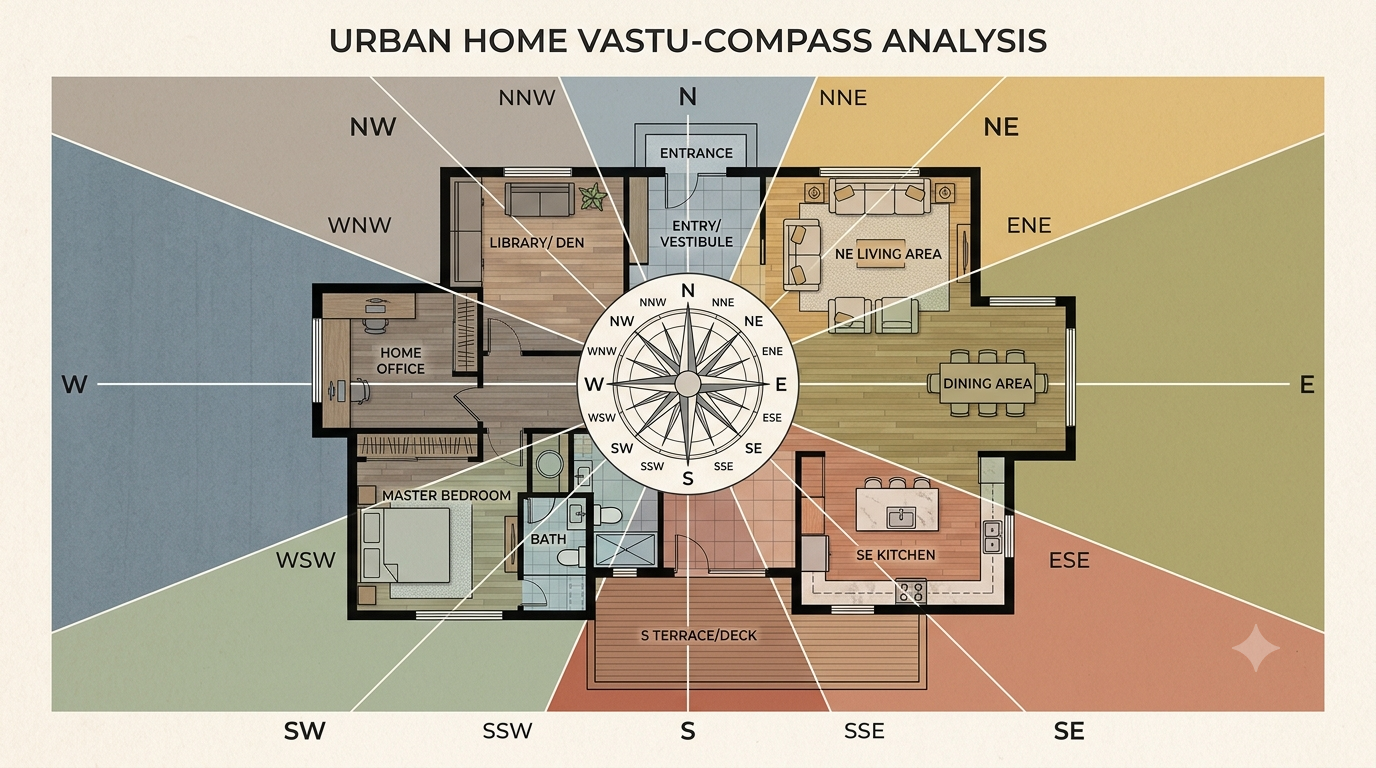
You’ve probably heard that the northeast is good for a prayer room and the southwest is best for the master bedroom. That’s the beginner version. Most people stop at eight directions — North, South, East, West, and the four corners — and assume that’s the whole map. It isn’t. Classical Vastu Shastra actually works with 16 zones, and once you understand them, vague advice like “keep the northeast open” turns into something far more specific and useful for your actual floor plan.
This guide breaks down all 16 zones, what each one governs, and how to apply that to a real home — including apartments where you can’t move a single wall.
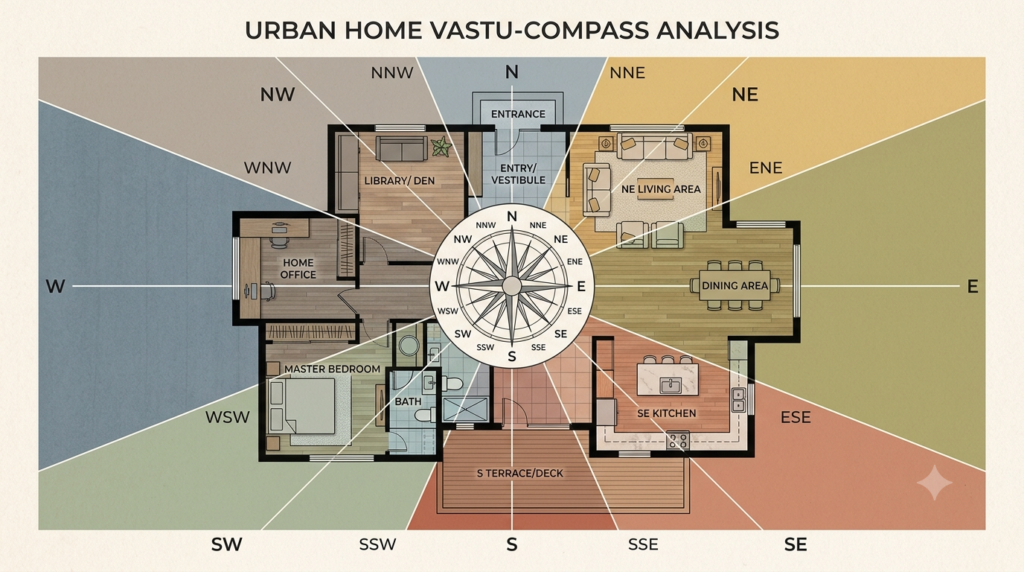
What the 16 Zone System Actually Means
The 16-zone model comes from the Vastu Purusha Mandala, the traditional grid used to map cosmic and elemental energy onto a physical plot. Where the commonly-cited “8 directions” cover North, South, East, West, and the four diagonal corners, the 16-zone system splits each of those eight into two, giving a much finer-grained map — each zone spanning roughly 22.5 degrees of the compass.
The four sub-divided directions look like this:
- North splits into North-by-Northwest and North-by-Northeast
- East splits into East-by-Northeast and East-by-Southeast
- South splits into South-by-Southeast and South-by-Southwest
- West splits into West-by-Southwest and West-by-Northwest
Each of the 16 zones is treated as a blend of the two energies on either side of it — a sub-zone between North and Northeast, for example, carries characteristics of both. This is what makes the 16-zone system more precise than the basic 8-direction version: it accounts for the fact that a room rarely sits neatly inside one direction, and gives a more accurate read on mixed-influence areas.
The 16 Vastu Zones, One by One
North (Uttar) — Wealth & Career Flow
Ruled traditionally by Kubera, the deity of wealth. This zone governs income, cash flow, career opportunities, and networking. It responds well to open space, light, and minimal weight — and reacts badly to clutter or heavy storage, which is traditionally linked to financial stagnation.
North-Northeast (N-NE)
A transition zone blending North’s wealth energy with Northeast’s clarity energy. It’s associated with financial decision-making and long-term planning. Best kept light and uncluttered — avoid heavy furniture or a toilet here.
Northeast (Ishanya) — Wisdom, Clarity & Spirituality
Considered the most sacred zone in the home, ruled by Ishanya (associated with Shiva) and linked to water energy. It governs mental clarity, spiritual practice, and overall positive flow into the house. This is the traditional spot for a prayer room or meditation corner — and the zone most guides warn against filling with a kitchen, toilet, or storeroom.
East-Northeast (E-NE)
Blends Northeast’s clarity with East’s vitality. Associated with new beginnings, learning, and fresh starts — a reasonable spot for a study corner or a child’s desk.
East (Purva) — Health, Growth & New Opportunities
Ruled by Indra, associated with the rising sun and vitality. This zone governs health, opportunity, and social growth. It benefits from large windows and morning light — a favored placement for living rooms and main entrances in many traditional layouts.
East-Southeast (E-SE)
A blend of East’s growth energy and Southeast’s fire element. Linked to creative energy and short-term financial matters — workable for a home office or hobby room.
Southeast (Agneya) — Fire, Energy & Finances
Ruled by Agni, the fire deity, this zone governs energy, digestion, and financial transactions. It’s the traditional placement for the kitchen, since fire-related activity is considered to belong here rather than in water-associated zones like the northeast.
South-Southeast (S-SE)
Blends Southeast’s fire energy with South’s stability. Associated with drive and ambition — reasonably suited to a home gym or an active workspace.
South (Yama) — Stability, Discipline & Recognition
Ruled by Yama, associated with structure and discipline. This zone governs authority, recognition, and grounded stability. Traditionally considered suitable for heavier storage and solid furniture, since South is treated as a naturally “weighted” direction.
South-Southwest (S-SW)
A blend of South’s stability and Southwest’s grounding earth energy. Associated with long-term security — a reasonable location for storage or a study.
Southwest (Nairutya) — Stability, Relationships & Rest
Ruled by Nairutya, linked to the earth element. This is the zone most strongly associated with the master bedroom, since it governs stability, restful sleep, and the health of the head of the household. It’s traditionally kept as the heaviest, most solid part of the home — the opposite treatment from the light, open northeast.
West-Southwest (W-SW)
Blends Southwest’s grounding energy with West’s introspective quality. Linked to savings and accumulated resources — suitable for a study or a secondary storage area.
West (Varuna) — Gains, Social Life & Reflection
Ruled by Varuna, associated with water and reflection. This zone governs social relationships, gains from effort, and children’s growth. It’s often considered a favorable direction for a children’s bedroom or a dining area.
West-Northwest (W-NW)
A blend of West’s social energy and Northwest’s movement quality. Associated with support systems and helpful relationships — workable for a guest room.
Northwest (Vayavya) — Movement, Support & Relationships
Ruled by Vayu, the air deity. This zone governs movement, travel, networking, and supportive relationships. It’s traditionally considered a favorable placement for a guest room, since Vayu’s mobile energy is thought to suit temporary occupants well.
North-Northwest (N-NW)
Blends Northwest’s mobility with North’s wealth energy. Associated with fluctuating income or short-term financial movement — best kept clutter-free, similar to North itself.
Common Mistakes People Make With the 16-Zone System
- Applying only the 8-direction model to a home with irregular angles, missing the more precise sub-zone read that would actually explain a persistent “off” feeling in a specific corner.
- Treating every sub-zone as identical to its parent direction, when it’s really a blend — a room in North-Northeast doesn’t behave exactly like a room in true North.
- Placing heavy, static furniture in light zones (North, Northeast, East) or, conversely, keeping the Southwest too open and empty when it’s meant to be the most grounded part of the home.
- Ignoring the transition zones (the “in-between” eight) entirely, when they often explain why a nearby correction in the main direction hasn’t fully worked.
- Trying to force an exact 16-zone layout onto an already-built home instead of using the map diagnostically — to explain patterns — and applying portable remedies where structural change isn’t realistic.
Do’s and Don’ts by Zone Type
| Zone Type | Do | Don’t |
|---|---|---|
| Light zones (N, NE, E) | Keep open, bright, minimal furniture | Fill with heavy storage or a toilet |
| Fire zones (SE) | Place the kitchen or active workspaces here | Place a water feature directly in this zone |
| Grounded zones (S, SW) | Use for the master bedroom, heavy storage | Leave completely empty or overly light |
| Transition zones (all “sub” directions) | Match furnishing to the blended energy of both neighbors | Assume they behave exactly like the nearest main direction |
Modern Adaptations for Apartments & Odd-Shaped Homes
Very few modern apartments are laid out as a perfect square aligned to the compass, which is exactly where the 16-zone system earns its keep — it can explain why a room that “should” work on paper still feels off.
- Irregularly shaped flat? Use a compass app or physical compass at your main door to map the true zones onto your actual floor plan, rather than assuming the “front” of the building faces a cardinal direction.
- Can’t relocate a room that falls in an unfavorable zone? Portable remedies — color, lighting, mirrors, and decluttering — do most of the practical work when structural change isn’t an option.
- Studio or one-room apartment? Even in a single room, you can usually zone activity: keep the northeast corner (or nearest equivalent) clear for calm/study use, and the southwest corner for the bed.
- Uncertain about your exact zone boundaries? A professional Vastu consultation using a proper floor plan and compass reading gives a far more accurate 16-zone map than eyeballing it.
Frequently Asked Questions
What is the difference between 8-direction and 16-direction Vastu?
The 8-direction model covers North, South, East, West, and the four diagonal corners. The 16-direction system splits each of those into two sub-zones, giving a more precise, blended read on areas that fall between two main directions — useful for irregularly shaped homes.
Which Vastu zone is best for the master bedroom?
The Southwest zone is traditionally considered the best location for the master bedroom, since it’s associated with stability, grounding, and restful sleep — particularly important for the head of the household.
Which zone should the kitchen be placed in?
The Southeast zone, ruled by the fire element, is the traditional placement for the kitchen. The Northeast, associated with water energy, is generally considered the least suitable zone for a kitchen.
What does the northeast zone control in Vastu?
The Northeast zone governs mental clarity, spiritual practice, and the overall flow of positive energy into a home. It’s the traditional location for a prayer or meditation space and is generally kept as open and uncluttered as possible.
Can the 16-zone system be applied to an apartment?
Yes. Use a compass at your apartment’s own front door — not the building’s main entrance — to map the 16 zones onto your specific floor plan, then apply portable remedies like color, lighting, and decluttering where structural changes aren’t possible.
Do the sub-zones (like North-Northeast) matter as much as the main 8 directions?
They matter most in homes with irregular shapes or when a main-direction remedy hasn’t fully resolved an issue. Sub-zones represent a blend of the two neighboring main directions, offering a more precise diagnostic tool for advanced Vastu analysis.
Final Thoughts
The 16-zone system isn’t about memorizing sixteen new rules — it’s a more accurate lens for understanding why certain corners of your home consistently feel right, and others don’t, no matter how they’re decorated. Start by identifying just your Northeast, Southeast, and Southwest zones, since these three carry the most weight in day-to-day Vastu practice, and build from there. If your home’s layout is irregular or you’re planning a renovation, a proper floor-plan-based consultation will map all 16 zones far more precisely than a general guide ever can.