
How to Check Vastu Directions in a Flat Using a Compass
Your building gate opens towards the east, your flat’s entrance faces a corridor, and the balcony gets afternoon sunlight. Which one tells you the direction of your home?
This is where many apartment owners get stuck. Before deciding where to place a bed, desk, or pooja shelf, you need a reliable way to identify directions—and a clear understanding of what you are measuring.
Learning how to check Vastu directions starts with separating three questions: which way your entrance faces, where that entrance sits on the plan, and how the rooms are oriented. A compass can help with orientation. It cannot decide whether a home will bring good fortune.
Quick answer: How do you check Vastu directions in a flat?
Using the convention in this guide, your flat’s facing is the direction you look when facing outward through its main entrance. Align your compass with that outward direction, avoid obvious magnetic interference, and compare repeated readings. Separately, orient a floor plan to north to locate rooms and the entrance. Record whether readings use magnetic or true north.
Three different things people mean by “direction”
These terms sound similar, but they answer different questions.
| Term | What it describes | Simple example |
|---|---|---|
| Flat facing | The outward orientation through the main entrance | You look east when facing straight out of the doorway |
| Entrance location | Where the entrance lies within a chosen floor-plan framework | The entrance sits towards the northern part of the plan |
| Room or furniture orientation | A room’s position or the direction a person or object faces | The bedroom is in the west, while the desk user faces north |
A doorway’s facing and location are separate properties. Taking a reading at the centre of your flat does not, by itself, tell you which way the door faces. Likewise, knowing that your entrance faces east does not locate the kitchen.
Modern Vastu guidance does not use one universally agreed apartment-assessment method. Some approaches consider the flat entrance, others also consider the building gate, and detailed assessments may use different grids. This article uses the individual flat’s outward entrance orientation to describe its facing. State that convention when discussing your measurements with anyone else.
What you need before you begin
Keep these ready:
- A physical compass or a phone with a functioning compass sensor and suitable app.
- The compass or phone manufacturer’s operating instructions.
- A floor plan, preferably scaled and carrying a verified north arrow.
- A pencil and somewhere to record readings.
An expensive Vastu instrument is unnecessary for this basic exercise. A phone can be convenient, but installing an app does not guarantee accurate indoor readings. A physical compass can also be disturbed by its surroundings.
If you are working with a brochure plan, confirm that it represents your actual flat. A mirrored or rotated layout can make otherwise careful notes misleading.
How to check your flat’s facing direction with a compass
1. Check the instrument and its settings
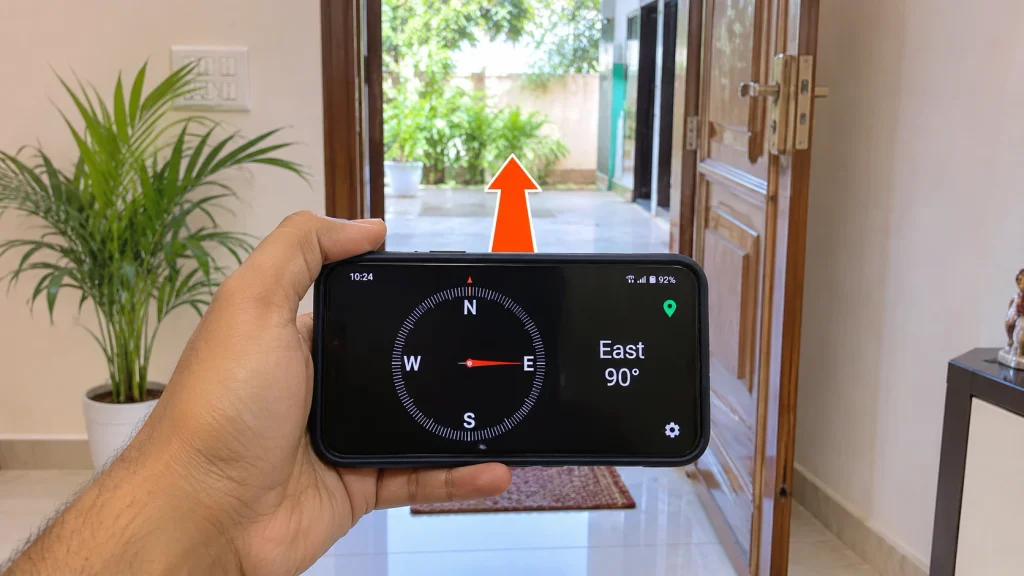
Read the device instructions before measuring. Establish which part of the compass indicates the bearing you are facing.
On many phone compass apps, that is the top edge of the handset. A physical compass may have a direction-of-travel arrow or sighting arrangement. The north-seeking needle identifies magnetic north; it is not automatically the direction you face.
Check whether the app displays magnetic north or true north, where that option exists. Record the setting. You will need the same reference when comparing readings or transferring an orientation to a plan.
2. Look for possible interference
Inspect the area around the entrance. A steel grill, metal door frame, magnetic accessory, appliance, or nearby electrical equipment may affect the result. Steel reinforcement can also make readings difficult indoors.
Apple warns that magnetic and environmental interference can affect its iPhone compass. Remove detachable magnetic accessories where practical and compare readings away from obvious sources of interference.
There is no single distance that guarantees a reliable reading in every apartment. Calibration cannot be assumed to remove a disturbance caused by the building itself.
3. Identify the outward entrance orientation
Imagine walking straight through the doorway from your flat into the corridor. The direction of that straight outward path is what this guide calls the entrance facing.
Use the doorway opening as the reference. Do not follow the angle of an open door leaf, which changes as the door swings. Do not turn along the corridor and measure the direction you walk after leaving.
Stand somewhere safe, keeping the entrance and common passage clear. There is no need to balance on a threshold or stand beside an unguarded staircase.
4. Hold and align the compass correctly
Hold the instrument as its manufacturer instructs—usually level for an ordinary handheld compass or a phone compass display designed for that position.
Align its heading indicator with the doorway’s outward orientation. Allow the reading to settle, then note the bearing in degrees and its north reference.
If measuring right at the doorway gives unstable results, move to a suitable nearby position while keeping the instrument parallel to the same outward orientation. Moving sideways does not change that orientation; turning to face another wall does.
5. Compare repeated readings
Repeat the measurement at several suitable nearby positions, maintaining the same alignment and settings. Note where each reading was taken.
A useful record includes the position, bearing, device, north reference, and any nearby metal. For example: “Inside living area, aligned parallel to outward doorway direction; magnetic setting; reading stable after moving away from grill.”
Repeated readings that agree support confidence, but they are not proof of survey accuracy. Two apps on the same phone may use the same sensor, so their agreement is not an independent check.
6. Stop if the readings remain inconsistent
If the bearing changes substantially as you move nearby, do not select whichever result suits a preferred direction. Check alignment, accessories, settings, and surroundings, then try again.
If uncertainty remains, use a reliably oriented plan or ask an architect or surveyor to establish the orientation. Do not assign a precise entrance sector from measurements you cannot reproduce.
How to use a mobile compass for Vastu
A phone compass is useful for a first check when you understand its limitations.
Follow the calibration guidance for your device and app. Google Maps recommends a figure-eight movement when the blue dot’s direction beam is wide or points incorrectly. This is Google’s troubleshooting method; other devices and apps may use different instructions.
Calibrate in a safe, clear space. Then return to your chosen measurement method and compare readings again. A calibration message disappearing does not certify the orientation of your flat.
Also distinguish location accuracy from heading accuracy. A map showing your building correctly does not establish that the phone’s compass bearing is correct. Avoid using an automatically rotating map as your only reference.
Magnetic north or true north: which should you record?
Magnetic north follows the local magnetic field. True north refers to geographic north. The angle between them is magnetic declination, which changes with location and time, as NOAA explains. [3]
A conventional unadjusted magnetic compass gives magnetic bearings. A phone app may provide a true-north option, depending on its settings and capabilities.
For this introductory check, use one clearly labelled reference consistently. If your plan or consultant uses a different reference, reconcile the difference before combining the results. Ask which reference an assessment uses rather than assuming that every Vastu approach specifies the same one.
Do not apply an online correction twice to an app already showing true north. Equally, switching settings will not resolve magnetic interference from a steel door.
How to mark Vastu directions on a floor plan
Once you have a dependable orientation, put it onto a plan.
Confirm the plan’s north arrow
The top of a page is not automatically north. Developers rotate layouts to fit brochures, and screenshots may be turned again when shared.
Use a verified north arrow or an orientation established from reliable measurements. If the arrow’s reference is unspecified and precision matters, ask whoever prepared the plan to clarify it.
Mark the main directions
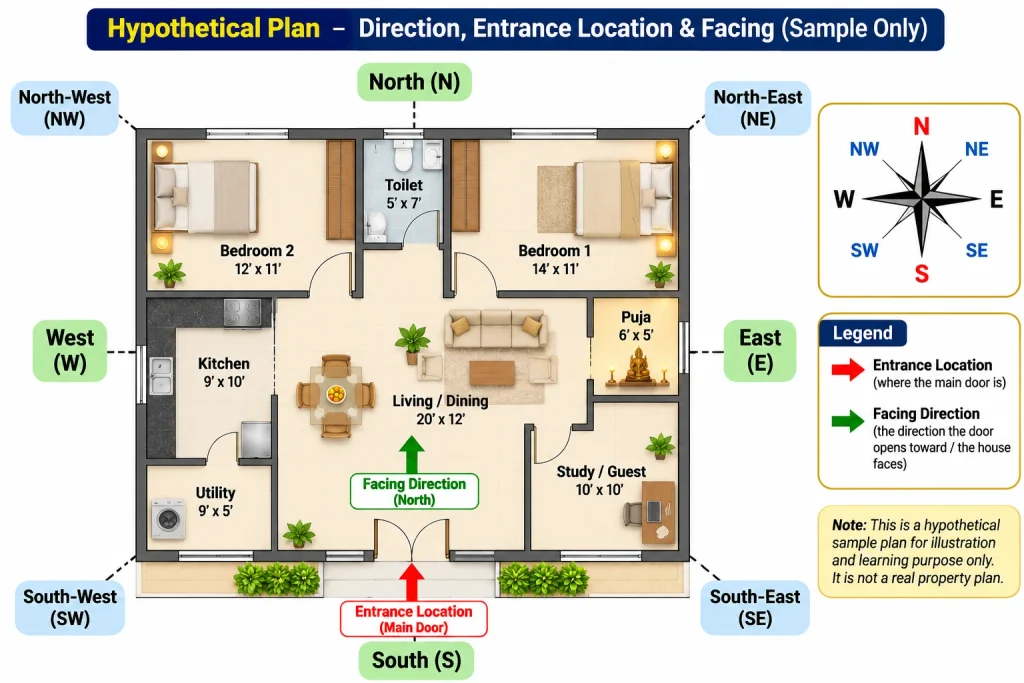
Draw north, then place east clockwise from north, south opposite north, and west opposite east. Northeast, southeast, southwest, and northwest lie between them.
For a simple illustration, an eight-direction framework divides a full turn into eight equal sectors. That is a beginner’s orientation aid. Detailed Vastu grids can use other divisions and should be labelled with their own method.
Choose the boundary and centre deliberately
For a simple rectangular flat, the intersection of its diagonals gives the rectangle’s geometric centre. However, you still need to decide what boundary the rectangle represents.
Balconies, projections, shafts, and common areas can complicate an apartment outline. An L-shaped flat has no obvious “middle” that every assessment method will use. Do not fill in missing portions or exclude spaces casually. Use a scaled plan and state the chosen boundary and centre method.
Locate rooms separately from the entrance facing
After orienting the plan, identify where the entrance, kitchen, bedrooms, and other spaces lie within the chosen framework. A large room may cross more than one sector.
Record broad locations where appropriate instead of forcing every room into one exact label. You can then consult our 1BHK flat layout guide with a clearer understanding of your own layout.
Worked example: An east-facing gate and a north-facing flat
Consider this hypothetical apartment:
- The building’s main gate faces east.
- Repeated entrance measurements give an outward bearing close to 0°, using a magnetic-north setting.
- A separately verified plan places the kitchen towards the southeast of the selected flat outline.
In a simple eight-direction convention, 0° represents north. Under this article’s entrance-facing convention, you would describe the flat as north-facing, with the measurement reference noted. The east-facing building gate remains a separate observation.
The kitchen’s location comes from the oriented floor plan. It cannot be deduced from the entrance bearing alone.
This example establishes an orientation and a room location under stated methods. It does not establish that the flat is fully “Vastu-compliant,” predict financial outcomes, or resolve every detailed grid interpretation.
Common mistakes when checking directions in a flat
Using the balcony as the only reference. A balcony’s orientation can help describe light and exposure, but it does not replace the entrance-facing definition used here.
Confusing facing with location. “The door faces north” and “the door sits in the northern sector” are different statements.
Measuring beside metal without checking elsewhere. A stable-looking number can still be distorted. Compare readings at suitable positions.
Relying on one reading. A single measurement provides no check on repeatability or alignment mistakes.
Assuming every plan has north at the top. Look for a verified arrow before assigning room directions.
Mixing north references or assessment methods. Record whether you used magnetic or true north, and identify the grid before comparing results.
Treating the result as a prediction. A compass describes orientation. It cannot diagnose illness, explain debt, or forecast family relationships.
What if your layout does not match a preferred Vastu arrangement?
Begin by checking the measurements and the interpretation. A wrong north arrow or a misunderstood doorway bearing can create a problem on paper that does not exist in the actual layout.
If you choose to follow traditional Vastu preferences, start with practical, reversible arrangements that suit the household. Keep circulation clear, use available daylight sensibly, maintain ventilation, and choose furniture positions that are comfortable and accessible.
Our guide to Vastu for 1BHK and 2BHK homes without demolition discusses broader placement ideas. Read symbolic remedies as traditional practices, rather than guaranteed corrections.
For a specific room, the Kitchen Vastu Checker and Best Sleeping Direction Finder can help organise questions once directions are established. These are interpretive tools, not independent measurements or scientific validation.
Do not alter a wall, gas connection, plumbing, or electrical installation because of one compass reading. Structural and service changes need the appropriate professional checks and permissions.
Frequently asked questions
Should I stand inside or outside the main door?
For the facing convention used here, the essential point is alignment with the outward direction through the doorway. A safe position just inside or outside may work if readings are reliable. Neither position is automatically free of interference. If you consult a practitioner, ask for their measurement protocol and record where you took readings.
Does the building gate or flat entrance matter for Vastu?
They describe different parts of the property. This guide uses the flat’s own outward entrance orientation when naming its facing. Modern assessments may also consider the building gate and wider site. Record both separately, and ask which one a guide or consultant means before comparing advice.
Can I use my phone compass instead of buying one?
Yes, if your phone has the necessary sensor and the app provides usable readings. Follow its operating and calibration instructions, remove obvious interfering accessories, and check repeatability. Buying another instrument is not automatically necessary, but neither a phone nor a physical compass should be assumed accurate beside metal or other disturbances.
Why do compass readings change around my flat?
Possible causes include magnetic interference, different device alignment, movement, or changed settings. Nearby metal, magnets, and electrical equipment are worth checking. Keep the instrument aligned with the same direction when comparing locations. Persistent disagreement is a reason to investigate or obtain a reliably oriented plan, rather than average unrelated readings.
Is my balcony direction the flat’s facing direction?
Not under the definition used in this article. Balcony orientation describes the balcony’s exposure, while flat facing describes the outward orientation through the main entrance. Both can be useful observations. If a property listing uses “facing” differently, ask what feature it refers to before making a comparison.
How do I check directions in an irregular flat?
First establish north reliably, as you would for a rectangular home. The additional difficulty is selecting the flat boundary and the centre or grid used to assign locations. Work from a scaled plan. Ask for the method to be explained, especially where balconies, shafts, projections, or missing corners affect the outline.
Should I use magnetic north or true north for Vastu?
There is no universal apartment protocol established by this guide. Record the reference your instrument uses and keep it consistent. When working with a plan or practitioner, confirm their reference before combining information. Magnetic declination matters when converting between references; it does not fix local magnetic interference.
Does a south-facing entrance automatically make a flat unsuitable?
No. Entrance orientation alone does not establish whether a home is suitable for your family. Consider the full layout, daylight, ventilation, construction, access, affordability, and daily needs. If Vastu preferences matter to you, request a clearly explained assessment without accepting guaranteed predictions of harm or prosperity.
Start with one reliable record
Take your floor plan, establish a dependable north reference, and record your entrance’s outward bearing along with the device settings. Those notes will make your next kitchen, bedroom, or entrance question much easier to discuss accurately.
Disclaimer: Vastu is a traditional belief system. Its directional interpretations do not guarantee health, wealth, or other life outcomes. Compass checks are approximate unless appropriately verified. Building safety, professional advice, and applicable permissions should guide structural or service changes.
Use real photographs or accurately constructed diagrams. Check every arrow and bearing before publication. Do not label a staged or illustrative photo as a measured survey.