
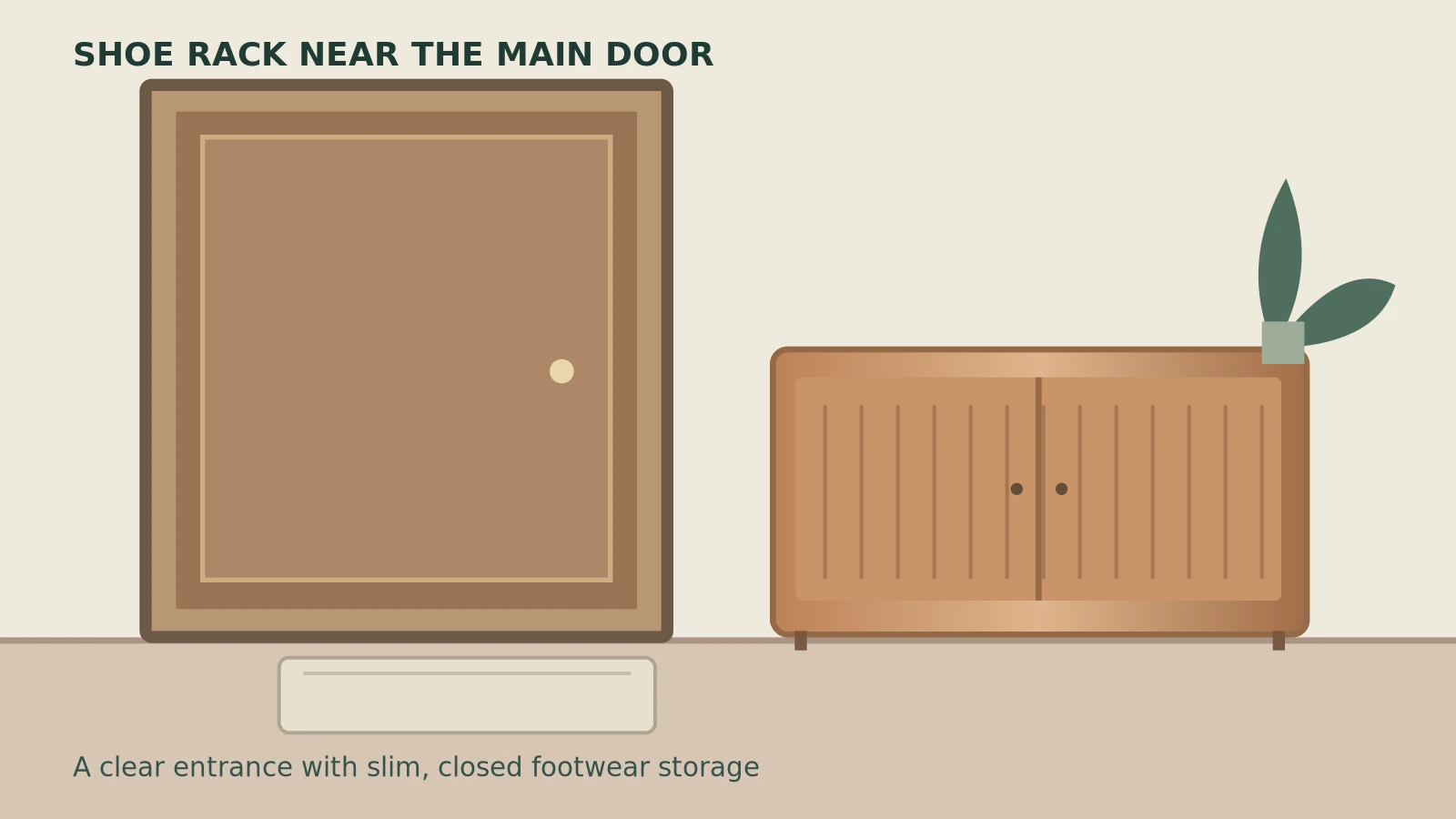
A shoe rack is one of the most useful pieces of furniture near a home’s entrance. Yet its placement often creates confusion, especially when homeowners want to follow Vastu Shastra while dealing with the limited space of a modern Indian apartment.
Should the shoe rack be placed in the west or south-west? Is the north-west also suitable? Can you keep shoes outside the main door? And what if your 1BHK or 2BHK flat has no space in the traditionally preferred directions?
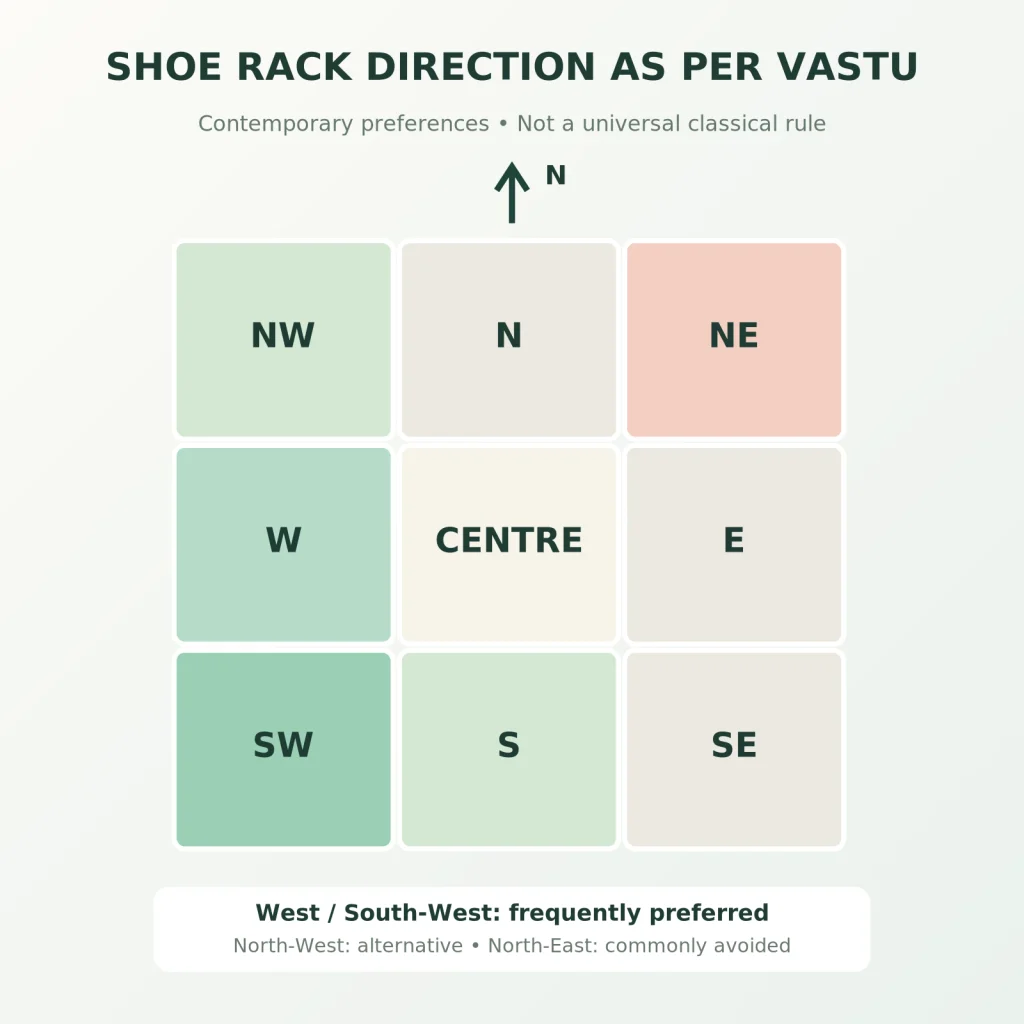
According to commonly followed contemporary Vastu recommendations, the west, south-west and, in some interpretations, north-west are suitable areas for shoe storage. However, recommendations vary among practitioners.
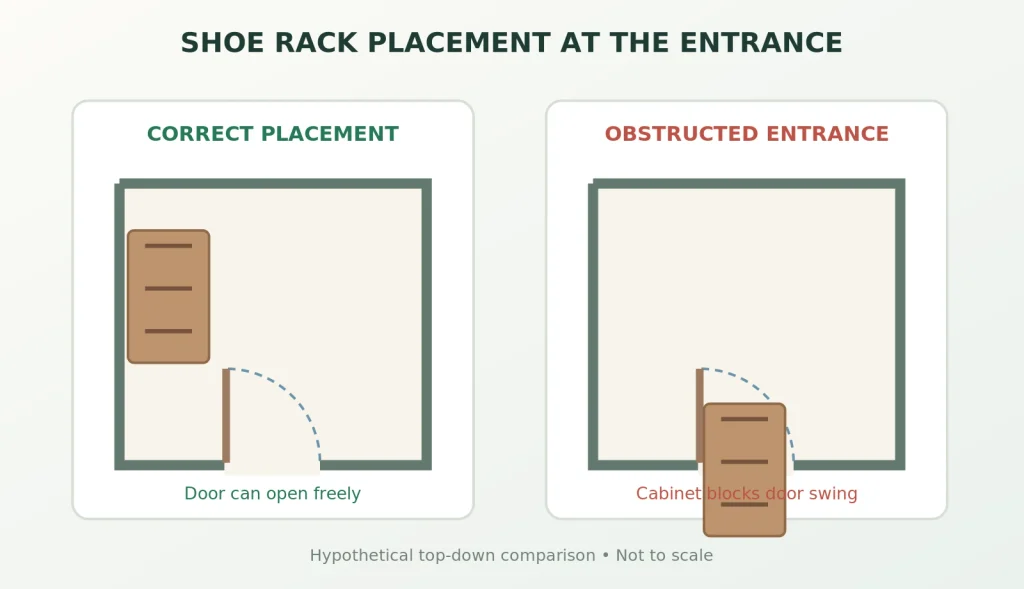
The practical priority is equally important: the shoe rack should not obstruct the main door, reduce access through a passage, or create unnecessary clutter.
This guide explains traditional Vastu preferences, direction-wise alternatives, placement rules for different entrance orientations, and practical solutions for small Indian homes.
Which Direction Is Best for a Shoe Rack as per Vastu?
Quick answer: In many contemporary Vastu practices, the west and south-west are preferred for shoe racks, while the north-west is an accepted alternative in some traditions. The north-east is commonly avoided for footwear storage. Place the rack against a suitable side wall, keep it organised, and ensure the main entrance remains unobstructed.
These recommendations reflect contemporary Vastu interpretations rather than a universally established rule from a single ancient text.
Shoe Rack Direction Vastu — Quick Reference Table
| Direction | Common Vastu interpretation | Practical recommendation |
|---|---|---|
| South-West (SW) | Frequently preferred | Suitable if space permits and the rack does not obstruct movement |
| West (W) | Frequently preferred | A practical first option for organised storage |
| North-West (NW) | Accepted or preferred by some schools | Useful alternative for apartments |
| South (S) | Accepted in some contemporary interpretations | Consider when other locations are impractical |
| North (N) | Often discouraged | Use an alternative if conveniently available |
| East (E) | Generally discouraged | Prefer not to occupy a prominent open entrance |
| North-East (NE) | Commonly avoided | Keep clear if following traditional Vastu zoning |
| South-East (SE) | Interpretations vary; often discouraged | Consider an alternative when feasible |
The table is a summary of commonly encountered contemporary guidance. It is not a verified directional prescription from one classical Sanskrit source.
Important: A shoe rack in an allegedly unfavourable direction has not been scientifically demonstrated to cause financial loss, illness, conflict, or bad luck.
Why Does Shoe Rack Placement Matter in Vastu Shastra?
Vastu Shastra is a traditional Indian body of architectural and spatial knowledge concerning the organisation of buildings, directions, functions, and their relationship with the surrounding environment.
In many modern Vastu interpretations, different parts of a home are associated with different qualities and activities.
For example:
- The north-east, traditionally called Ishanya, is frequently associated with worship and contemplation.
- The south-west, called Nairritya, is commonly associated in modern Vastu practice with stability and heavier furnishings.
- The north-west, called Vayavya, is associated with the air direction and movement in directional symbolism.
- The centre, often termed Brahmasthana, is generally treated as an important spatial area.
These are traditional and symbolic associations, not scientifically established effects of compass directions on household prosperity.
Why footwear receives special attention
Footwear comes into contact with roads, dust, soil and moisture. As a result, storing shoes appropriately has both cultural and practical significance.
In many Indian households, shoes are removed before entering living or prayer areas. A designated storage space helps maintain this custom.
From a practical standpoint, a good shoe rack can:
- Reduce footwear scattered around the entrance.
- Keep frequently used pairs accessible.
- Make floor cleaning easier.
- Separate wet or muddy shoes from clean indoor areas.
- Help household members maintain a consistent organisation routine.
The value of these habits does not depend on an invisible energy mechanism.
Best Shoe Rack Directions: South-West, West and North-West
South-West: A commonly recommended location
South-west is one of the directions frequently recommended for shoe storage in contemporary Vastu advice.
It is often associated with heavier, stable furniture, making a substantial shoe cabinet an acceptable item in this zone according to some practitioners.
How to arrange a south-west shoe rack
Choose a stable cabinet appropriate for the available space. Place it against a wall without interfering with doors, electrical panels, ventilation openings or movement paths.
Store clean and dry footwear on shelves. Avoid stacking shoes so high that they fall when the cabinet opens.
If the cabinet is tall, secure it against tipping, especially in a household with young children.
A south-west shoe rack can be convenient, but there is no need to move an otherwise well-positioned rack across the entire apartment solely to meet this recommendation.
West: A practical and traditionally popular choice
The west is another widely suggested direction for a shoe rack.
In apartments, this can be especially convenient if the entrance passage or living-room storage wall happens to fall on the western side.
A closed or partially enclosed cabinet against the west wall can help maintain a tidy appearance.
Consider a cabinet with:
- A washable interior surface.
- Enough capacity for regularly used footwear.
- Ventilation openings that allow shoes to dry.
- Easy access without blocking the entrance.
- A depth appropriate for a narrow passage.
A slim cabinet is generally preferable to a bulky cupboard in a compact flat.
North-West: A useful alternative
North-west deserves special attention because recommendations differ among contemporary Vastu practitioners.
Some traditions favour west or south-west, while others recommend north-west because it is symbolically associated with movement and items used frequently.
This is one reason different websites may appear to contradict each other.
For a small apartment where the north-west offers the only sensible, unobstructed storage space, it may be a reasonable choice.
For example, imagine a north-facing flat with a narrow entrance and a small north-west utility alcove. A closed shoe cabinet in that alcove may be more practical than moving footwear into a distant south-west bedroom.
The important distinction is between a preferred traditional arrangement and a physically workable home.
Can a shoe rack be placed in the south?
Some contemporary Vastu practitioners accept the south as another footwear-storage area, although it is not universally listed as a preferred direction.
If your only suitable storage wall is in the south, there is no evidence-based reason to treat that placement as harmful.
Focus on maintaining an accessible entrance, a secure cabinet and adequate space for cleaning.
Which Directions Should Be Avoided for Shoe Racks?
North-East
North-east is one of the most consistently discouraged directions for shoe storage in contemporary Vastu literature.
The traditional reasoning is that this area is symbolically associated with cleanliness, spiritual activities and a relatively open environment.
If you maintain a prayer area or meditation corner in the north-east, keeping outdoor footwear away from it also makes practical and cultural sense.
However, the presence of shoes in the north-east cannot be used to diagnose health, financial or relationship problems.
East
The east is associated in many traditions with sunrise and daylight.
Some practitioners consequently prefer keeping the eastern side relatively open and uncluttered.
In practical terms, this can also help if the eastern portion contains windows or a narrow entrance passage.
There is no universal requirement to leave every east-facing wall completely empty.
North
North is often discouraged for shoe storage by contemporary Vastu guides that associate it with prosperity.
This should be understood as a traditional belief rather than a prediction that storing shoes in the north will cause financial losses.
A properly positioned rack in the north can still be preferable to loose shoes scattered in front of the doorway.
South-East
South-east is traditionally called Agneya and is associated with fire symbolism.
Some modern Vastu approaches discourage footwear storage here, although there is no universal rule accepted by all practitioners.
Irrespective of Vastu, avoid positioning combustible storage or loose objects too close to cooking appliances, electrical equipment or emergency access routes.
Where Should You Keep a Shoe Rack Near the Main Door?
This is the most important practical question for apartment owners.
You do not necessarily need to place a shoe rack in the exact south-west corner of the entire property. Instead, assess the layout and identify a suitable storage area that respects your preferred Vastu approach without compromising safety.
Understand three different types of direction
House-facing direction: The compass direction you face when looking outward through the main entrance.
Shoe rack location: The compass sector of the home or portion of the floor plan where the rack is physically positioned.
Side of the doorway: Whether the rack is to the left or right of the entrance when viewed from a clearly specified position.
These are not interchangeable.
For example, a west-facing home can have a shoe rack located in its north-west zone. Similarly, keeping a rack on the right side of a doorway does not automatically mean it is in the south-west.
This distinction is essential when interpreting online Vastu diagrams.
Step-by-step: Choose the right location
Step 1: Identify your apartment’s directions.
Use a reasonably reliable compass or a correctly oriented floor plan. Repeat readings if necessary and avoid obvious magnetic interference.
Step 2: Mark the entrance and major storage areas.
Identify possible locations near the entrance, in a utility area or in another convenient part of the apartment.
Step 3: Check Vastu preferences.
Among the practical options, compare the west, south-west and north-west sectors if following contemporary Vastu recommendations.
Step 4: Check the doorway.
Open the main door fully and verify that the cabinet will not obstruct the door leaf, threshold, passage or emergency movement.
Step 5: Choose functional storage.
Select a cabinet that fits your shoes, can be cleaned easily and does not trap moisture.
Step 6: Reassess after use.
After a week, check whether shoes are accumulating outside the cabinet. If the storage arrangement is difficult to use, adjust it.
The best layout is one household members can maintain consistently.
Shoe Rack Placement for North-, East-, South- and West-Facing Homes
A common mistake is to assume that the direction a house faces automatically determines where the shoe rack must go.
In reality, the home’s facing tells you the direction of the entrance, not the location of every possible storage area.
The following recommendations are practical illustrations, not mandatory Vastu prescriptions.
North-facing house
For a north-facing entrance, some practitioners prefer placing footwear away from the north-east.
If a west or north-west storage alcove is available, it may work well.
In a compact flat, a closed cabinet along a suitable wall inside the foyer can be considered if no other convenient location exists.
Avoid placing shoes in a position that makes the front door difficult to open.
East-facing house
An east-facing entrance may be located along a narrow passage or directly beside the living room.
Look for a convenient storage location away from the main circulation route.
If the flat includes a west-side utility cabinet or another sensible storage area, that may be appropriate.
Do not assume that the left or right side of an east-facing door is automatically favourable. Determine the actual compass location first.
South-facing house
A south-facing entrance does not automatically require a shoe rack in the south.
If a west or south-west storage area is available, it may align with many modern Vastu preferences.
However, ensure that the cabinet does not interfere with the main doorway or access to other rooms.
West-facing house
In a west-facing flat, a west-side storage cabinet may be convenient, although entrance geometry varies.
A shallow cabinet along a clear side wall can be an attractive solution.
If the entryway is too narrow, consider an internal shoe-storage area rather than placing a large cabinet directly beside the door.
Direction-wise summary
| House facing | Location to consider | What matters most |
|---|---|---|
| North | West/NW storage area if available | Avoid blocking the doorway |
| East | West/SW storage area or suitable alternative | Preserve light and circulation |
| South | West/SW storage area if practical | Keep entrance accessible |
| West | West-side cabinet or NW alternative | Avoid overcrowding the foyer |
A recommendation based only on the home’s facing cannot establish the ideal exact location without examining the floor plan.
Should a Shoe Rack Be Inside or Outside the Main Door?
Indian apartment residents frequently face this dilemma.
The area outside the front door may appear to offer convenient storage, particularly in buildings with compact entryways.
However, that space may form part of a shared corridor, lift lobby, fire escape route or common area.
Keeping the shoe rack inside
An indoor cabinet is often the more dependable choice because the storage remains within the household’s controlled space.
Benefits include protection from rain and outdoor dirt, easier cleaning, and avoiding possible disputes over shared corridor use.
A narrow, wall-adjacent cabinet may be suitable.
Make sure the rack does not create a trip hazard, restrict wheelchair access or obstruct the movement of people carrying groceries or luggage.
Keeping the shoe rack outside
Outside storage may be possible in some homes, but only where it is permitted and safe.
Before placing a rack outside an apartment:
- Check your housing society or apartment association’s rules.
- Confirm that the area is not part of a required exit or protected route.
- Ensure fire equipment, doors and other residents’ access remain unobstructed.
- Avoid leaving loose footwear across a shared passage.
- Check whether the cabinet could affect door movement or maintenance access.
Indian building regulations contain requirements for exits and passageways. An attractive cabinet or a traditional placement preference does not override these requirements.
Practical recommendation: Never obstruct a common corridor or emergency exit merely to obtain a preferred Vastu direction.
Best Shoe Rack Placement for Small 1BHK and 2BHK Flats
Most Indian apartments were designed with fixed room layouts and limited storage.
Changing the structure to create a perfectly positioned shoe rack is rarely necessary or sensible.
Here are three realistic examples.
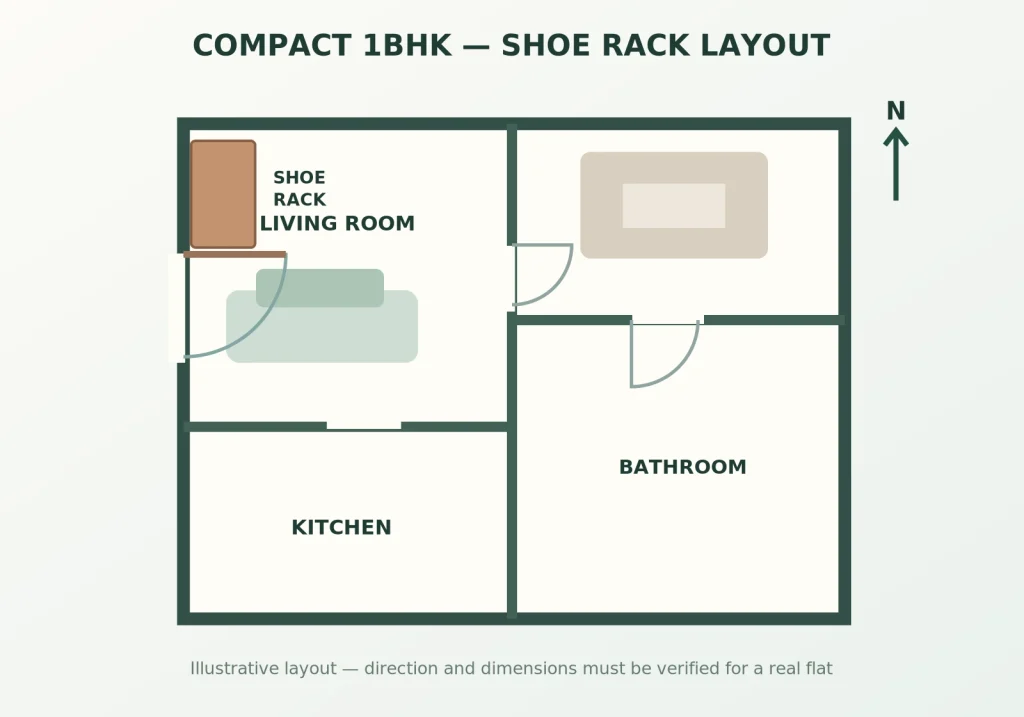
Example 1: A compact 1BHK with a narrow entrance
Hypothetical example
A family lives in a 550 sq. ft. 1BHK. The entrance opens directly into a small living room.
There is no dedicated foyer, and a large shoe cabinet would obstruct the passage.
Suggested solution: Use a shallow, closed cabinet along an available wall, outside the doorway’s swing and the walking path. Store only regularly used footwear there and keep additional pairs elsewhere.
If the location is not one of the traditionally preferred zones, it can still be a practical arrangement.
Example 2: A 2BHK with a north-east entrance area
Hypothetical example
A 2BHK apartment has its main entry in the north-eastern portion of its floor plan.
The family wishes to keep the north-east relatively clear in accordance with its Vastu preferences.
Suggested solution: Identify a suitable west or north-west storage wall within the apartment, provided it remains convenient and accessible.
Place a small washable doormat near the entrance to manage footwear-related dirt without blocking the door.
Example 3: A rented flat without a storage niche
Hypothetical example
A tenant cannot drill walls, install built-in cabinetry or modify the foyer.
The only available location is an unobstructed part of the living room.
Suggested solution: Choose a freestanding shoe cabinet with suitable stability and ventilation. Use removable floor protection if necessary. Avoid structural changes and keep the door area clear.
The cabinet can be moved if the arrangement proves inconvenient.
These examples illustrate how traditional preferences can be considered without unnecessary renovations.
Open vs Closed Shoe Rack: Which Is Better as per Vastu?
Many modern Vastu practitioners prefer closed shoe cabinets because they keep footwear out of sight and help the entrance appear less cluttered.
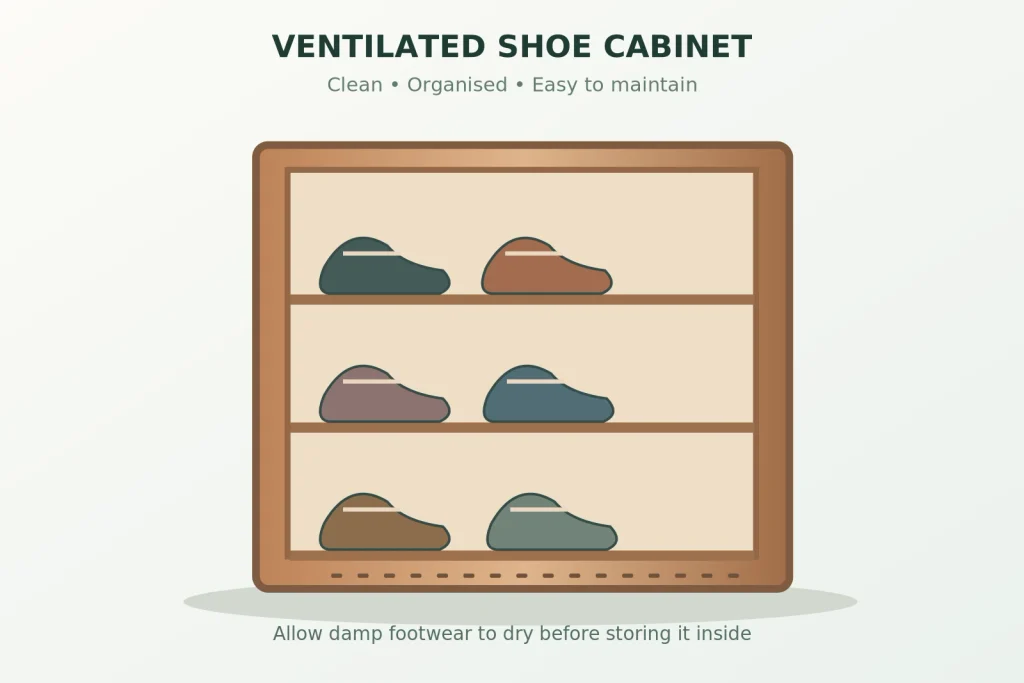
However, a completely airtight cabinet can trap moisture when shoes are stored wet.
A useful compromise is a closed cabinet with suitable ventilation and removable shelves.
| Feature | Open shoe rack | Closed shoe cabinet |
|---|---|---|
| Appearance | Shoes remain visible | Shoes are concealed |
| Airflow | Usually better | Depends on ventilation design |
| Dust management | Requires frequent cleaning | Interior still needs regular cleaning |
| Small-apartment suitability | Useful in utility areas | Often suitable in visible foyers |
| Common modern Vastu preference | Less frequently preferred | Often preferred |
| Maintenance | Easy to inspect | Needs periodic internal cleaning |
For everyday footwear, choose a storage design that allows damp shoes to dry before they are put away.
Do not assume that closed storage automatically prevents unpleasant odours.
Best Shoe Rack Colour as per Vastu
Colour recommendations are among the least consistent aspects of modern Vastu advice.
Some practitioners associate earthy finishes with south-west storage and lighter shades with compact spaces, but there is no universally established classical colour chart specifically for modern shoe cabinets.
Natural wood and oak
Suitable for neutral, warm interiors and commonly associated with earthy design.
White and light beige
Useful for making compact foyers appear visually lighter.
Grey and taupe
Practical neutral options for contemporary interiors.
Walnut and dark wood
Suitable for larger entrance spaces with adequate lighting.
How to choose the colour
Consider the existing walls, floor finish, natural lighting, cabinet material and room size.
A very dark cabinet may make a narrow, poorly lit entryway feel visually crowded, while a lighter finish can help create a more open appearance.
These are interior-design considerations rather than evidence of the cabinet’s effect on household fortune.
Common Shoe Rack Vastu Mistakes to Avoid
Mistake 1: Blocking the main door
The most important mistake is placing a cabinet where the door cannot open properly.
Maintain a safe and accessible route through the entrance.
Mistake 2: Leaving shoes scattered on the floor
Loose shoes can create clutter and a trip hazard.
Provide enough storage for regularly used footwear.
Mistake 3: Placing wet shoes in an enclosed cupboard
Damp footwear may contribute to unpleasant smells and moisture accumulation.
Allow wet shoes to dry appropriately before putting them into enclosed storage.
Mistake 4: Putting footwear beside a prayer space
If your household follows the custom of keeping outdoor footwear away from worship areas, select a separate storage location.
This arrangement respects the intended use of the prayer space.
Mistake 5: Choosing direction over safety
A shoe rack in the preferred Vastu sector is not a good choice if it obstructs the exit, creates a tripping hazard or conflicts with fire-safety requirements.
Mistake 6: Buying an oversized cabinet
Measure the usable floor area and account for the cabinet doors when they are fully open.
A shallow cabinet may be more practical than a large, deep storage unit.
Mistake 7: Ignoring the needs of children and older adults
Children may attempt to climb tall furniture. Older residents may also need greater passage clearance and a convenient place to sit while putting on footwear.
Secure tall cabinets and choose an arrangement that is comfortable for everyone.
Vastu Remedies When the Shoe Rack Is in the Wrong Direction
If your current shoe rack is in the north, north-east, east or another direction discouraged by a particular Vastu tradition, there is no need to panic.
Start with simple, reversible changes.
Remedy 1: Relocate the rack if practical
If a preferred zone is available and moving the rack does not create inconvenience, reposition it.
Avoid moving the cabinet into an unsafe or inaccessible area.
Remedy 2: Reduce visible clutter
Keep only footwear that is regularly used.
Remove damaged or unused pairs and clean the storage area.
Remedy 3: Use a ventilated closed cabinet
If it fits the available space, a closed cabinet can maintain a more organised appearance.
Remedy 4: Keep the entrance well lit
Adequate lighting improves visibility around footwear and makes the entrance more comfortable to use.
Remedy 5: Separate shoes from worship areas
Where culturally important to the household, create a clear separation between outdoor footwear and prayer activities.
Remedy 6: Improve the arrangement without structural changes
A narrow freestanding cabinet, rearranged shelf or alternative storage space may solve the problem.
A note on symbolic Vastu remedies: Some practitioners recommend pyramids, crystals, metal strips or other objects for directional corrections. Their claimed supernatural effects have not been scientifically demonstrated. Such objects are optional cultural or decorative choices, not substitutes for practical improvements.
There is no evidence that purchasing a remedy is necessary to protect your wealth, health or family.
How to Check the Correct Direction of Your Shoe Rack
Before calling your shoe rack east-facing or west-positioned, clarify exactly what you are measuring.
Step 1: Obtain a floor plan
A simple hand-drawn plan may be sufficient for understanding a rectangular apartment.
Mark the external boundaries, main entrance and proposed shoe-storage location.
Step 2: Establish north
Use a reliable compass or correctly oriented plan.
Phone compasses can be affected by nearby metal and magnetic interference, so verify uncertain readings.
Step 3: Identify the rack’s location
For a simple rectangular apartment, mark the central point and identify the general compass direction of the storage location relative to that centre.
This is an approximate zoning method, not a universally accepted basis for every Vastu school.
Step 4: Distinguish rack location from rack orientation
A cabinet positioned on the west side of a house can have doors that open towards the east.
That does not make it an east-zone shoe rack.
Likewise, the compass direction faced by a person standing in front of the rack is different from the area in which the rack is located.
Step 5: Check movement and safety
Inspect the complete arrangement with the entrance door and cabinet doors open.
Make sure the passage remains usable.
In an irregular floor plan, exact sector boundaries may differ depending on the assessment method. Do not pretend that a basic sketch establishes a precise Vastu classification.
Shoe Rack Placement Checklist for Every Indian Home
Use this checklist before deciding on the final position.
Your entrance inspection
0/10 completeI have identified the main entrance and the available storage areas.I have checked the home’s approximate compass orientation.I have considered west, south-west or north-west where practical.The main door opens and closes without obstruction.The cabinet does not restrict an exit or shared corridor.The rack is stable and suitable for household members.Wet shoes can dry before enclosed storage.The entrance has adequate lighting.Unused and damaged shoes are removed regularly.The arrangement follows applicable society and building rules.
Copy checklistReset
Frequently Asked Questions
1. What is the best direction for a shoe rack as per Vastu?
West and south-west are commonly recommended in contemporary Vastu practice. North-west is also favoured by some practitioners. However, interpretations vary, and no single universally verified ancient prescription establishes a compulsory modern shoe-cabinet location.
2. Can we keep a shoe rack near the main door?
Yes. A shoe rack near the entrance is practical when the location is permitted and does not block movement. Place it along a suitable side wall or in a storage niche rather than immediately in the doorway’s path.
3. Can a shoe rack be kept outside the main door?
Only if the space is legally and practically available for private storage. In an apartment, shared corridors and exit routes must not be obstructed. Check society rules and applicable building-safety requirements before installing a rack.
4. Is a shoe rack in the north-east bad according to Vastu?
Many contemporary Vastu practitioners discourage shoe storage in the north-east because of its traditional association with spiritual activities. However, there is no reliable scientific evidence that placing shoes there causes illness, financial difficulties or other misfortunes.
5. Is the north-west direction good for a shoe rack?
North-west is an accepted or preferred alternative in several modern Vastu interpretations. This can make it useful for flats where west or south-west storage is inconvenient. Other practitioners may place greater emphasis on west or south-west.
6. Which side of the main door should the shoe rack be placed on?
There is no universal left-side or right-side rule that works for every doorway. The compass direction, door swing and floor plan all matter. Choose a side that allows the door to open fully and keeps the entrance accessible.
7. Should the shoe rack face east or west?
First distinguish the direction in which the cabinet doors face from the location of the cabinet within the house. Most contemporary recommendations focus on the storage zone rather than requiring the front of the cabinet to face a particular direction.
8. Can a shoe rack be placed in the living room?
Yes, if the living room provides a practical storage location. A compact, ventilated shoe cabinet can be preferable to an obstructed entrance. Keep footwear organised and avoid placing the cabinet where it interferes with household activities.
9. Is a wooden shoe rack better than a metal shoe rack?
Both can work. Material choice should reflect durability, maintenance, moisture conditions, stability and design. Some practitioners prefer wood in certain zones, but no scientific evidence shows that wooden shoe racks inherently produce better fortune.
10. Which colour is best for a shoe rack according to Vastu?
Natural wood, beige, brown and other neutral finishes are often recommended in contemporary design-oriented Vastu advice. Preferences differ. Choose a finish that suits your entrance, provides good visibility and is easy to maintain.
11. What should I do if there is no space in the west or south-west?
Use another safe, convenient storage location. North-west may be an acceptable alternative within some Vastu traditions. A practical and well-maintained rack is preferable to blocking a passage merely to satisfy a directional preference.
12. Does the wrong shoe rack direction cause money problems?
There is no reliable scientific evidence that shoe rack direction causes debt, financial loss or business difficulties. Vastu may be meaningful as a cultural or spiritual practice, but financial outcomes depend on many factors unrelated to furniture positioning.
Choose a Balanced Shoe Rack Placement
The best shoe rack direction as per Vastu is not simply a matter of choosing one compass point.
Many contemporary Vastu recommendations favour west or south-west, with north-west as an alternative. These preferences can guide your arrangement when multiple practical locations are available.
However, a safe, tidy and convenient entrance should always take priority.
For a modern Indian apartment, the most sensible approach is to identify the available space, check the relevant direction, select an appropriately sized cabinet and keep footwear organised.
You do not need expensive renovations or symbolic remedies to improve an entrance.
A thoughtful arrangement that respects your cultural preferences and meets your everyday needs is a reasonable place to begin.
Continue exploring Vastu for your home
If you are arranging a new apartment, explore our guides on identifying directions using a compass and planning a 2BHK layout.
For a systematic home-organisation approach, read our 30-Day Vastu Declutter & Energy Reset guide, which includes entrance decluttering and room-wise organisation.
References and further reading
The directional recommendations above reflect varying contemporary Vastu practices rather than conclusively authenticated verses from a single classical Sanskrit text.
- NoBroker — Shoe Rack Direction as per Vastu — example of west/north-west-oriented advice.
- Housing.com — Shoe Rack Designs — storage design and common placement suggestions.
- Vasturaviraj — Shoe Rack as per Vastushastra — example of practitioner-specific reasoning.
- Mumbai Development Control Regulations — Fire Protection and Exits — requirements concerning safe exits and obstruction-free passage.
- Google Search Central — Helpful, Reliable, People-First Content — editorial and search-quality guidance.
Editorial note: Vastu is presented here as a traditional and contemporary system of spatial beliefs. Claims about invisible energies, financial outcomes or health effects are not presented as scientifically established facts.