
I was visiting a friend’s new apartment last month. She had spent a fortune on velvet sofas, designer lamps, and gold-trimmed mirrors. On paper, it looked like a page out of a luxury magazine. But as we sat down for tea, she sighed and said, “I don’t know what it is, but I just can’t relax in here. I feel restless, and lately, my husband and I keep bickering over the smallest things.”
I looked around the room. Her living room was beautiful, but it was “heavy.” There were things in that space—objects she thought were just decor—that were actually creating a kind of energetic traffic jam.
In Vastu Shastra, your living room is the “social heart” of the home. It’s where you welcome the world. When this room is cluttered with the wrong items, it doesn’t just look messy; it blocks the flow of Prana (life force). This can lead to stalled finances, constant tiredness, or that “unsettled” feeling my friend was experiencing.
The good news? You don’t need to knock down walls or hire a contractor. Sometimes, getting your home’s energy back on track is as simple as taking a trash bag and removing a few things that shouldn’t have been there in the first place.
Why Dried Flowers and Faded Plants Drain Your Energy
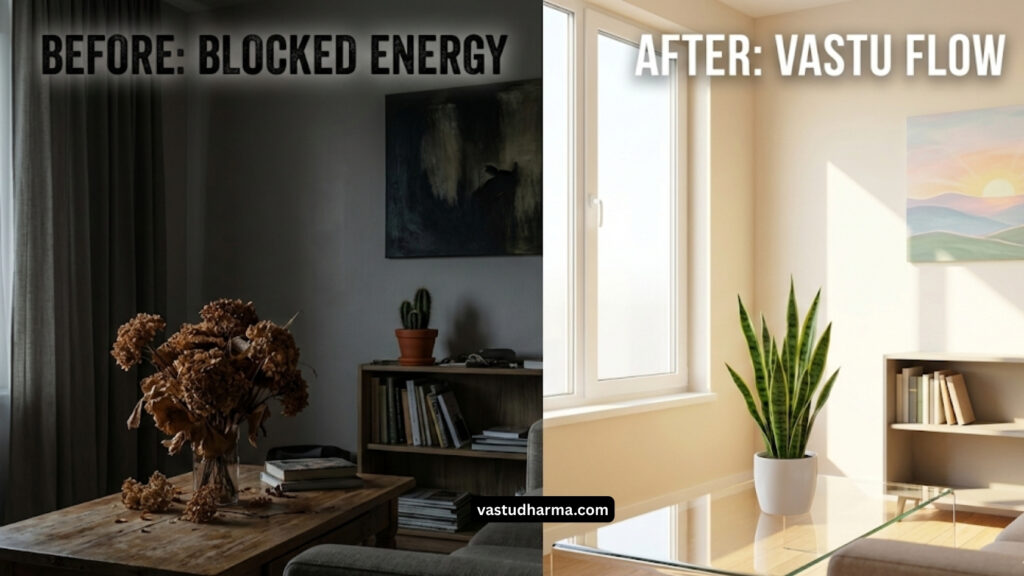
We’ve all seen them—those beautiful pampas grass arrangements or the bouquet of roses you saved from an anniversary that have now turned brittle and brown. You might think they look “shabby chic” or vintage, but in Vastu, dried flowers are considered “dead” energy.
Why It Matters
Think about it this way: Living plants are breathing, growing, and vibrating with life. They pull in carbon dioxide and give back oxygen. They are active. A dried plant, however, is a symbol of something that has stopped growing. When you keep dead or decaying things in your living room, you are essentially telling the universe that you are okay with “stagnation.”
I remember a client who kept a massive collection of dried sea shells and preserved starfish in his North-West corner (the zone for support and networking). He complained that his business leads had completely dried up. We replaced those “dead” shells with a healthy, green Money Plant in a clean pot. Within three weeks, he called to tell me three old clients had reached out out of the blue.
The Common Mistake
Many people think that if a plant is expensive (like expensive preserved flowers), it’s okay. It’s not. If it’s not growing, it shouldn’t be in your living space. This also includes “Bonsai” trees. While they are beautiful, they represent “stunted growth” because their roots are intentionally constricted.
The Simple Solution
- The 24-Hour Rule: If a bouquet starts to wilt, compost it within 24 hours. Don’t wait for the water to turn slimy.
- Go Green: Replace dried arrangements with air-purifying plants like Sansevieria (Snake Plant) or Areca Palms.
- Silk is Better than Dead: If you really can’t maintain real plants, high-quality silk flowers are actually better than dead, dried ones—just make sure to dust them weekly!
Broken Mirrors and Distorted Reflections
Mirrors are one of the most powerful tools in Vastu. They are basically “energy multipliers.” Whatever they reflect, they double. If they reflect a beautiful view, they double the beauty. If they reflect a trash can, they double the waste.
But there is something far worse than a misplaced mirror: a broken, cracked, or “distorted” one.
The Story of the “Antique” Mirror
I once worked with a family that had a stunning antique mirror in their hallway, right where it could be seen from the living room sofa. It had that beautiful “foxing” (those dark spots you see on old glass) and a small crack in the corner. They loved its “character.”
However, every time they looked into it, their faces were slightly distorted or cut off. Over time, this creates a psychological and energetic “fragmentation.” You start to feel “broken” or less confident without even realizing why. In Vastu, a cracked mirror in the living room can lead to misunderstandings among family members, as if no one is seeing the “full picture” of the other person.
The Common Mistake
Keeping “distorted” mirrors is a frequent error. This includes those trendy multi-paneled mirrors where the image is cut into ten different squares. While they look modern, they “break” your reflection. You want your reflection to be whole, clear, and bright.
The Simple Solution
- The Instant Fix: If a mirror has even a tiny chip or crack, it’s time to let it go. Don’t try to hide the crack with a sticker.
- Check the Height: Ensure your mirrors are hung at a height where the tallest person in the house doesn’t have their head “cut off” in the reflection.
- Cleanliness is Key: A dusty, cloudy mirror represents “clouded judgment.” Give your mirrors a quick wipe with a vinegar-water solution once a week to keep the energy sharp.
Why Cacti and Thorny Plants Are Living Room Taboos
We often buy plants because they are “easy to care for.” That is usually how the cactus finds its way onto a living room coffee table or a bookshelf. You forget to water it for three weeks, and it still looks the same. But in Vastu, the physical shape of an object determines the “shape” of the energy it emits.
Why It Matters
Think about the physical sensation of a cactus. It’s defensive. It’s covered in needles meant to keep the world away. When you place thorny plants in the “social heart” of your home, you are unintentionally placing “barbs” in your relationships.
can we keep cactus in living room according to vastu?
I once consulted for a couple who were both working from home. They had a beautiful collection of rare succulents and cacti right on the desk in their living room corner. They mentioned that their conversations had become “sharp” lately—lots of poking fun that turned into actual arguments. The energy of the room had become defensive. We moved the cacti to the balcony (outdoor spaces are fine for thorns) and replaced them with “Jade” plants, which have soft, round, heart-shaped leaves. The atmosphere in the room softened almost immediately.
The Common Mistake
The biggest mistake is thinking that “small” thorns don’t count. Even a tiny desk cactus sends out Sha Chi (sharp or piercing energy). Another common error is keeping roses with thorns inside. While roses are beautiful symbols of love, the thorns should always be stripped off before placing them in an indoor vase to keep the energy smooth.
The Simple Solution
- Go Round and Soft: Look for plants with rounded leaves. In Vastu, curves represent the smooth flow of wealth and harmony.
- The Aloe Exception: Aloe Vera is a bit of a gray area. While it’s “pointy,” its medicinal properties are wonderful. If you keep it, place it on a windowsill behind a curtain rather than as a centerpiece.
- Outdoor Only: If you love your cactus collection, move them to a balcony or a garden. They act as “protectors” when they are outside the home’s envelope, but they are “aggressors” when they are inside.
The Hidden Impact of Sad or Aggressive Images
We often choose art because it’s “interesting” or “edgy.” Maybe it’s a painting of a lonely figure in the rain, or a dramatic scene of a shipwreck, or even a depiction of a historical battle. You might think, “It’s just art, it doesn’t affect me.” But your subconscious mind doesn’t know the difference between a real event and a picture of one.
The Story of the “Melancholy” Hallway
I remember a client who had a very expensive, high-end photograph in her living room of a weeping willow over a dark, stagnant pond. It was artistic and moody. But she couldn’t figure out why she felt a “heavy cloud” over her head every time she sat down to read.
Your living room should be a place of Chaitanya (consciousness and life). When you surround yourself with images of sorrow, war, poverty, or even “lonely” subjects (like a single tree in a desert), you are inviting those frequencies into your life.
The Common Mistake
Many people display “abstract” art that is chaotic, with sharp lines and clashing, dark colors. While it might look modern, it creates mental clutter. Another mistake is keeping photos of deceased ancestors in the living room. While we love them, Vastu suggests keeping those photos in a more private area (like the South or South-West wall of a quiet room) rather than the active, social “fire” of the living room.
The Simple Solution
- The “Smile” Test: Look at your wall art. Does it make you feel lighter? Does it make you want to smile? If it feels “heavy,” it’s time to move it.
- Pair Things Up: Instead of a photo of a single bird or a lone person, choose art that shows pairs—two birds, a happy family, or a lush forest. This promotes companionship and support.
- Color Psychology: Use art with vibrant, warm colors like yellow, orange, or soft greens to boost the energy of the room.
The Silent Drain of Non-Working Gadgets
In 2026, we are surrounded by technology. But look closely at your TV stand or your side tables. Is there an old remote with no batteries? A tablet with a cracked screen that you “mean to fix”? A tangled nest of charging cables that don’t fit any of your current phones?
Why It Matters
In Vastu, anything that is “broken” or “stagnant” creates Rahu energy—which is associated with confusion, delays, and sudden obstacles. Non-working electronics are the modern equivalent of a “clogged drain.” They sit there, taking up space, and every time you look at them, your brain registers a “to-do” task that hasn’t been finished. This creates a subtle, constant drip of stress.
The Real-Life Example
I see this most often with “clocks.” A clock that has stopped or is running slow is a major Vastu “No-No.” It signifies that your time—your life—is standing still. I’ve seen families struggle with career growth for years, only to realize they had a beautiful grandfather clock in the living room that hadn’t ticked in a decade. Once they fixed it or removed it, the “gears” of their life seemed to start turning again.
The Common Mistake
Storing “junk” electronics in the storage compartments of your sofa or inside the TV cabinet. Just because you can’t see the tangled wires doesn’t mean the energy isn’t there.
The Simple Solution
- The Monthly Purge: Once a month, test your remotes and gadgets. If it’s broken, fix it within a week or recycle it.
- Hide the Wires: Use cable management boxes. “Visible” tangled wires are like “veins” of chaotic energy running through your room.
- The Clock Check: Ensure every clock in your house is showing the correct time (or even 1-2 minutes fast). Never let a clock stay dead on the wall.
Balancing the Zones of Your Living Room
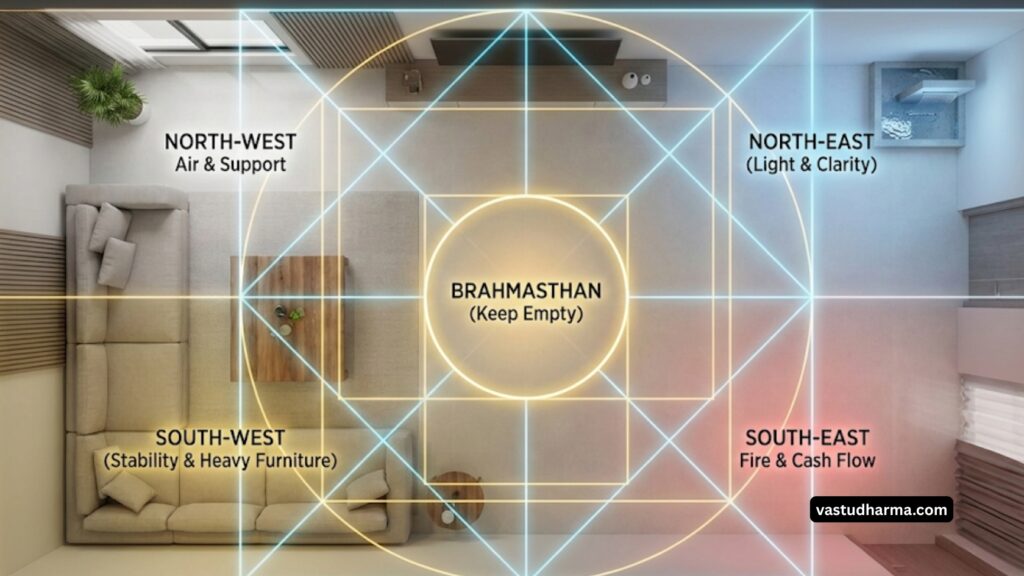
Now that we’ve cleared out the “energy vampires”—the dead plants, the broken mirrors, and the thorny cacti—you might notice the room already feels lighter. It’s like taking a deep breath after being underwater. But to truly “Discover-proof” your home’s energy, we need to look at the invisible map of your living room: the Vastu Purusha Mandala.
Every living room is divided into zones, and each zone “rules” a different part of your life. If you put a heavy, dark cabinet in a zone that needs to stay light, it’s like trying to run a marathon with lead weights in your pockets.
The Brahmasthan: The “Lungs” of Your Room
The most important part of your living room isn’t a corner—it’s the center. This is the Brahmasthan. In ancient Vastu texts, this area is linked to the element of Space (Akasha).
The Common Mistake: I often see people placing a massive, heavy wooden coffee table right in the center of the room, or worse, a heavy chandelier that hangs too low. The Solution: Keep the center as open as possible. If you must have a coffee table, choose one with a glass top or thin legs so the energy can still “breathe” through it. Imagine a column of light rising from the floor to the ceiling in the center of your room; don’t block that light.
The North-East Corner
The North-East (Ishanya) is ruled by the Water element. This is where the purest energy enters your home. In a living room, this corner dictates your mental clarity and your “luck.”
Real-Life Story: The “Cluttered” Genius
I once met a student who was incredibly bright but kept failing his entrance exams. His living room’s North-East corner was where he kept his “junk” bin—old newspapers, a heavy iron gym set, and a dusty vacuum cleaner.
In Vastu, North-East should always be the lightest part of the house. We moved his gym equipment to the South-East and replaced the junk bin with a simple ceramic bowl of fresh water and a few floating petals. He told me that within a week, the “brain fog” he’d been feeling for months finally lifted. He felt sharp again.
Practical Tips for the North-East:
- Keep it Low: This is the best place for low-seated chairs or a small prayer/meditation nook.
- The Color Palette: Use light blues, whites, or silver here. Avoid reds or deep oranges in this corner, as “Fire” colors clash with the “Water” energy of the North-East.
- The Weight Rule: Never place heavy wardrobes or heavy sofas in this corner. If the North-East is “heavy,” your bank balance and your mood will likely feel “heavy” too.
The South-West Corner
While the North-East is for “entry,” the South-West (Nairutya) is for stability. This corner is ruled by the Earth element. If this corner is weak or empty, you might find that money comes in but flows out just as fast, or that your relationships feel “shaky.”
The “Floating” Family
Have you ever felt like you’re constantly busy but getting nowhere? Often, this is because the South-West of the living room is “too light.”
The Solution: This is exactly where you should put your heaviest furniture. That big, chunky L-shaped sofa? The massive bookshelf filled with hardbacks? The heavy stone sculpture? Put them here. By “grounding” the South-West, you are anchoring your family’s energy. It makes you feel secure, like a tree with deep roots.
Common Mistake:
Putting a water fountain or a fish tank in the South-West. Since this is an “Earth” zone, adding “Water” makes the ground muddy and unstable. Keep the water features in the North or East.
The South-East Corner
The South-East is the “Agneya” or Fire corner. In a living room, this governs your vitality, your passion, and—crucially—your cash flow.
Fixing the “Cold” Fire
If your South-East corner is damp, dark, or painted in “watery” colors like black or dark blue, you might feel a lack of motivation.
Practical Solution:
- Light it up: This is the perfect spot for your electronics, your TV, or a beautiful floor lamp that you keep on during the evening.
- The “Red” Touch: You don’t need to paint the whole wall red, but a small red candle, a painting with a sunset, or even a couple of red throw pillows can “jump-start” the fire energy here.
Actionable Takeaways for a Vastu-Perfect Living Room
To wrap this all up, remember that Vastu is not about “superstition”—it’s about environmental psychology. When your space is organized according to these natural laws, your brain relaxes, your stress drops, and you become more productive.
Your 5-Step Weekend Reset:
- The Purge: Remove any “dead” plants, broken gadgets, or “prickly” cacti.
- The Reflection Check: Look into every mirror in your living room. Is it clear? Is it whole? Does it show your full face? If not, move or replace it.
- The Weight Shift: Push your heaviest furniture toward the South and West walls. Open up the North and East areas.
- The Center Sweep: Clear the center of your room. Make sure you can walk across the middle without tripping over a rug or a low table.
- The “Vibe” Audit: Look at your art. If a painting doesn’t make you feel “expansion” or “joy,” it doesn’t belong in your social heart.
Conclusion
Your living room is a reflection of your inner state. By removing the five common objects we discussed—the “energy leeches”—you create a vacuum. And in the world of energy, a vacuum never stays empty for long. When you clear out the “old” and the “broken,” you make physical and energetic room for the “new” and the “prosperous” to enter.
Start with just one object today. Maybe it’s that dead plant in the corner or the broken remote in the drawer. Notice how the room feels once it’s gone. You might be surprised at how much “weight” you were carrying without even knowing it.
Frequently Asked Questions (FAQs):
Where should the TV be placed in the living room?
The Southeast (Agni Kon) is the best spot. Since the TV is an electronic device that generates heat and energy, it belongs in the “fire” corner. Placing it in the Northeast can disturb the mental peace and spiritual focus of the room.
Can I use mirrors in the living room?
Yes, but only on the North or East walls. Mirrors are “energy multipliers.” Placing them on these walls reflects positive light back into the room. Avoid placing a mirror directly facing the main entrance, as it will push the incoming energy right back out the door.
Which colors are luckiest for living room walls?
Stick to light, earthy neutrals. Cream, beige, white, and soft pastels (like light blue or mint green) are the top searches. These colors reflect natural light and make the space feel larger. Avoid dark, heavy colors like black or deep red, as they can lead to emotional heaviness and arguments.
What is the best direction for seating?
The Head of the Family should sit in the Southwest corner, facing North or East. This ensures they remain in “command” of the home’s energy. Guests should ideally be seated in the Northwest or East to keep conversations light and harmonious.
Does the center of the room (Brahmasthan) have to be empty?
Ideally, yes. The center is the “diaphragm” of the home. Keeping it free of heavy furniture, pillars, or staircases allows energy (Prana) to circulate to all other corners. If you must have a table there, choose a light glass one.
Are indoor plants actually good for Vastu?
Only if they are healthy. Money plants, Snake plants, and Jade are highly recommended for the North or East zones. However, thorny plants (like cactus) and dried/artificial flowers are considered “energy drains” and should be removed immediately to avoid stagnation.
About the Author Jagdish Vajpeyee is the founder of Vastu Dharma and a Vastu Shastra consultant with a specialized focus on Vedic Astrology. With a professional background in banking, Jagdish brings a unique, analytical approach to ancient wisdom, helping modern families and businesses correct their energy flow without unnecessary demolition. He is passionate about merging traditional Indian architecture with contemporary lifestyle needs.
Disclaimer
Information Purpose Only: The content provided in this article is for educational and informational purposes only. Vastu Shastra is a traditional system of architecture and design; while many find its principles beneficial for creating a harmonious environment, these suggestions are based on cultural traditions and personal research.
No Guarantees: The author and this website do not guarantee specific financial, physical, or psychological results from following these tips. Vastu should be used as a lifestyle enhancement tool and is not a substitute for professional architectural, legal, medical, or financial advice.
Structural Changes: Before making any significant structural changes to your property, always consult with a qualified architect or structural engineer to ensure the safety and integrity of your home.