
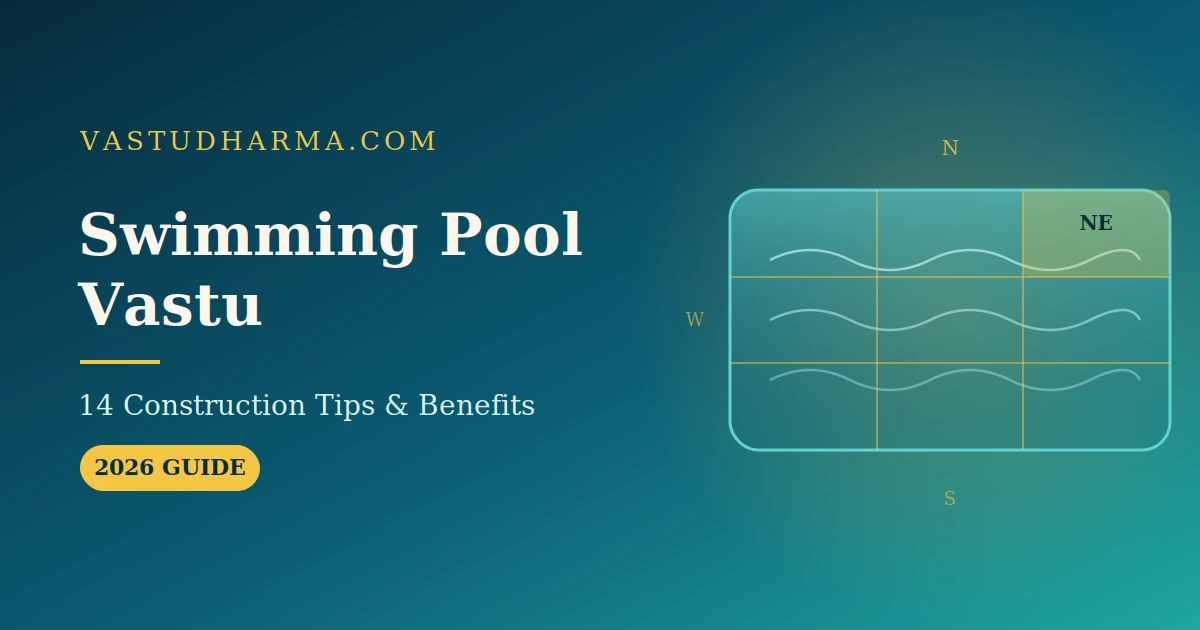
A swimming pool is one of the biggest water features you can add to a home — and in Vastu Shastra, water is never a “just decorate wherever” element. Get the direction, shape, or placement wrong, and instead of a peaceful retreat, your pool can become a source of financial strain, family friction, or health complaints, according to traditional Vastu belief.
The good news: pool Vastu is actually one of the more straightforward areas to get right, because the core rule is simple — water belongs in the north, northeast, or east of the property. Everything else in this guide builds on that one principle.
Whether you’re building a private pool at an independent house or villa, or you’re on the managing committee deciding where to place a clubhouse pool for your apartment complex, these 14 tips will help you avoid the most common Vastu mistakes.
Why Direction Matters So Much for a Pool
In Vastu, every direction is governed by a specific element and deity. North and northeast are associated with the water element and are considered naturally receptive to features like ponds, fountains, and pools. Placing a large body of water in a fire-dominant zone (southeast) or an earth-dominant, stability-focused zone (southwest) is believed to create an imbalance — quite literally mixing elements that don’t belong together.
That’s the logic behind almost every tip below.
14 Swimming Pool Vastu Construction Tips
1. Northeast (Ishan Corner) Is the Gold Standard
The northeast corner of your plot is considered the most auspicious spot for a swimming pool. This zone is associated with clarity, spirituality, and the free flow of positive energy — a pool here is believed to enhance prosperity and family harmony.
2. North or East as Strong Alternatives
If the northeast corner isn’t available — maybe it’s occupied by the main entrance or a pooja room — the north or east directions are considered the next best options. Both remain within the water-friendly zone of the compass.
3. Never in the South, Southwest, or Center
These zones are governed by fire and earth energies (Agni and stability respectively) in Vastu. A pool here is considered one of the more serious Vastu doshas for water features, traditionally linked to financial instability and health concerns for the household.
4. Avoid the Exact Center (Brahmasthan)
The center of any plot — the Brahmasthan — is meant to stay open and light in Vastu, symbolically holding the entire home’s energy in balance. A heavy water feature here is considered disruptive rather than beneficial, even though center placements can look striking in modern architectural design.
5. Keep the Pool Below Ground Level
A sunken or below-ground-level pool positioned toward the northeast is considered more auspicious than a raised or elevated pool. If your design calls for an elevated pool, try to keep the raised sections toward the south or west instead.
6. Get the Slope Right
For pools on the northern side, the base slope should ideally run from west to east — meaning the deeper end sits toward the west and the shallow end toward the east. This subtle detail is often missed by contractors unfamiliar with Vastu-specific construction.
7. Square or Rectangular Shapes Are Preferred
Vastu favors geometric regularity. Square and rectangular pools are considered the most stable and balanced shapes. Circular or oval pools are also acceptable, as their continuous curve symbolizes uninterrupted flow. Irregular, jagged, or asymmetric shapes are generally discouraged.
8. Avoid Placing the Pool Under a Bedroom or Living Room
If you’re building a multi-level home or the pool is on a terrace/podium level, make sure it isn’t directly beneath (or above) a bedroom or main living area. This is believed to disturb sleep and create a sense of unease in frequently used rooms.
9. Don’t Position It Under a Staircase or Overhead Tank
A pool directly beneath a staircase or a water tank is considered a structural and energetic conflict — combining two water-related or heavy elements in a way that Vastu treats as destabilizing.
10. Keep the Entrance to the Pool Area Separate from the Main Door
Ideally, access to the pool zone should come from the north or east side of the property, and should not align directly with your home’s main entrance. A pool visible immediately upon entry, in direct axis with the front door, is generally avoided.
11. Choose Natural, Vastu-Friendly Materials
Tiles, natural stone, and eco-friendly finishes are preferred for the pool deck and surrounds, as they’re believed to stay in harmony with the earth’s natural energy. Excessive plastic or synthetic decking is best minimized.
12. Plant Greenery Thoughtfully Around the Pool
Short plants and flowering shrubs in the north, northeast, or east enhance the positive effect of a well-placed pool. Avoid planting large, heavy-canopy trees in the southwest corner near the pool, as their shadow is believed to interfere with the water zone’s energy.
13. Prioritize Safety Alongside Vastu
A traditional but important point: Vastu guidance is never a substitute for basic pool safety. Proper fencing, non-slip flooring, adequate depth markers, and safety covers matter just as much as directional placement — especially in homes with children or elderly family members.
14. Maintain It Well — Stagnant Water Is Bad Vastu
A neglected, algae-filled, or stagnant pool is considered to work against you in Vastu, regardless of how correctly it was positioned. Regular cleaning and filtration aren’t just hygiene basics — they’re treated as essential to keeping the water element’s energy “alive” rather than stagnant.
What If You Already Have a Pool in the Wrong Direction?
Not everyone is building from scratch — many readers inherit a home, buy a resale property, or move into a villa where the pool already exists in a south or southwest location. Demolishing and rebuilding isn’t realistic for most families, so here are commonly suggested remedies:
- Keep the water moving with a fountain, waterfall feature, or regular filtration rather than letting it sit still
- Add northeast-facing lighting or a small water feature elsewhere on the property to “balance” the misplaced element
- Keep the pool impeccably clean and well-maintained — stagnation is considered worse than imperfect placement
- Avoid additional water features (fountains, ponds) in the south or southwest to prevent compounding the imbalance
- Consult a Vastu expert for a personalized assessment — a slightly-off placement is very different from a severely misplaced one, and remedies should match the actual severity
For Apartment & Society Pools: Does This Apply to You?
If you live in an apartment complex rather than an independent house, you’re not usually the one deciding where the clubhouse or common pool goes — but Vastu for shared spaces still matters if you’re on the managing committee, buying into a new project, or simply curious about your building’s layout. When evaluating a housing project, checking whether the common pool sits in the northeast/north/east zone of the overall plot (not just your individual flat) is a reasonable Vastu data point to factor in alongside the usual criteria like construction quality and amenities.
Benefits of a Vastu-Compliant Swimming Pool
- Positive energy flow: A correctly placed pool is believed to support the free circulation of beneficial energy through the property
- Natural cooling: Beyond the symbolic benefits, a well-placed pool genuinely helps cool the surrounding area during hot months
- Balance and harmony: Vastu treats correct water placement as a stabilizing influence on the household’s overall equilibrium
- Emotional wellbeing: Swimming itself has genuine relaxation and stress-relief benefits, which Vastu principles aim to support rather than work against
- Prosperity association: Traditionally, a well-placed water body is linked to sustained wealth and abundance for the family
Final Thoughts
Swimming pool Vastu comes down to one central idea: water wants to sit in the north, northeast, or east, and it wants to stay clean, moving, and well-maintained. If you’re planning new construction, this is one of the easier Vastu elements to design around from day one. If you’ve inherited a pool that doesn’t tick every box, focus on the remedies — maintenance, movement, and balancing elements elsewhere — rather than assuming a structural fix is your only option.
Frequently Asked Questions
What is the best direction for a swimming pool as per Vastu?
The northeast (Ishan) corner is considered ideal, with north and east as strong alternatives when the northeast isn’t available.
Which directions should be avoided for a swimming pool?
South, southwest, and the exact center (Brahmasthan) of the property are generally avoided in Vastu for swimming pool placement.
Can I fix a swimming pool that’s already built in the wrong direction?
You can’t always change the location, but you can apply remedies — keeping water constantly moving and clean, adding balancing features in the northeast, and avoiding additional water elements in unfavorable zones.
What shape of swimming pool is best according to Vastu?
Square and rectangular pools are most preferred for their stability and balance; circular or oval shapes are also acceptable.
Does swimming pool Vastu apply to apartment complexes?
It’s more relevant to independent houses and villas where you control the layout, but the same principles can be a useful data point when evaluating a housing project’s common pool placement.
Disclaimer: The information in this article is based on traditional Vastu Shastra principles and is intended for general informational and educational purposes only. Vastu is a belief system rooted in ancient Indian architectural tradition, and its guidance on swimming pool placement is not scientifically proven to guarantee prosperity, health, or any other specific outcome. Swimming pool construction involves significant structural, safety, and regulatory considerations — always work with a licensed architect, structural engineer, and pool contractor, and ensure compliance with local building codes, safety regulations, and society/municipal approvals before construction. This content is not a substitute for professional architectural, structural, engineering, or safety advice, and Vastu guidance should never take priority over safety standards such as fencing, depth markings, and proper filtration systems. Vastudharma.com does not guarantee any specific result from applying the suggestions in this article and encourages readers to consult a qualified Vastu expert alongside their construction professionals for guidance specific to their property.