
You’ve just moved into a cozy rental apartment. You love the neighborhood, the balcony view is great, but there’s a catch—the kitchen is in the “wrong” corner according to Vastu, and the main entrance faces a direction that makes your traditional grandmother nervous.
You can’t exactly tear down walls or remodel a home you don’t own. So, you start wondering, “Is it even worth it to fix just one room? Does Vastu even work in patches?”
The short answer? Yes, absolutely. Think of Vastu Shastra like tuning a guitar. Even if the whole instrument is slightly out of sync, tightening one string can still improve the melody. Focusing on the rooms where you spend the most time—like your bedroom or your study—can significantly shift the “vibe” of your life.
The “Micro-Vastu” Concept: Why One Room Matters
Most people think Vastu is an “all or nothing” deal. But in ancient Indian architecture, the principles of energy flow apply to a massive palace just as much as they apply to a tiny studio apartment or even a single cubicle.
I remember a friend, Rahul, who was struggling with insomnia. He lived in a house where the layout was a mess, and he couldn’t change the floor plan. We made three tiny changes to just his bedroom: we moved his bed, swapped a bright red painting for a neutral one, and cleared the junk from under his bed. Within a week, he was sleeping like a baby.
That’s the power of Micro-Vastu. You are optimizing your immediate environment.
The Sanctuary: Vastu Tips for Your Bedroom
Your bedroom is where you recharge. If the energy here is chaotic, you’ll wake up feeling like you’ve been running a marathon instead of sleeping.
1. The Power of Direction
The most important rule in a bedroom is the direction of your head while sleeping.
- The Golden Rule: Always try to sleep with your head toward the South or East.
- The Big No-No: Never sleep with your head toward the North.
Why? Think of the Earth as a giant magnet. Your body has its own magnetic field. When you sleep pointing North, the magnetic poles clash, which can lead to headaches, stress, and disturbed sleep.
2. Mirror, Mirror on the Wall (But Not There!)
One of the most common mistakes I see is a large dressing table mirror reflecting the bed. In Vastu, a mirror reflecting your sleeping body is said to “drain” your energy or cause health issues.
- The Fix: If you can’t move the mirror, simply cover it with a nice cloth at night. Problem solved!
3. Clear the Under-Bed “Museum”
Are you using the space under your bed to store old shoes, broken electronics, or suitcases? Stop! This creates “stagnant” energy. You want air and energy to circulate freely around you while you sleep. Keep it clear, keep it clean.
The Focus Zone: Vastu for Your Study Room
Whether you’re a student or working from home, your study area is your “productivity engine.” If this room is cluttered or poorly oriented, you’ll find yourself doom-scrolling on your phone instead of getting work done.
1. Facing the Right Way
When you sit down to work or study, which way are you facing?
- Best Directions: Face North or East.
- Facing East brings the energy of the rising sun (great for memory and freshness).
- Facing North is associated with opportunities and success.
2. The “Solid Wall” Support
Avoid sitting with your back to a door or a window. It creates a subconscious feeling of insecurity—like someone could sneak up on you.
- The Fix: Try to have a solid wall behind your back. It acts as a “support system” for your focus.
3. Desk Organization and Light
A cluttered desk is a cluttered mind. Keep only what you need for the current task on the surface. Also, ensure the light falls from the left side if you are right-handed, so you don’t create shadows on your work.
Common Mistakes We All Make (and How to Fix Them)
Even with the best intentions, it’s easy to trip up. Here are three things I see people get wrong when trying to do “partial Vastu”:
- The “Heavy” North-East: People often put heavy wardrobes or bookshelves in the North-East corner of a room. This corner should be light, open, and clean. Move the heavy furniture to the South or West.
- Electronic Overload: We tend to keep routers, TVs, and laptops right next to our pillows. This creates “Electronic Stress.” Keep gadgets at least 3-4 feet away from where you sleep.
- The Dead Plant Syndrome: Keeping dried flowers or dying plants in your room “for decor” is a bad idea. They represent stagnant energy. If it’s not living and breathing, it shouldn’t be in your sanctuary.
Can You Really See Results?
You might be thinking, “Will moving my desk really get me a promotion?” Think of it this way: Vastu isn’t magic; it’s psychology and environmental science. When your room is organized, your brain is calmer. When you face the right direction for light and air, your body feels more alert. When you sleep better, you perform better.
It’s about creating a “frictionless” environment. When your room works with you instead of against you, everything else in life feels just a little bit easier.
Actionable Takeaways for Your Home
If you’re ready to start, don’t try to change everything at once. Pick one room—the one you feel “stuck” in—and follow these steps:
- The Compass Test: Download a simple compass app. Stand in the middle of the room and check where North is.
- The Bed/Desk Pivot: If you can only do one thing, move your bed (Head to South/East) or your desk (Facing North/East).
- The 5-Minute Declutter: Clear out anything from under the bed or on top of your study desk that hasn’t been used in a month.
- The Color Check: Use soothing colors (whites, creams, light blues) for the bedroom. Save the bright, “fiery” colors like red or orange for the living room.
Color is actually one of the easiest and most effective ways to “fix” a room’s Vastu without moving a single piece of heavy furniture. In Vastu, colors represent the five elements (Earth, Water, Fire, Air, and Space), and each direction has a “friendly” element.
To give you the best advice, I’d need to know which direction your room faces, but here is a quick “Cheat Sheet” for the most common bedroom and study directions:
1. The North or East (The “Water & Air” Zones)
If your bedroom or study is in the North or East, you want to keep things light and fresh. These areas are all about growth and new beginnings.
- Best Colors: Off-white, light blue, or very pale green.
- Why: These colors mimic the sky and nature, which helps keep your mind calm for studying and your heart peaceful for sleeping.
- Avoid: Dark reds or deep oranges, as these “fire” colors clash with the “water” energy of the North.
2. The South or South-West (The “Earth & Fire” Zones)
This is the most common area for a Master Bedroom. It’s the zone of stability and strength.
- Best Colors: Peach, light brown, beige, or soft “earth” tones.
- Why: These colors feel “grounding.” They help you feel secure and settled, which is exactly what you want when you’re trying to get deep, restorative sleep.
- Avoid: Pure white or bright blue, which can feel too “cold” for this stable corner.
3. The West (The “Space” Zone)
The West is associated with gains and social energy. It’s a neutral zone that handles many colors well.
- Best Colors: Grey, white, or even a soft cream.
- Why: These represent the “Space” element and help keep the energy balanced.
A Pro-Tip for Study Desks
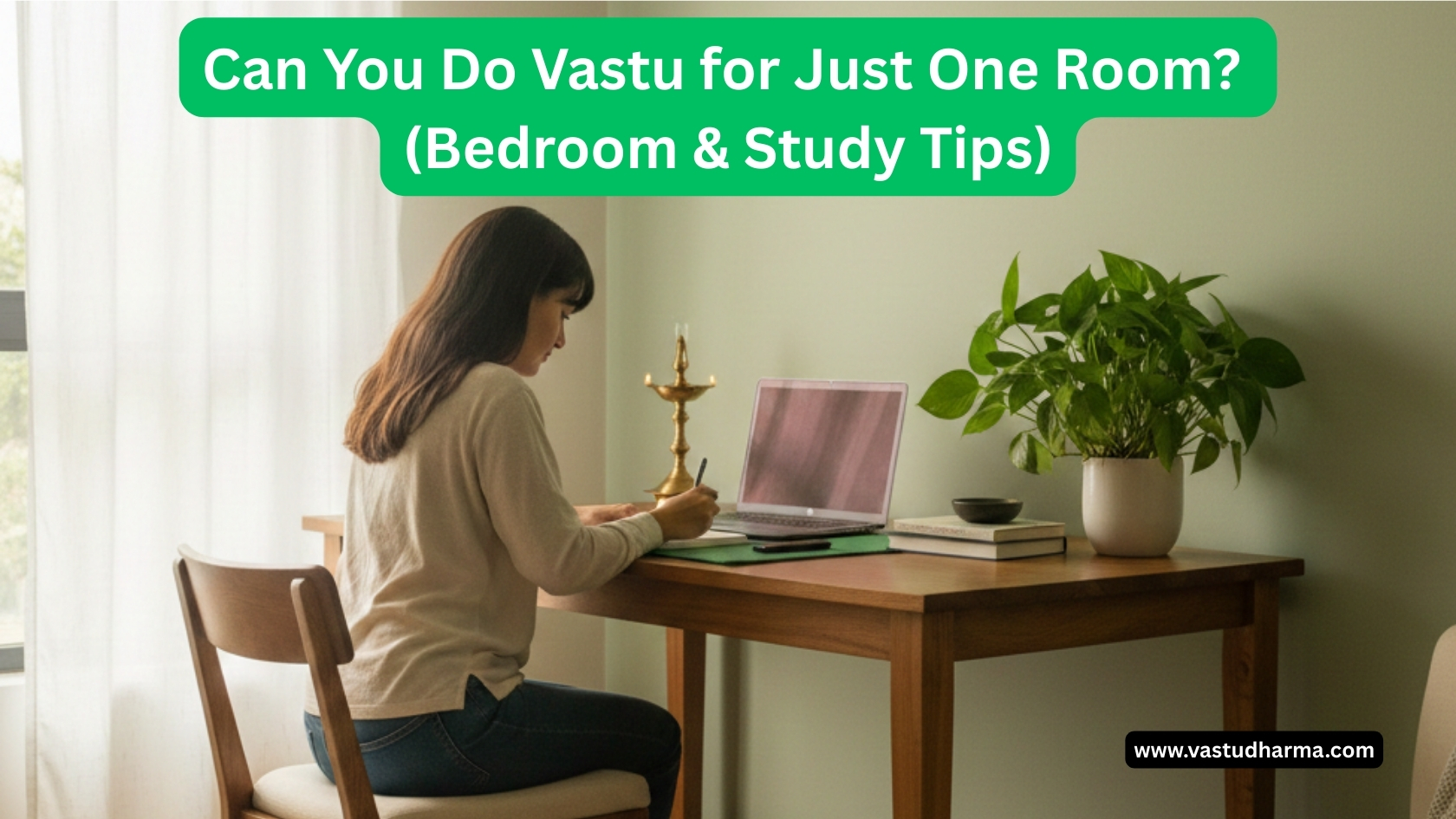
Regardless of the wall color, try to have a wooden finish or a green mat on your study table. Green is the color of Mercury (Budh), the planet of intelligence and communication. Having a splash of green where you work acts like a “battery” for your brain.
Common Color Mistake: The “Passionate” Red
Many people paint their bedroom a bright red or deep purple because they think it looks “romantic” or “royal.” In Vastu, these are high-energy colors. While they look great, they can actually make you irritable or restless over time because they never let your energy “level down.”
Conclusion
Vastu doesn’t require you to be a billionaire with a custom-built mansion. It’s a tool meant to serve you, not the other way around. By fixing just one room—the space where you dream or the space where you build your future—you are sending a signal to yourself that your environment matters.
Start small. Move that chair, cover that mirror, and see how the “vibe” changes. You might be surprised at how much lighter you feel.
Frequently Asked Questions (FAQ)
Is bedroom Vastu for rented apartments really effective?
Yes, it is. Vastu is about the energy of the space you inhabit, not necessarily the one you own. Since you can’t move walls in a rental, “Micro-Vastu” focuses on what you can control—like furniture placement, colors, and lighting. Even minor shifts, like changing your sleeping direction or adding a salt bowl to a heavy corner, can significantly improve the “vibe” and support your well-being.
What is the best direction for a study table in a small room?
In a compact space, the best direction is to place the table so you are facing East or North while working.
East brings fresh energy and clarity (great for students).
North is associated with career growth and success. Even if the table is small, ensure there is a tiny gap between the table and the wall to allow energy to circulate.
About the Author Jagdish Vajpeyee is the founder of Vastu Dharma and a Vastu Shastra consultant with a specialized focus on Vedic Astrology. With a professional background in banking, Jagdish brings a unique, analytical approach to ancient wisdom, helping modern families and businesses correct their energy flow without unnecessary demolition. He is passionate about merging traditional Indian architecture with contemporary lifestyle needs.
Disclaimer: The information provided in this article is for educational and informational purposes only. Vastu Shastra is an ancient architectural and energetic system; while many individuals find value in its principles for creating a harmonious environment, these suggestions are based on traditional interpretations and personal research. This content is not intended to be a substitute for professional architectural, legal, financial, or medical advice. The author and this website do not guarantee specific outcomes—such as financial gain or health improvements—resulting from the application of these tips. Before making significant structural modifications to your home or basement, please consult with a licensed architect or structural engineer to ensure the safety and integrity of your property.