

You know that feeling when you walk into a room and it just feels heavy? Like the air is thick, and you instantly feel tired or anxious? Now, think about the opposite—a space that feels light, breezy, and energized.
We often blame these vibes on clutter, bad lighting, or maybe just a stressful day. But have you ever looked at your house plants?
I’m serious. That innocent-looking fern in the corner or that trendy cactus on your desk might be doing more than just gathering dust. According to ancient architectural sciences like Vastu Shastra, plants are powerful energy conductors. They are like living antennas. If you place an antenna in the right spot, you get a crystal-clear signal (in this case, opportunities and cash flow). Put it in a dead zone, and you get static, dropped calls, and frustration.
In this guide, we aren’t just talking about decoration. We are talking about the invisible plumbing of your home’s finances. If your money seems to come in one hand and go out the other, it might be time to check which direction your leaves are pointing.
The “Green Engine”: How Plants Actually Influence Money
Let’s get one thing straight: a plant is not going to magically print money for you. If you buy a Money Plant and sit on the couch waiting for a check to arrive in the mail, you’re going to be waiting a long time.
However, plants influence the environment in which you make decisions.
Think of your home as a battery. The North direction is the positive terminal, and the South is the negative. Energy (or “Prana”) flows between them. Plants are living, breathing organisms that interact with this flow. When placed correctly, they act like amplifiers—they speed up the energy, keeping it fresh and moving. In financial terms, this movement equates to “liquidity”—cash flow.
The Stagnant Water Effect
I once visited a client, let’s call him Raj, who ran a small logistics business. He was working hard—12 hours a day—but his payments were always delayed. Clients would promise to pay on Monday, but the money wouldn’t hit his account until Friday… three weeks later.
When I walked into his home office, the first thing I saw was a massive, overgrown rubber plant in the North-East corner. The North-East is the “brain” of the house—it needs to be light, airy, and open. By placing a heavy, dense, earth-element plant there, Raj had essentially put a giant boulder in the middle of his financial highway.
We moved the heavy plant to the South-West (the zone of stability) and replaced it with a small jar of water and lucky bamboo in the North. It wasn’t magic, but within a month, the “heaviness” in his business lifted. The delays stopped. Why? because his environment was no longer fighting against him.
Nature’s Logic
It’s simple biology mixed with spatial geometry.
- Growth: Plants grow upward. This symbolizes rising career graphs.
- Decay: Dead leaves or rotting roots symbolize loss and waste.
- Thorns: Sharp points create defensive, prickly energy—great for a fence, terrible for a wallet.
The Directional Compass: Where to Park Your Greens
If you take nothing else away from this, remember this rule: Every direction has an element.
In Vastu Shastra, the universe is made of five elements: Water, Fire, Earth, Air, and Space. Your house is a microcosm of the universe. To keep your finances healthy, you have to match the plant to the element of the direction.
The North: The Gateway to Wealth (Water Element)
The North direction is governed by Kuber, the Lord of Wealth. This is the inlet valve for money.
- The Vibe: This area should be light, open, and fluid.
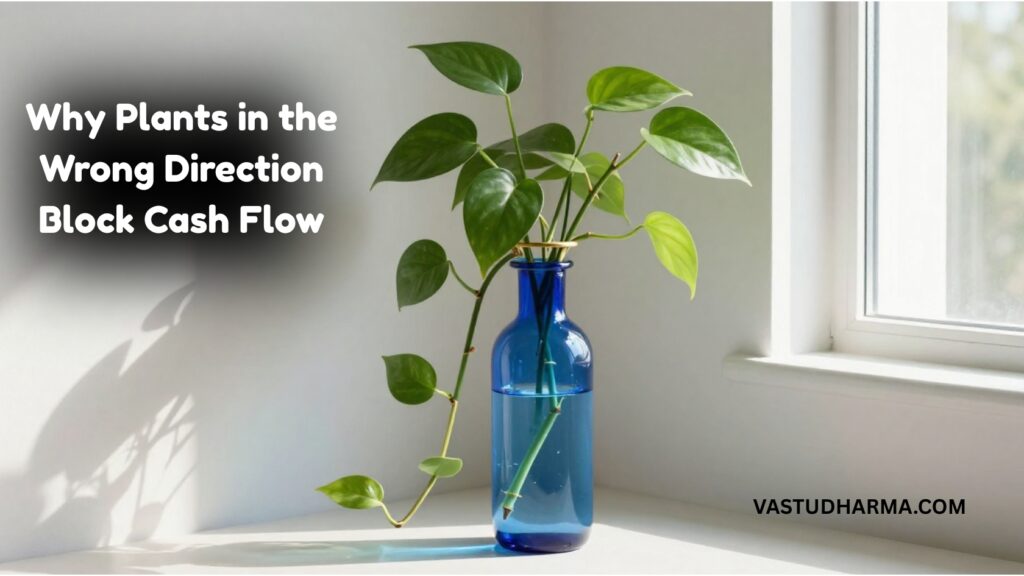
- The Best Plants: Think “water-loving.” Lucky Bamboo, small Money Plants (Epipremnum aureum) grown in blue bottles, or anything with lush, light green leaves.
- The Mistake: Placing big, heavy clay pots or tall, thick trees here. It blocks the entry. Imagine parking a semi-truck in front of your shop’s front door; customers (money) can’t get in.
The South-East: The Cash Burner (Fire Element)
The South-East is the zone of Agni (Fire). In modern terms, this is your “liquidity.” It’s the cash in your wallet, not the savings in the bank.
- The Rule: Wood feeds Fire. So, plants (Wood element) generally do well here—BUT they must not be “watery” plants.
- The Trap: If you put a Money Plant in a jar of water in the South-East, you are mixing Water and Fire. What happens when you pour water on fire? It dies. Similarly, putting water-based plants here can “douse” your cash flow, leading to a crunch where you have assets but no cash to pay the bills.
- The Fix: Use plants in red or terracotta pots here. Avoid blue pots.
The South-West: The Vault (Earth Element)
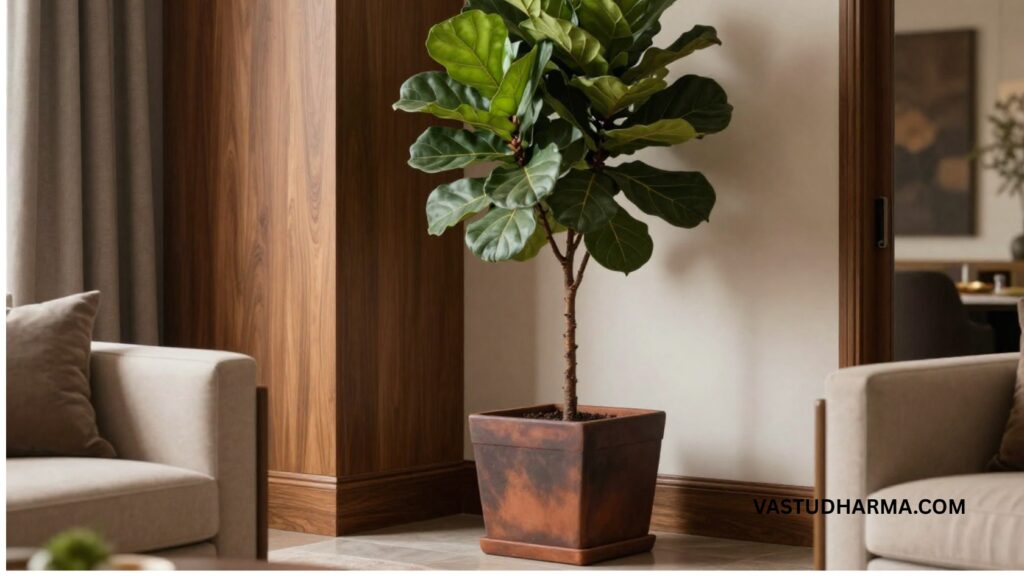
This is where you store your wealth. It’s the zone of stability, savings, and skill.
- The Strategy: You want this area to be heavy. This is the only place where heavy, tall plants are actually good.
- The Best Plants: Tall Ficus trees, Rubber plants, or heavy palms in yellow or brown square pots. These plants act like paperweights, holding your fortune down so it doesn’t blow away.
The “Anti-Wealth” Plants: Greenery That Drains Your Wallet
We often go to the nursery and pick whatever looks cute. “Oh, look at that tiny bonsai!” or “That cactus is so edgy!” But some plants, by their very nature, carry energy that conflicts with prosperity.
The Bonsai Trap: Stunted Growth
I love the art of Bonsai. It takes patience and skill. But energetically? A Bonsai is a tree that has been stopped from growing to its full potential. It is genetically wired to be a giant, but it has been clipped, wired, and restricted to stay small.
When you keep a Bonsai in your workspace or your “Wealth Corner” (North), you are subconsciously mimicking that energy. You are telling the universe, “I want my growth to be controlled, limited, and small.”
- Real-Life Consequence: You might find that you get promotions, but with a tiny raise. Or you get new business leads, but they are all small fish, never the big catch.
- Advice: Keep Bonsai in your garden or a hobby room, never in your finance sector.
Cacti and Thorns: The “Prickly” Payer
Cacti are survivors. They survive by being defensive. Their needles are designed to say, “Stay away.” If you place a cactus on your desk or in the South-East (Cash) sector, you are introducing “sharp” energy into your transactions.
- The Result: Arguments over payments. Clients who nitpick every invoice. Unexpected “stinging” expenses like a sudden car repair or a fine.
- The Exception: Rose plants are okay because they have flowers (positive energy) that outweigh the thorns, but even they should be kept outside on a balcony, not indoors.
The Downward Spiral: Creepers
Watch how your Money Plant grows. Is it climbing up a moss stick, or is it trailing down from a bookshelf toward the floor?
- The Logic: We want our bank balance to go up. Plants that cascade downward pull energy toward the ground (Earth).
- The Fix: Always give your creepers and climbers a path to travel upward. Use a green stick, a string, or a trellis. Guide the leaves toward the ceiling. It’s a simple visual metaphor that aligns your mindset with growth.
The “Money Magnets”: Plants That Actually Attract Wealth
Now that we’ve cleared out the prickly cacti and the dying ferns, let’s talk about the heavy hitters. These are the plants that, when placed correctly, act like a green light for abundance.
The Classic: Golden Pothos (The “Money Plant”)
In India and many parts of Asia, this is the undisputed king of wealth cures. But here is the secret: it’s not just about owning one; it’s about how you grow it.
- The Leaf Shape: Notice the leaves are heart-shaped? In energy terms, this invites “love” into your work.
- The Placement: Ideally, grow this in water (a blue bottle is best) in the North zone. This activates the Water element of opportunity.
- The Rule: Never, ever let it trail on the floor. I once had a client whose business had “flatlined.” I visited his office and saw his massive Pothos trailing 4 feet across the carpet. We pinned the vines up along the wall, guiding them toward the ceiling. It’s a psychological trigger: as the plant climbs, so does your ambition.
The “Dollar” Plant: Jade (Crassula Ovata)
This succulent is famous in Feng Shui. Why? Look at the leaves. They are round, plump, and look almost like coins.
- The Placement: This belongs at the entrance of your home or business. It invites wealth to walk in the front door.
- The Care: Unlike the thirstier Money Plant, Jade holds water in its leaves. This symbolizes “retaining” wealth. It’s perfect for people who earn well but can’t seem to save.
Lucky Bamboo: The Resilience Factor
This isn’t actually bamboo (it’s a Dracaena), but it’s tough as nails.
- The Number Game:
- 3 Stalks: For happiness and long life.
- 5 Stalks: For wealth.
- 6 Stalks: For luck and gold.
- The Trick: Keep the water crystal clear. If the water gets murky or smells bad, you are literally letting your financial energy rot. Change it every Tuesday or Friday.
Maintenance: Dust is the Enemy of Flow
You wouldn’t expect a solar panel to work if it was covered in mud, right? Plants are solar panels for energy.
The “Grey Film” Problem
I visit so many homes where the plants are “correct” according to Vastu, but the leaves are covered in a thick layer of grey dust.
- The Impact: Dust blocks light. In energy terms, it blocks clarity. If your North-zone plant is dusty, you might find that opportunities come to you, but they are “foggy” or confusing—like a job offer without a clear salary.
- The Fix: Once a week, take a damp cloth and gently wipe the leaves. While you do it, set an intention. Think, “I am clearing the path for abundance.” It sounds woo-woo, but it focuses your mind on your goals.
The Pot Matters
Plastic pots are okay, but natural materials are better.
- Terracotta (Clay): represents Earth. Great for stability (South-West).
- Ceramic: Represents a mix of Earth and Fire. Good for vibrant energy.
- Metal: Good for the West and North-West.
- The Cracked Pot: Never keep a plant in a chipped or cracked pot. A leak in the vessel symbolizes a leak in your wallet.
Quick Cures: What to Do If You Can’t Move Things
“But Jagdish,” you might say, “I live in a tiny studio apartment. My only window is in the South! Does that mean I’m doomed to be broke?”
Absolutely not. Vastu and Feng Shui are about balance, not rigid rules. If you can’t move the plant, you use “cures” to balance the energy.
The “Ribbon” Trick
If you have a plant in a spot where it might be draining energy (like a bathroom), tie a bright red ribbon around the pot or the stem.
- Why it works: Red is the color of Fire and vitality. It “burns off” the negative draining energy and protects the plant’s positive vibes.
The “Light” Fix
If you have a dark corner in your Wealth Zone (North) where plants just won’t grow, don’t force a real plant to die there.
- The Solution: Use a high-quality artificial plant (silk, not cheap plastic) and shine a small “uplight” or LED lamp on it. The light represents energy, and the green color represents growth. It’s 80% as effective as the real thing because your brain sees the growth.
Conclusion: It’s About Intention, Not Magic
At the end of the day, moving a flower pot isn’t going to win you the lottery tomorrow. If it were that easy, every gardener would be a billionaire.
However, your home is a reflection of your mind. When you take the time to prune a dead leaf, move a cactus outdoors, or water your bamboo, you are performing a daily ritual of “caring” for your wealth. You are telling your subconscious that you are ready for growth, you are attentive to details, and you respect the flow of abundance.
So, take a walk around your house today. Look at your green friends. Are they climbing up, or dragging on the floor? Are they dusty, or shining? A small shift in your living room might just be the shift you need in your bank account.
Actionable Takeaways:
- The “North” Check: Ensure the North side of your home has light, water-based plants (like Lucky Bamboo). Avoid heavy pots here.
- Ban the Thorns: Move cacti and thorny plants to the balcony or outside the main door.
- Climb High: If you have a Money Plant (Pothos), use a moss stick or hooks to guide the vines upward, never let them trail down.
- Dust Weekly: Wipe the leaves of your “wealth plants” every week to keep the energy channels open.
- Fix the Leaks: Immediately remove any plant that is dead, dying, or has yellowing leaves. Replace it or nurse it back to health in a “hospital” area (like a balcony) away from your main living space.
Frequently Asked Questions: about plants and Vastu for wealth
Which plant is best for money according to Vastu?
The Money Plant (Epipremnum aureum) is the top choice. It’s believed to attract wealth and remove financial obstacles. Jade Plant (Crassula ovata) and Lucky Bamboo are also excellent for attracting prosperity.
Where should I keep my Money Plant at home?
The best direction is the South-East corner of your living room or hall. This direction is governed by Lord Ganesha and represents the Fire element (cash flow). Avoid keeping it in the North-East or East, as it can cause financial losses or relationship issues.
Can I keep a cactus indoors for good luck?
No. Vastu strongly advises against keeping thorny plants like cacti inside the house. They are believed to spread negative energy, cause stress, and lead to arguments or financial losses. Keep them outside on a balcony or in the garden.
Why is my Money Plant dying?
Apart from lack of water or light, a dying Money Plant is considered a bad omen in Vastu, symbolizing financial loss. Ensure you water it regularly, give it indirect sunlight, and remove yellow leaves immediately.
Is Lucky Bamboo good for home Vastu?
Yes. Lucky Bamboo is excellent for attracting positive energy and wealth. Place it in the East or South-East corner of your home. Keep the water clean and change it frequently to prevent stagnation in your finances.
Can I put artificial plants in my home for Vastu?
While live plants are preferred for their fresh energy, high-quality silk or fabric artificial plants are acceptable if you can’t maintain real ones. Avoid cheap plastic plants or dried flowers, as they represent “dead” energy.
What should I do if my plant leaves turn yellow?
Yellow leaves represent decay and negative energy. Pluck them off immediately. Do not let dead or dying parts of a plant remain on the stem, as this symbolizes a drain on your resources.
About the Author Jagdish Vajpeyee is the founder of Vastu Dharma and a Vastu Shastra consultant with a specialized focus on Vedic Astrology. With a professional background in banking, Jagdish brings a unique, analytical approach to ancient wisdom, helping modern families and businesses correct their energy flow without unnecessary demolition. He is passionate about merging traditional Indian architecture with contemporary lifestyle needs.
Disclaimer: The information provided in this article is for educational and informational purposes only. Vastu Shastra is an ancient architectural and energetic system; while many individuals find value in its principles for creating a harmonious environment, these suggestions are based on traditional interpretations and personal research. This content is not intended to be a substitute for professional architectural, legal, financial, or medical advice. The author and this website do not guarantee specific outcomes—such as financial gain or health improvements—resulting from the application of these tips. Before making significant structural modifications to your home or basement, please consult with a licensed architect or structural engineer to ensure the safety and integrity of your property.