
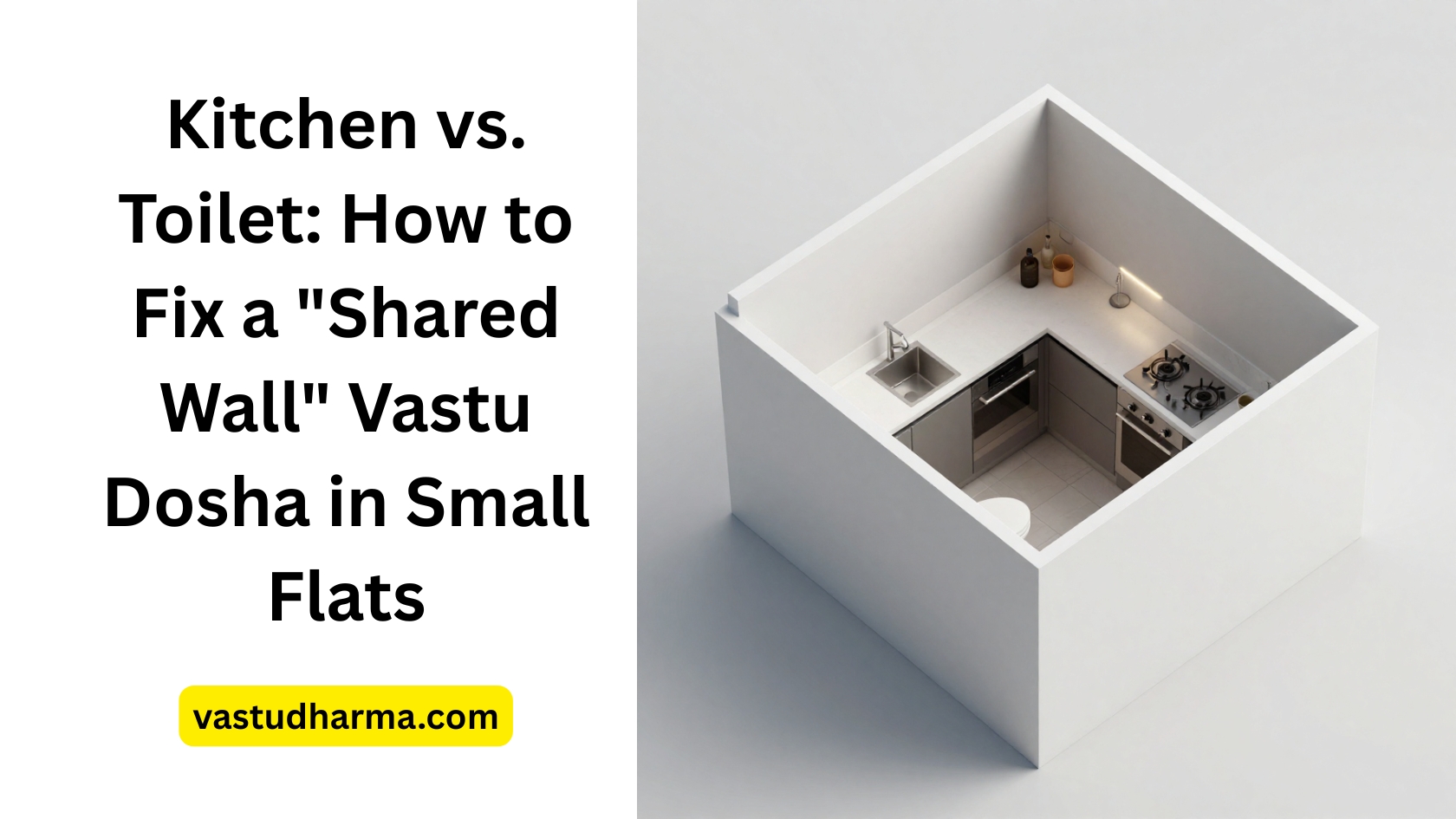
So, you’ve finally moved into that sleek, modern apartment. It’s got the balcony you wanted, the sunlight is decent, and the rent doesn’t make you want to cry every month. But then, you start looking at the floor plan a bit more closely. You notice that your beautiful, stainless-steel kitchen—the place where you make your morning coffee and healthy dinners—is sharing a wall with… the toilet.
If that gives you a bit of an “ick” feeling, you aren’t alone. In the world of Vastu Shastra, this is known as a significant dosha (or flaw). It’s essentially an energy collision. While modern architects love it because it saves money on plumbing, your home’s “vibe” might be paying the price.
Don’t worry, though. You don’t need to break down walls or move out. In this guide, we are going to look at why this happens and how you can fix it using simple, non-destructive tricks.
1. The Great Clash: Why Fire and Water Don’t Mix
In Vastu, every room represents a specific element. The kitchen is the “Agni” (Fire) corner. It’s the heart of the home, the source of health, and the energy that fuels your family. The toilet, on the other hand, is associated with the “Varuna” (Water) element, but more specifically, it’s about disposal and elimination.
When these two share a wall, you have two very different energies fighting for space.
The Science of Subtle Energy
Think of it like this: your kitchen is trying to “cook” up positive energy for your body, while the toilet is trying to “flush” away waste. When they share a wall, that wall becomes a conductor. The “disposal” energy of the bathroom starts to seep into the “nourishment” energy of the kitchen.
I once spoke to a woman named Priya who lived in a beautiful flat in Mumbai. She was an incredible cook, but she told me that no matter how much she cleaned, her kitchen always felt “heavy.” She felt tired every time she stood near the stove. When we checked the layout, her stove was backed up directly against the toilet’s commode on the other side of the wall.
It wasn’t a hygiene issue—her house was spotless. It was an energy issue. Her “Fire” was being doused by the “Waste Water” energy 24/7.
Why It Matters for Your Health
In ancient wisdom, the kitchen is directly linked to the health of the female head of the household and the overall digestion of the family. A shared wall can lead to:
- Irritability: Feeling “short-circuited” for no reason while cooking.
- Digestive Woes: Chronic acidity or feeling bloated despite eating healthy.
- Drainage of Wealth: Just like a toilet flushes away water, this layout can make it feel like your money is “flushing away” on unexpected repairs or medical bills.
2. The Builder’s Secret: Why Your Flat Is Designed This Way
You might be wondering, “If this is so bad, why do they build it this way?” The answer is simple: Plumbing Efficiency.
Plumbing vs. Peace of Mind
When a developer builds a high-rise with 200 apartments, they want to keep costs down. The most expensive part of construction (besides the foundation) is the plumbing and sewage lines. By “stacking” the kitchen and the toilet together or making them share a wall, the builder only has to run one main sewage line (the “wet wall”) up through the building.
It’s a practical, logical, and cost-saving move for the builder. But they aren’t thinking about your Prana (life force). They are thinking about PVC pipes and labor costs.
The Small Flat Trap
In small studio apartments or 1BHKs, space is at a premium. Architects try to “nest” the utilities together to leave more room for the living area. This usually means the kitchen and bathroom are squeezed into a corner, back-to-back.
I’ve seen this a hundred times in cities like Bangalore or Delhi. People buy these flats because they look “compact and efficient,” but within six months, they start feeling a sense of restless energy. You can’t change the plumbing, but you can change the way the wall interacts with your home.
3. Warning Signs: How This “Shared Wall” Shows Up in Your Life
Sometimes we don’t realize a layout is a problem until we see the symptoms in our daily lives. Since you can’t see energy with your eyes, you have to look at the “side effects.”
A Real-Life Story: The Case of the Burnout Couple
I remember a couple, Amit and Sneha, who moved into a very modern, “chic” apartment. It was their first home together. Both were high-performing bankers, used to stress, but suddenly they found themselves arguing over the smallest things—like who forgot to buy milk or whose turn it was to do the laundry.
When I looked at their floor plan, the kitchen sink and the toilet were on the same shared wall. In Vastu, the sink is “Water” and the stove is “Fire.” But because the toilet was also right there, the “Water” element in that part of the house was completely overwhelmed and “dirty.”
Sneha mentioned that she felt “drained” every morning. Amit felt like his career had hit a plateau. We didn’t do a renovation; we simply used a “Vastu Shield” (which I’ll explain in the next section) and changed the color of the shared wall. Within weeks, the “static” in their relationship cleared up.
Common “Symptoms” of the Shared Wall Dosha:
- The “Lobby” Effect: People don’t like to hang out in your kitchen. It feels like a place you want to leave as quickly as possible.
- Stagnant Savings: You earn well, but your savings account never seems to grow. It’s as if there’s a “leak” in your finances.
- Frequent Illness: Small, nagging health issues like colds, headaches, or low energy that seem to “cycle” through the family.
If any of this sounds familiar, don’t panic. You aren’t “cursed.” You just have a bit of architectural static that needs to be tuned out.
4. The “Vastu Shield”: Non-Invasive Remedies for Small Spaces
Since you can’t exactly call a contractor and ask them to slide your bathroom two feet to the left, we have to look at “energetic insulation.” Think of it like soundproofing a room. You aren’t moving the noise; you’re just making sure it doesn’t get through the wall.
The Copper Strip Technique
One of the most effective ways to “cut” the energy of a shared wall is using a copper strip or wire. In Vastu, copper is considered a highly sattvic (pure) metal and a powerful energy conductor.
- The Fix: Take a thin copper strip or wire and place it along the length of the shared wall, either on the floor or near the ceiling. If you’re a renter, you can even hide it behind a skirting board or a piece of molding.
- Why it works: The copper acts as a “circuit breaker.” It prevents the negative, draining energy from the bathroom from crossing over into the kitchen’s vital space.
The Mirror Illusion (Use with Caution!)
Mirrors can be your best friend or your worst enemy in a small flat.
- The Fix: If your kitchen is sharing a wall with the toilet, you can hang a large mirror on the kitchen side of that shared wall.
- The Logic: In energetic terms, a mirror “pushes” the wall back. It creates the illusion that the bathroom doesn’t exist behind it. You’re essentially “reflecting” the kitchen’s energy back into itself rather than letting it leak into the toilet.
Note: Just make sure the mirror isn’t reflecting the stove directly. You don’t want to “double” the fire, as that can lead to high tempers in the house!
Using Wood as a Buffer
In the cycle of elements, Wood acts as a bridge between Water and Fire.
- The Fix: If you have a shared wall, try to place wooden cabinets or a wooden panel against it on the kitchen side.
- The Logic: Water (Toilet) feeds Wood, and Wood feeds Fire (Kitchen). Instead of Water putting out the Fire, the Wood element absorbs the Water and uses it to fuel the Fire. It turns a conflict into a productive cycle.
5. Color Therapy: Neutralizing the Conflict
Color isn’t just about aesthetics; it’s about frequency. If your kitchen and toilet share a wall, the colors you choose can either amplify the problem or “quiet” the energy down.
The Neutral Zone
When walls are shared, avoid “aggressive” colors on that specific wall.
- The Mistake: Painting the shared wall bright red (too much fire) or deep blue (too much water). This just makes the clash more intense.
- The Solution: Use Cream, Beige, or Off-White. These are “Earth” tones. Earth is the element that stabilizes everything. It “soaks up” the excess water from the bathroom and “grounds” the fire from the kitchen.
The “Hidden” Remedy: Sea Salt
This is a classic “Grandma’s remedy” that actually has a lot of weight in Vastu.
- The Fix: Place a small bowl of unrefined sea salt in a corner of the bathroom that shares the wall.
- The Logic: Salt is a natural absorber of “negative ions” and stagnant energy. It acts like a little vacuum cleaner, sucking up the “drainage” energy before it can even touch the shared wall. Just remember to change the salt every week (flush the old salt down the toilet) to keep it effective.
6. Habitual Vastu: Small Daily Changes with Big Impact
Sometimes the best Vastu fixes don’t cost a penny. They just require a change in how you live in your space. This is especially important in 1BHKs or studio apartments where everything is close together.
The “Lid Down” Rule
This is the number one rule for any home with a shared wall. Keep the toilet lid closed at all times when not in use.
- The Logic: An open toilet is a constant “drain.” It’s literally a hole where energy is being sucked out. By closing the lid, you’re putting a cap on that drainage.
- Pro-Tip: Also, keep the bathroom door closed. If you have a shared wall, that door should be treated like a vault. Keep it shut!
Cleanliness is More Than Godliness
In a small flat, clutter isn’t just a mess—it’s “stuck” energy.
- The Kitchen Side: Keep the shared wall in the kitchen as clear as possible. Don’t stack dirty dishes against it. Don’t lean your broom against it.
- The Bathroom Side: Fix any leaks immediately. A dripping faucet on a shared wall is like a “slow leak” in your bank account. In Vastu, “leaking water equals leaking wealth.”
The Power of Fragrance
Use scent to define the space.
- In the Kitchen: Use citrus or ginger scents. These are “Fire” scents that keep the energy bright and clean.
- In the Bathroom: Use camphor or sandalwood. These are “Cleansing” scents that neutralize the heavy energy of the toilet.
Common Mistakes to Avoid in Shared-Wall Layouts
- Stove Placement: Never place your gas stove or hob directly against the shared wall if the toilet is on the other side. If you must, use a “Vastu Shield” (like a piece of tin or copper) between the stove and the wall.
- Religious Symbols: Avoid hanging pictures of deities or ancestors on a shared wall. It’s considered disrespectful to have a divine image backed up against a bathroom.
- Storage: Don’t store your drinking water or grains (rice, flour) right against the shared wall. These are high-energy foods that “absorb” the vibes of their surroundings. Move them to a different wall if possible.
Balancing the “Wet and Dry”
Living in a small flat means making compromises, but your peace of mind doesn’t have to be one of them. While a shared wall between a kitchen and a toilet isn’t “ideal” in Vastu, it is absolutely manageable.
Remember, Vastu isn’t about fear; it’s about alignment. By using a few simple tools—like a copper strip, the right colors, and a bowl of sea salt—you can create an energetic “buffer” that keeps your kitchen’s fire burning bright and your bathroom’s drainage exactly where it belongs.
Your home is your sanctuary. Even if it’s small, and even if the plumbing is a bit quirky, you have the power to make it a place where you feel healthy, wealthy, and at peace.
Actionable Takeaways:
- Seal the Drain: Keep the toilet lid and bathroom door closed 24/7.
- Buffer with Metal: Install a thin copper wire along the shared wall to act as an energy breaker.
- Salt the Air: Keep a bowl of sea salt in the bathroom to absorb stagnant energy.
- Choose Earth Tones: Paint the shared wall in cream or beige to ground the conflicting elements.
- Check the Stove: Ensure your stove isn’t directly touching the wall that shares a pipe with the toilet.
Frequently Asked Questions regarding the “Kitchen-Toilet” shared wall:
Is it bad to have a kitchen and toilet sharing the same wall?
In Vastu, yes. It is considered a dosha because it brings the Fire element (Kitchen) and the Disposal/Water element (Toilet) into direct conflict. It can lead to health issues and financial instability if left uncorrected.
Where should I place my stove if the kitchen shares a wall with the bathroom?
You should ensure the stove is not placed directly against the shared wall. If space is tight, move it to an adjacent wall or place a “Vastu barrier,” such as a copper sheet or a tiled backsplash, between the stove and the wall.
What is the best color for a shared kitchen-bathroom wall?
Neutral, grounding colors are best. Beige, cream, or light yellow represent the Earth element, which helps stabilize and absorb the clash between the Fire of the kitchen and the Water of the bathroom.
Does keeping the bathroom door closed really help?
Absolutely. It is the simplest and most effective non-invasive remedy. Keeping the door and the toilet lid closed prevents the “drainage” energy from leaking out and affecting the “nourishment” energy of the kitchen.
Can I place a Vastu pyramid or copper strip on a shared wall?
Yes, these are common “cures.” A copper strip installed along the length of the floor or ceiling on the shared wall acts as an energy breaker, separating the two zones effectively without needing a renovation.
About the Author Jagdish Vajpeyee is the founder of Vastu Dharma and a Vastu Shastra consultant with a specialized focus on Vedic Astrology. With a professional background in banking, Jagdish brings a unique, analytical approach to ancient wisdom, helping modern families and businesses correct their energy flow without unnecessary demolition. He is passionate about merging traditional Indian architecture with contemporary lifestyle needs.
Disclaimer: The information provided in this article is for educational and informational purposes only. Vastu Shastra is an ancient architectural and energetic system; while many individuals find value in its principles for creating a harmonious environment, these suggestions are based on traditional interpretations and personal research. This content is not intended to be a substitute for professional architectural, legal, financial, or medical advice. The author and this website do not guarantee specific outcomes—such as financial gain or health improvements—resulting from the application of these tips. Before making significant structural modifications to your home or basement, please consult with a licensed architect or structural engineer to ensure the safety and integrity of your property.
1 thought on “Kitchen vs. Toilet: How to Fix a “Shared Wall” Vastu Dosha in Small Flats”