
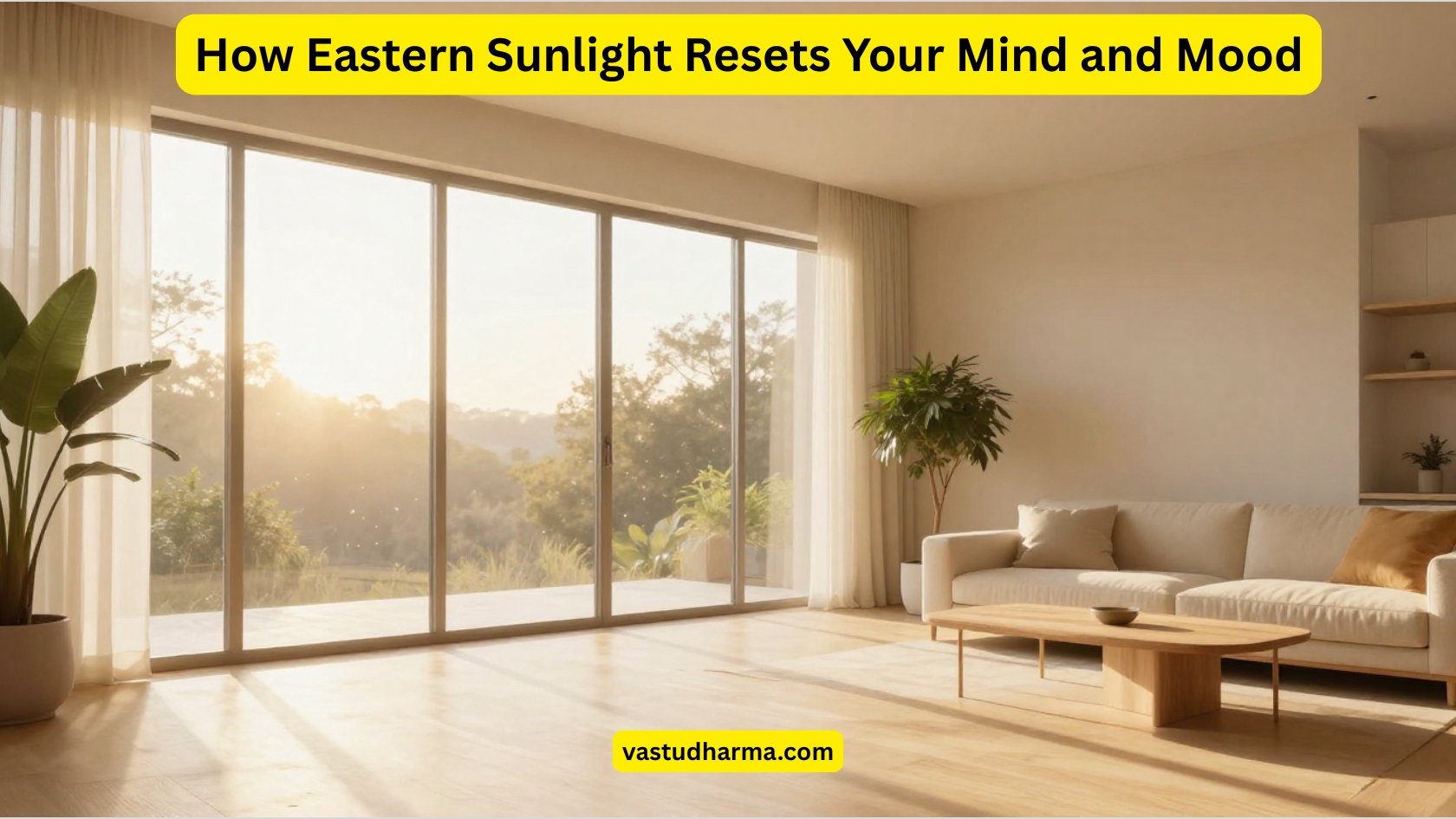
Have you ever noticed how a gloomy, overcast day makes you want to crawl back under the covers and stay there forever? Or how, on the flip side, walking into a room flooded with the early morning sun feels like an instant shot of espresso for your soul?
I remember talking to a friend, Ravi, who had recently moved into a new apartment. On paper, it was perfect—modern, spacious, and in a great neighborhood. But within three months, he felt like a different person. He was constantly tired, irritable, and found himself spiraling into a low mood that he just couldn’t shake. When I visited him, I realized the problem immediately: his bedroom was tucked away in the back of the building with one tiny window facing a dark alley to the West. He hadn’t seen a sunrise from his own home in months.
In the world of Vastu Shastra, we often talk about directions like they are magical, but there is a deeply grounded science behind why the East is considered the most important direction for your mental health. It’s not just about “good vibes”; it’s about how your home interacts with the most powerful healing tool we have: the Sun.
1. The Science of the “Morning Reset”
Why Your Body Craves the East
To understand why a lack of sunlight leads to depression, we have to look at how our bodies are wired. Think of your body like a high-tech smartphone. For it to function correctly, its internal clock needs to “sync” with a master server every single morning. That master server is the Sun.
The Circadian Rhythm: Your Internal Body Clock
We all have an internal 24-hour clock called the Circadian Rhythm. This clock tells your brain when to release Serotonin (the “happy” hormone that keeps you calm and focused) and when to release Melatonin (the “sleep” hormone that helps you recover at night).
When you wake up and your eyes catch those first golden rays of eastern light, it sends a direct signal to your brain: “Hey, the day has started! Stop making Melatonin and start pumping out Serotonin.”
What Happens When You’re “Out of Sync”?
If you live in a home where the East is blocked—maybe by a heavy wall, a staircase, or thick curtains that stay closed—your body never gets that “start” signal. You stay in a state of “social jetlag.” You feel groggy in the morning, anxious during the day, and ironically, you find it harder to sleep at night. Over time, this chronic “hormonal confusion” is a leading physical trigger for clinical depression and seasonal affective disorder (SAD).
A Real-Life Example: Think of a plant placed in a dark corner. It doesn’t die instantly, but it loses its color, its leaves droop, and it stops growing. Humans are no different. Without the “Prana” (life force) that enters through the East, our mental “leaves” begin to wilt.
2. Vastu Shastra and the “Head” of the Home
In Vastu, the house is seen as a living organism called the Vastu Purusha. The North-East (Ishan) and the East represent the head and the face of this being.
The Portal of Opportunity
If the “face” of your home is covered or dirty, how can it see the opportunities coming its way? The East is ruled by Lord Indra (the king of gods) and Surya (the Sun God). Spiritually, this direction represents new beginnings, clarity of thought, and social connections.
When this zone is compromised, the “mental atmosphere” of the house becomes heavy. I once consulted for a family where the East side of their home was used as a junk storage area. Old newspapers, broken electronics, and heavy trunks were piled up against the eastern wall. The result? The family felt “stuck.” The son couldn’t focus on his studies, and the father felt a constant weight of “unexplained sadness.”
Why “Weight” Matters in the East
One of the most common Vastu mistakes is placing heavy furniture or constructing a staircase in the East. In Vastu logic, the East and North should always be light and open, while the South and West should be heavy and closed.
- The Logic: You want to let the morning energy in and keep the evening heat out.
- The Consequence: A “heavy” East creates a mental “block.” It feels like you are constantly pushing against a headwind in life.
3. Common Vastu Defects in the East That Drain Your Mood
Before we look at the fixes, we need to identify the “leaks.” You might be doing everything right—eating well, exercising—but if your environment is working against you, it’s like trying to swim upstream.
The “Hidden” Sunlight Killers
- The Toilet in the East: This is a major “Dosha.” A toilet is a place of waste and drainage. Placing it in the direction of the rising sun is like pouring ink into a clear stream. It “pollutes” the mental energy of the residents, often leading to cynical thoughts and a lack of motivation.
- Tall Trees or High Compound Walls: Sometimes the problem isn’t inside your house, but just outside. If you have massive, thick trees right against your eastern windows, you are effectively living in a permanent eclipse.
- The Red/Dark Color Trap: Painting your eastern walls in very dark, muddy, or overly aggressive colors (like deep chocolate or dull grey) can absorb the light rather than reflecting it into the room. This makes the space feel “compressed.”
The Story of the “Blue Room”
I remember a client who painted her East-facing meditation room a very dark, navy blue because she thought it would be “calming.” Instead, she found herself crying during her practices. We changed the wall color to a very pale, “sun-kissed” cream and added a large mirror on the North wall to reflect the eastern light. Within two weeks, she told me the room felt like it had “doubled in size,” and her morning anxiety had vanished.
4. How to “Open” the East Without Renovating
Not everyone has the luxury of knocking down a wall or moving a staircase. If you are living in a rented apartment or a house with structural limitations, don’t worry—Vastu is about balancing energy, not just moving bricks.
The Mirror Trick
If your Eastern wall is solid and has no windows, the best remedy is a large, high-quality mirror. By placing a mirror on the Eastern wall (or the North wall to reflect light from the East), you create a “virtual window.” It creates an illusion of depth and reflects whatever light does enter the home, bouncing it into the dark corners of your mind.
Use the Power of “Light” Colors
If you can’t get physical sunlight, you must simulate its vibration. Paint your Eastern rooms in shades of:
- White or Off-White: To maximize light reflection.
- Light Yellow or Cream: To mimic the Sun’s spectrum.
- Pale Green: Representing growth and the wood element associated with the East.
The Crystal Solution
Hanging a faceted lead crystal in a window (even if the window is small or slightly off-center) can help. When the sun hits these crystals, they scatter rainbows across the room. In Vastu, these “rainbows” are considered pure, broken-down white light that purifies the “Prana” of the room. It’s a simple, low-cost way to cheer up a space that feels “dead.”
5. The Kitchen and the East: Fueling Your Emotional Fire
In many Indian households, the kitchen is the heart of the home. Vastu places a huge emphasis on the South-East (Agneya), which is the transition between the East and the South.
Cooking with the Sun
Ideally, the person cooking should face East. Why? Because when you face East while preparing food, you are absorbing the morning solar energy. This energy is transferred into the food through your mood and intention.
A Short Story:
I once met a woman named Meera who complained that her family was always “on edge.” No one ate together, and dinner time was filled with silence or bickering. I noticed her stove was placed such that she faced a dark, windowless South wall while cooking. She felt claustrophobic and grumpy, and that “grumpiness” literally went into the rotis. We moved her induction cooktop to a small island where she could face the Eastern balcony. Within a month, she felt more cheerful, and surprisingly, the family started lingering at the table longer.
Avoid the “Fire and Water” Conflict
A common mistake is having a sink (Water) right next to the stove (Fire) in the East or South-East. This creates internal “steam” or friction in the house. If you can’t move them, place a small green plant or a wooden divider between them to act as a “buffer” between these two clashing elements.
6. Morning Rituals to Activate Your “Internal Sun”
Vastu isn’t just about where your sofa sits; it’s about how you interact with your space. To truly reset your circadian rhythm and beat depression, you need to “invite” the East into your body.
The 10-Minute Sun Salutation
Even if you don’t do yoga, simply standing in your Eastern balcony or by an Eastern window for 10 minutes between 6:00 AM and 8:00 AM is life-changing.
- Step 1: Open the curtains wide.
- Step 2: Keep your phone in another room (blue light from screens competes with the sun and ruins the “reset”).
- Step 3: Take deep breaths. This is called Surya Arghya or Sun Gazing (safely). It tells your nervous system that the world is safe and the day has begun.
Sound and Scent
The East is associated with the “Air” and “Space” elements. Using a brass bell or playing soft flute music in the morning in the Eastern zone breaks up stagnant energy. Pair this with the scent of sandalwood or citrus to further stimulate the brain’s alertness centers.
7. The Checklist: Is Your East Healthy?
To make this actionable, here is a quick “audit” you can do today. If you answer “No” to more than two of these, your home’s East zone might be contributing to your low mood.
| Question | Yes | No |
| Can you see the sky from your Eastern windows? | [ ] | [ ] |
| Is the Eastern floor level lower than the Western floor? | [ ] | [ ] |
| Is the East area of your home free of heavy storage/junk? | [ ] | [ ] |
| Are the curtains in the East kept open until noon? | [ ] | [ ] |
| Is the Eastern wall painted in a light, bright color? | [ ] | [ ] |
Conclusion: Light the Way to a Brighter Mind
At the end of the day, Vastu Shastra is a bridge between our external environment and our internal biology. We are not separate from the buildings we live in; we “breathe” with them.
If you’ve been feeling heavy, unmotivated, or “stuck” in a dark mental place, don’t just look at your thoughts—look at your walls. Look at your windows. Your home might be “starving” for the light it needs to keep your brain healthy. By opening up the East, clearing the clutter, and aligning your morning routine with the rhythm of the sun, you aren’t just following an ancient tradition—you are giving your body the biological “software update” it needs to thrive.
Actionable Takeaways:
- Declutter the East: Spend 15 minutes today removing anything heavy or broken from the Eastern part of your home.
- Light Up: Replace any fused bulbs in the East with “Cool Day Light” (6500K) LEDs to simulate morning sun.
- The 7 AM Rule: Commit to opening every Eastern curtain by 7 AM for the next 7 days. Observe how your energy levels change.
Frequently Asked Questions (FAQs)
Can Vastu really help with clinical depression?
While Vastu is not a substitute for medical treatment, practitioners and researchers suggest it acts as “environmental therapy.” By correcting imbalances in zones like the North-East (mental clarity) and East (energy), you reduce the external stressors and biological disruptors (like lack of light) that can worsen depressive symptoms.
What is the “circadian reset,” and why is the East direction so important?
The “circadian reset” is your body’s way of syncing its internal clock with the 24-hour day. Sunlight in the East is the primary trigger for this. Early morning light has a specific blue-light frequency that signals the brain to stop producing Melatonin (sleep hormone) and start producing Serotonin (mood-stabilizing hormone).
What does a “blocked” East zone mean for my mood?
A “blocked” East usually refers to structural obstructions like heavy walls, lack of windows, or clutter. In Vastu, this prevents Prana (life force) from entering. Biologically, it means you aren’t getting the morning light needed to regulate your hormones, leading to “brain fog,” lethargy, and a persistent low mood.
Are there simple remedies if I don’t have an East-facing window?
Yes, this is a top-tier query for apartment dwellers. Popular “hacks” include:
Mirrors: Placing a large mirror on the North or East wall to reflect light deeper into the room.
Color Therapy: Using light yellow or “sun-kissed” cream paints to mimic the sun’s vibration.
Full-Spectrum Bulbs: Using “Daylight” LEDs (6500K) in the morning to simulate natural sky light.
Why is the North-East (Ishan) corner called the “Brain” of the house?
In the Vastu Purusha Mandala, the head of the cosmic being lies in the North-East. This zone represents the Water element and governs the subconscious mind. Clutter, toilets, or heavy storage here are believed to “clog” your thinking, leading to anxiety and overthinking.
About the Author Jagdish Vajpeyee is the founder of Vastu Dharma and a Vastu Shastra consultant with a specialized focus on Vedic Astrology. With a professional background in banking, Jagdish brings a unique, analytical approach to ancient wisdom, helping modern families and businesses correct their energy flow without unnecessary demolition. He is passionate about merging traditional Indian architecture with contemporary lifestyle needs.
Disclaimer: The information provided in this article is for educational and informational purposes only. Vastu Shastra is an ancient architectural and energetic system; while many individuals find value in its principles for creating a harmonious environment, these suggestions are based on traditional interpretations and personal research. This content is not intended to be a substitute for professional architectural, legal, financial, or medical advice. The author and this website do not guarantee specific outcomes—such as financial gain or health improvements—resulting from the application of these tips. Before making significant structural modifications to your home or basement, please consult with a licensed architect or structural engineer to ensure the safety and integrity of your property.