
Toilet in North-East or Brahmasthan? What Vastu Actually Recommends
Most Vastu articles treat a toilet in the north-east and a toilet in the Brahmasthan as the same emergency, hand you the same three remedies, and move on. They’re related problems, but they’re not the same problem. The north-east corner and the exact centre of your home sit in different positions on the Vastu Purusha Mandala, answer to different elements, and respond to different corrections. If someone has just pointed out that your toilet falls in one of these zones, here’s the direct answer, followed by everything else you actually need.
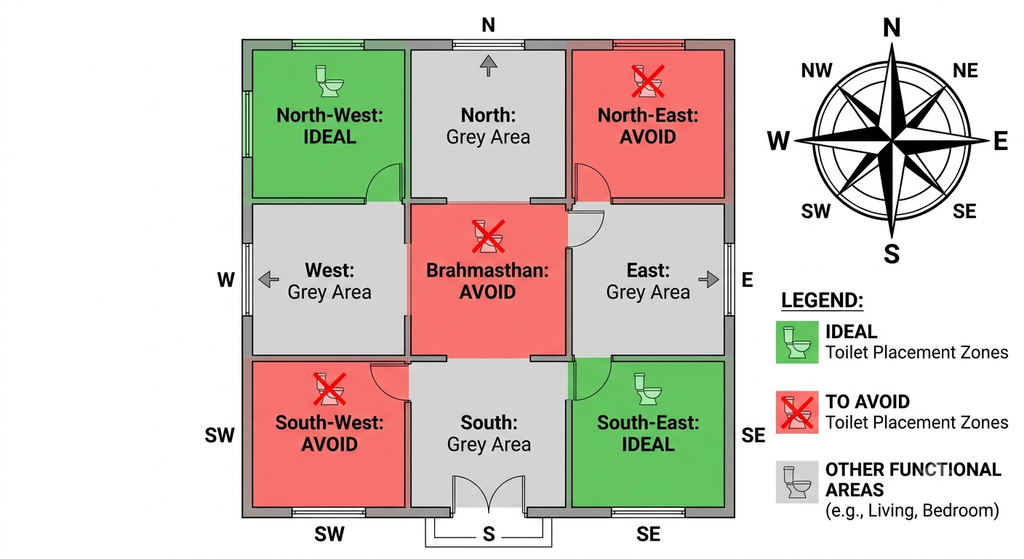
Quick answer: Classical Vastu Shastra advises against a toilet in either the north-east or the Brahmasthan, but for different reasons. The north-east (Ishan corner) is treated as the point where prana, or life energy, enters the home, and is traditionally kept for worship or open space. The Brahmasthan — the geometric centre of the plot — is meant to stay open so energy can circulate outward to the eight zones around it. Both are considered serious defects (dosha), but the remedies for each are not interchangeable, which is the part most guides skip.
If you can’t relocate the toilet — true for the large majority of flat owners and almost every tenant — non-structural remedies exist for both situations. They don’t change the physical layout, but within Vastu’s own framework, they’re the accepted way to manage a dosha you’ve inherited rather than created. We’ll go through both zones separately, then cover what’s realistic if you’re renting.
North-East vs. Brahmasthan: Why They’re Not the Same Problem
| North-East (Ishan Corner) | Brahmasthan (Centre) | |
|---|---|---|
| Location | The corner where the north wall meets the east wall | The geometric centre of the plot or floor plan — not a corner |
| Ruling deity | Ishana, a form of Shiva | Brahma |
| Governing element | Water (jal) | Space/ether (akasha) — often described as the neutral meeting point of all five elements |
| Position on the Vastu Purusha | The head | The navel |
| Classical guidance | Keep light and open; ideal for worship, water storage, or an open corner | Keep completely unobstructed — no walls, columns, or heavy fixed structures |
| Why a toilet is a problem here | Waste and drainage sit at the point meant for energy to enter | A permanently enclosed, “wet” structure occupies the exact point meant to distribute energy outward |
| How consultants typically rank severity | Serious | Also serious — sometimes ranked more disruptive, since a compromised centre is said to affect the whole floor plan rather than one corner |
Severity rankings vary by consultant and by which regional tradition they trained in — the table above reflects the most common contemporary view, not a single universal rule everyone agrees on.
Where This Comes From: The Vastu Purusha Mandala, Briefly
Both zones trace back to the same source: the Vastu Purusha Mandala, the grid every classical Vastu recommendation is built on. The story, told in the Matsya Purana and referenced in the Brihat Samhita — a 6th-century-CE text by the astronomer Varahamihira that remains one of the earliest detailed sources on Vastu — describes a being pinned face-down to the earth by the gods, with each deity taking a position on his body. Brahma occupies the navel, at the exact centre. That point became the Brahmasthan. The head, in this arrangement, falls in the north-east, which is why that corner carries its own separate significance rather than being treated as just another edge zone.
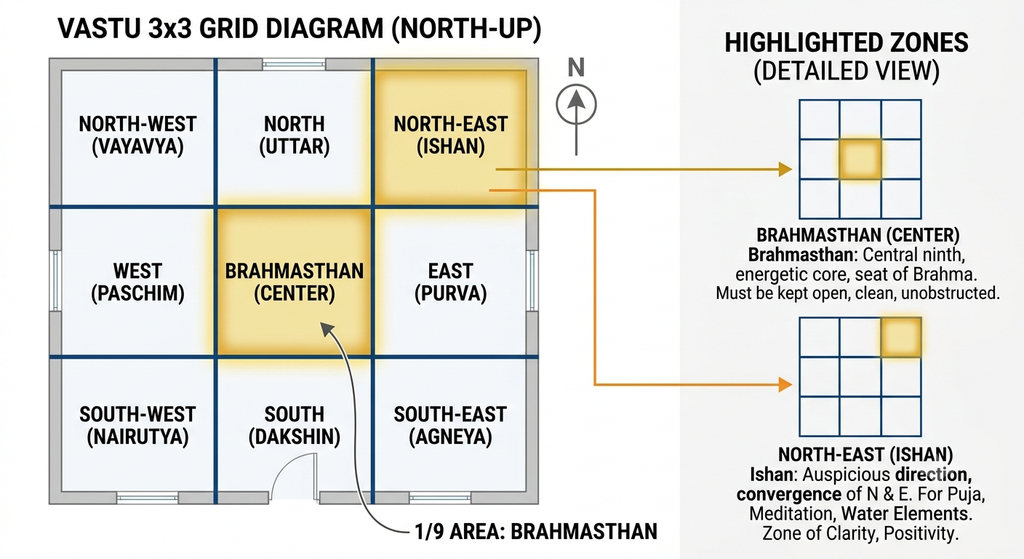
For practical home use, most consultants simplify the full mandala — which classical texts describe in versions running to 64 or 81 squares — into a working 9-zone grid: divide the plot into a 3×3 layout, and the centre square is your Brahmasthan. This is a reasonable simplification for everyday use, worth knowing so you’re not trying to plot 81 individually-named deities onto a two-bedroom flat.
One distinction worth being upfront about: the mandala itself, and the idea that the north-east and centre should stay open, comes from these classical texts. Many of the specific objects sold as remedies today — copper pyramids, branded yantras, “energy strips” — are contemporary consultancy additions, not things you’ll find named in Brihat Samhita or Mayamata. That doesn’t make them useless within the tradition, but it’s worth knowing the difference between what’s centuries-old doctrine and what’s a more recent practice built on top of it.
For a full walkthrough of all the mandala’s zones and their ruling deities
How to Actually Check If Your Toilet Is in the North-East or Brahmasthan
A surprising number of “Vastu problems” turn out to be misdiagnosed. Before you apply any remedy, confirm you’re actually dealing with what you think you’re dealing with:
- Find true north, not assumed north. Use a compass app corrected for magnetic declination, or a physical compass, and take the reading standing at the centre of the plot — not at the front door, which can be misleading in irregular layouts.
- Draw the plot as a simple rectangle. Even if your actual flat has notches or extensions, start with the basic outer boundary.
- Divide it into a 3×3 grid. In a north-up drawing, the north-east square is the top-right zone. The centre square is the Brahmasthan.
- Check the toilet’s full footprint, not just the commode. A toilet whose fixtures sit in the west but whose outer wall clips into the north-east square still counts as a partial affliction of that zone.
- Treat irregular plots as a professional job. L-shaped flats, plots with cut corners, or buildings with significant extensions shift where the true centre falls in ways that aren’t obvious from a quick sketch. If your layout isn’t close to a clean rectangle, this is worth a proper on-site or plan-based consultation rather than a DIY estimate.
A common mistake worth flagging directly: people often confuse “my house faces north” with “my toilet is in the north-east.” The direction your main door faces and which zone a specific room occupies are two separate checks, using two separate parts of the same grid. You can have a north-facing home with a toilet nowhere near the north-east, or a south-facing home with one squarely inside it.
An Honest Note on What “Effects” Actually Means Here
In Vastu consultations, an afflicted north-east or Brahmasthan is commonly associated with a general sense of instability in the home — recurring minor health complaints, money that doesn’t seem to “stay” however much comes in, more friction at home than usual, restless sleep, or a flat, stuck feeling in work and in prayer or meditation practice.
It’s worth being direct about what this is: a traditional association passed down through classical texts and generations of consultancy practice, not a claim verified by modern medicine or science. That doesn’t make it meaningless — for a very large number of Indian households, it’s a genuine part of how home, wellbeing, and decision-making are understood, and that’s the lens this article uses throughout. What it does mean is that no one, however experienced, can honestly tell you a toilet in the wrong corner will cause a specific illness or a specific life event. Treat the remedies below as traditional practice, not medical or financial guarantees.
Fixing a Toilet in the North-East (Ishan Corner)
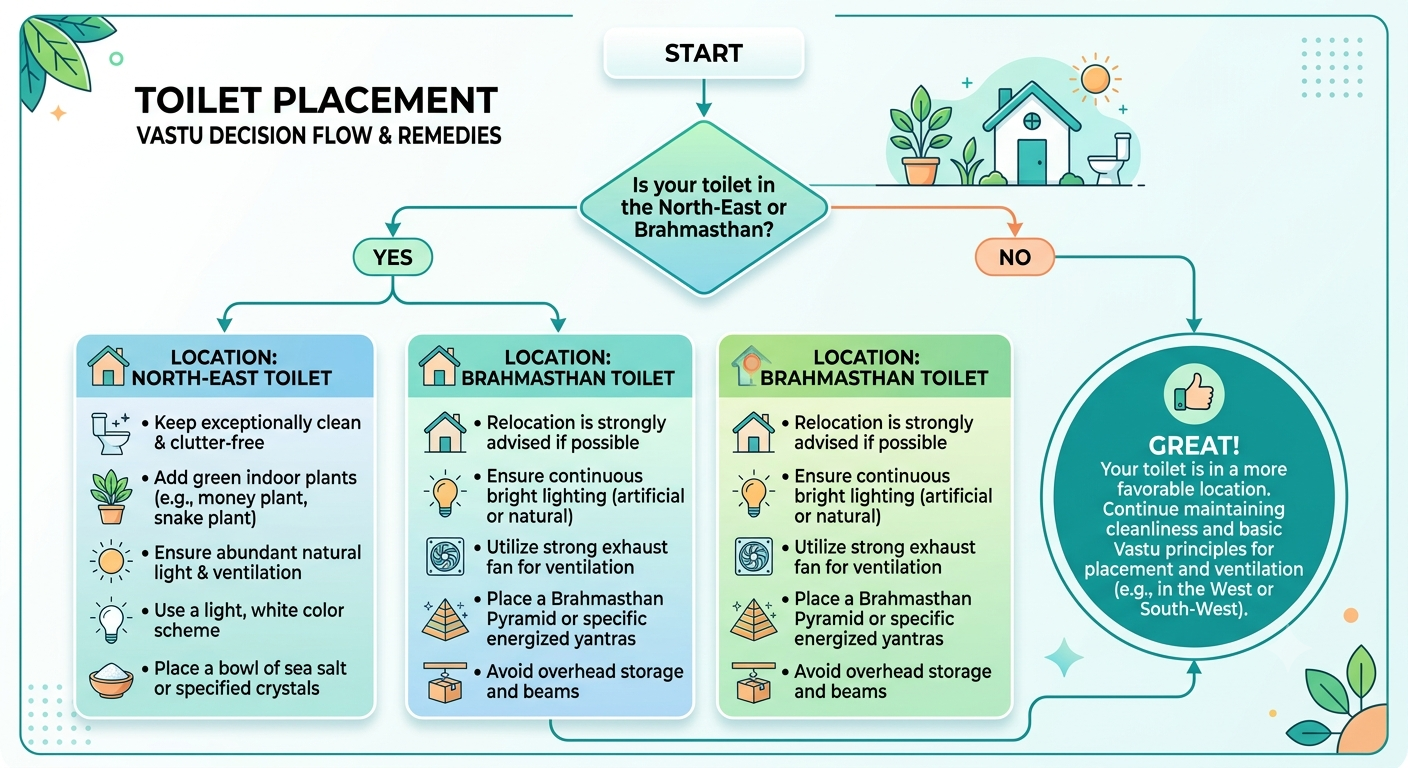
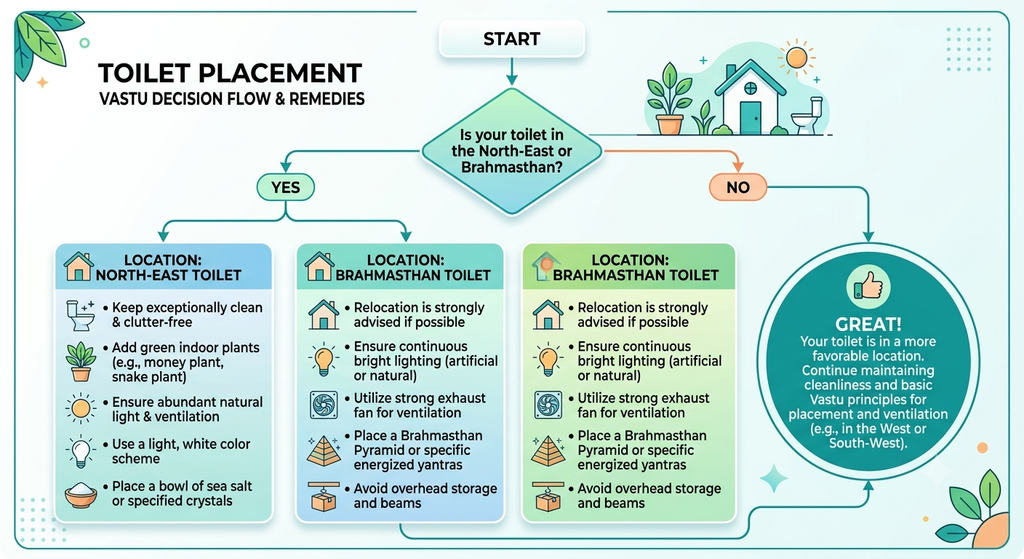
- Keep it immaculately clean, always. This is the single most agreed-upon remedy across different consultants and traditions — purity is considered the north-east’s core quality, so cleanliness partially works with the zone rather than against it.
- Keep the door and the commode lid closed whenever the toilet isn’t in use.
- Use light colours only — white, cream, very pale blue, or soft yellow. Avoid black, dark red, or maroon in this specific zone.
- Prioritise real ventilation. A working exhaust fan or an actual window does more here than any object-based remedy — the north-east is linked to the water element, and stagnant, humid air is considered to compound the problem.
- A small bowl of sea salt, placed in a corner (not in the water tank) and replaced weekly, is a widely used remedy for absorbing negative energy.
- A copper or brass pyramid, or a north-east yantra, placed just outside the toilet wall, is common in contemporary consultancy practice. Treat it as a supplementary measure, not a replacement for the basics above.
- Keep plants like money plant or bamboo just outside the door, not inside the wet zone itself.
- If you have two toilets, use the north-east one only for bathing where possible, rather than as the household’s primary WC.
- Commode orientation matters too: aim for the user to face north or south while seated, rather than east or west.
Fixing a Toilet in the Brahmasthan
The core principle for the Brahmasthan is simply “keep it open.” A toilet already breaks that rule by existing, so the goal shifts from “restore the ideal” to “minimise how much the space is enclosed and weighed down.”
- Keep interior partitions as light as structurally possible. Avoid adding storage, heavy cabinetry, or additional fixtures beyond what the toilet needs.
- Lean even harder into light colours than you would in the north-east — a dark, heavy colour scheme is thought to compound a blocked centre.
- Paint exposed beams, ducts, or columns to match the surrounding wall if any cross the Brahmasthan elsewhere in the home. This changes nothing structurally, but is a standard way consultants recommend visually “opening” the space.
- Pay extra attention to the eight zones surrounding the centre. Since a Brahmasthan defect is said to radiate outward to the whole floor plan, keeping the immediately adjoining zones clean, well-lit, and correctly used is a common way to partially offset a compromised centre — sometimes called peripheral compensation.
- Maximise light directly above the space — a skylight or ventilator if feasible, or at minimum strong artificial lighting, to keep the zone visually and energetically “open.”
- If you’re building new or doing a major renovation, this is one of the few doshas genuinely worth paying an architect to design around from the start. A Brahmasthan toilet is avoidable in new construction in a way a fixed apartment layout usually isn’t.
If You’re Renting: What’s Actually in Your Control
If you’re a tenant, most of the structural advice above simply isn’t available to you, and that’s the reality for the majority of people searching this topic. What is in your control: cleanliness, lighting, keeping the door and lid shut, portable remedies like a sea salt bowl or a small pyramid, an exhaust fan you can install and take with you, and battery-powered or plug-in lighting if the fixture itself is poor. Paint is sometimes negotiable with a landlord and sometimes not — ask before assuming either way.
A full renovation-based fix generally isn’t on the table for tenants, which is exactly the gap a dedicated tenant-focused resource is meant to close. [Internal link opportunity: reference the Rented Flat Vastu Fixbook here once published — see recommendations below.]
Remedies That Sound Impressive But Deserve Scepticism
Some remedies marketed online come with suspiciously precise claims: an exact percentage of the dosha “removed,” a guarantee of results within one specific lunar cycle, or a proprietary “energised” product positioned as the only real fix. Be cautious of these. Vastu is a centuries-old tradition carried through texts and lineage-based practice — it isn’t a measurable science, and no consultant, however skilled, can honestly quantify a percentage of energy neutralised.
That doesn’t mean every product-based remedy is worthless. It means the core practices that show up consistently across independent traditions and consultants — cleanliness, light, ventilation, colour, closed doors, sea salt, and a supplementary pyramid or yantra — deserve more trust than anything sold as a single proprietary miracle fix with numbers attached.
Common Mistakes People Make With Toilet Vastu
- Confusing the direction the main door or house faces with which zone the toilet actually occupies.
- Estimating the Brahmasthan “by eye” instead of measuring the true plot boundary, especially in irregular flats.
- Applying north-east remedies to a Brahmasthan toilet, or the reverse, because a product page or article treated the two as identical.
- Relying on a single object — one pyramid, one yantra — instead of combining the basics that every tradition agrees on: cleanliness, ventilation, colour, and closed doors.
- Fixating on colour or a salt bowl while ignoring the commode’s facing direction entirely.
- Assuming the dosha is unfixable and skipping remedies altogether, or the opposite mistake — assuming one product removes the need for the basics.
When a Quick Remedy Isn’t Enough
The remedies above are a reasonable first pass for a typical single-toilet dosha in an existing flat. Get a proper on-site or plan-based consultation instead of relying on general advice if: the toilet shares a wall directly with a pooja room, you’re buying a home or planning new construction, your plot is genuinely irregular in shape, or you’re dealing with more than one significant dosha at the same time. Layering doshas tend to interact in ways a general guide can’t responsibly account for.
A Note for High-Rise Flats: Whose Brahmasthan Is It?
This is genuinely debated among consultants rather than settled: in an apartment building, does the Vastu Purusha Mandala apply to the whole building’s footprint, or to each individual flat treated as its own unit? Most contemporary practitioners assess each flat independently, since that’s the boundary within which a household’s daily life actually happens. Some more traditional assessments consider the building as a whole first. If your building’s overall centre happens to fall on a lift shaft or stairwell rather than someone’s toilet, that’s often read as a mitigating factor for the building as a whole — though not every consultant weighs it the same way, and it’s a reasonable question to ask if you get a professional assessment.
Conclusion
In almost every existing flat with this dosha, you’re managing a defect, not eliminating one — and that’s a normal, common starting point, not a special kind of bad luck. The north-east and the Brahmasthan call for different fixes because they’re different zones with different jobs in the mandala, and getting that distinction right matters more than any single product you add afterward. Cleanliness, light, ventilation, closed doors, and the basic remedies above, applied consistently, are what most traditions and consultants would agree on as the sensible starting point — before you spend money on anything marketed as a one-object miracle fix.
Frequently Asked Questions
Is a toilet in the north-east always a serious Vastu dosha, or does severity vary?
Severity is generally read as a matter of degree. A toilet whose footprint barely clips the north-east corner is typically considered less severe than one that occupies most of the zone, and a scrupulously clean, well-ventilated north-east toilet is treated as less problematic than a neglected one. It’s still considered a dosha worth addressing either way.
What’s the actual difference between the north-east corner and the Brahmasthan?
The north-east is a corner zone linked to the water element and the entry of prana into the home. The Brahmasthan is the centre of the plot, linked to Brahma and meant to stay structurally open. They sit in different positions on the Vastu Purusha Mandala and call for different remedies, even though both are considered serious.
Can sea salt alone fix a north-east toilet?
No single remedy is treated as sufficient on its own. Sea salt is one part of a combined approach that also includes cleanliness, ventilation, light colours, and keeping the door and lid closed — consultants generally recommend layering these together rather than relying on any single fix.
Which direction should the toilet seat face according to Vastu?
Most guidance points to north or south, with east and west generally discouraged for the direction the user faces while seated. This is a separate consideration from which zone the toilet itself occupies.
Is a Brahmasthan toilet really worse than a north-east toilet?
Many consultants rank it as at least equally serious, and some rank it as more disruptive, on the reasoning that a compromised centre is said to affect the energy of the entire floor plan rather than one corner. This isn’t a universal ranking, though — it varies by consultant.
Can I just seal off the toilet and use it purely as storage instead?
This is sometimes suggested as a partial remedy, since it removes the “waste and water” function from the zone, but it doesn’t fully resolve a Brahmasthan defect specifically, since the space is still enclosed and obstructing the centre. It’s more directly useful for a north-east toilet than for one in the Brahmasthan.
What if my rented flat has the toilet in the Brahmasthan and I can’t renovate?
Focus on what doesn’t require landlord permission: cleanliness, lighting, ventilation, keeping the door shut, and portable remedies. A structural fix generally isn’t realistic for a tenant, and that gap is exactly what a dedicated rented-flat Vastu resource is meant to address.
Does the direction my main door faces matter for toilet Vastu too?
It’s a separate check using the same underlying grid. A north-facing home isn’t automatically safe from a north-east toilet, and a south-facing home isn’t automatically at risk of one — you have to check the toilet’s actual zone independently of which way the entrance faces.
Are Vastu pyramids and yantras mentioned in the classical texts?
The Vastu Purusha Mandala itself, and the principle that the north-east and Brahmasthan should stay open, come from classical sources like the Brihat Samhita and later texts such as Mayamata and Manasara. Specific branded remedy objects sold today are largely contemporary consultancy additions built on top of that older framework, not items named in the original texts.
Does the Vastu Purusha Mandala apply to my individual flat or to the whole apartment building?
Consultants differ on this. Most assess each flat as an independent unit, since that’s the space a household actually occupies day to day, while some more traditional assessments look at the building’s footprint as a whole first. Both approaches are used in practice.
Disclaimer: The information provided on vastudharma.com is for general informational and cultural purposes only, based on traditional Vastu Shastra principles. While we strive to offer well-researched and practical insights, this content should never serve as a substitute for professional architectural, structural engineering, financial, psychological, or medical advice. Any application of the Vastu guidelines, remedies, or structural changes suggested in our articles is undertaken entirely at your own risk and discretion, and vastudharma.com makes no warranties or guarantees regarding specific outcomes—such as health improvements, financial gain, or personal success—derived from implementing these practices.