
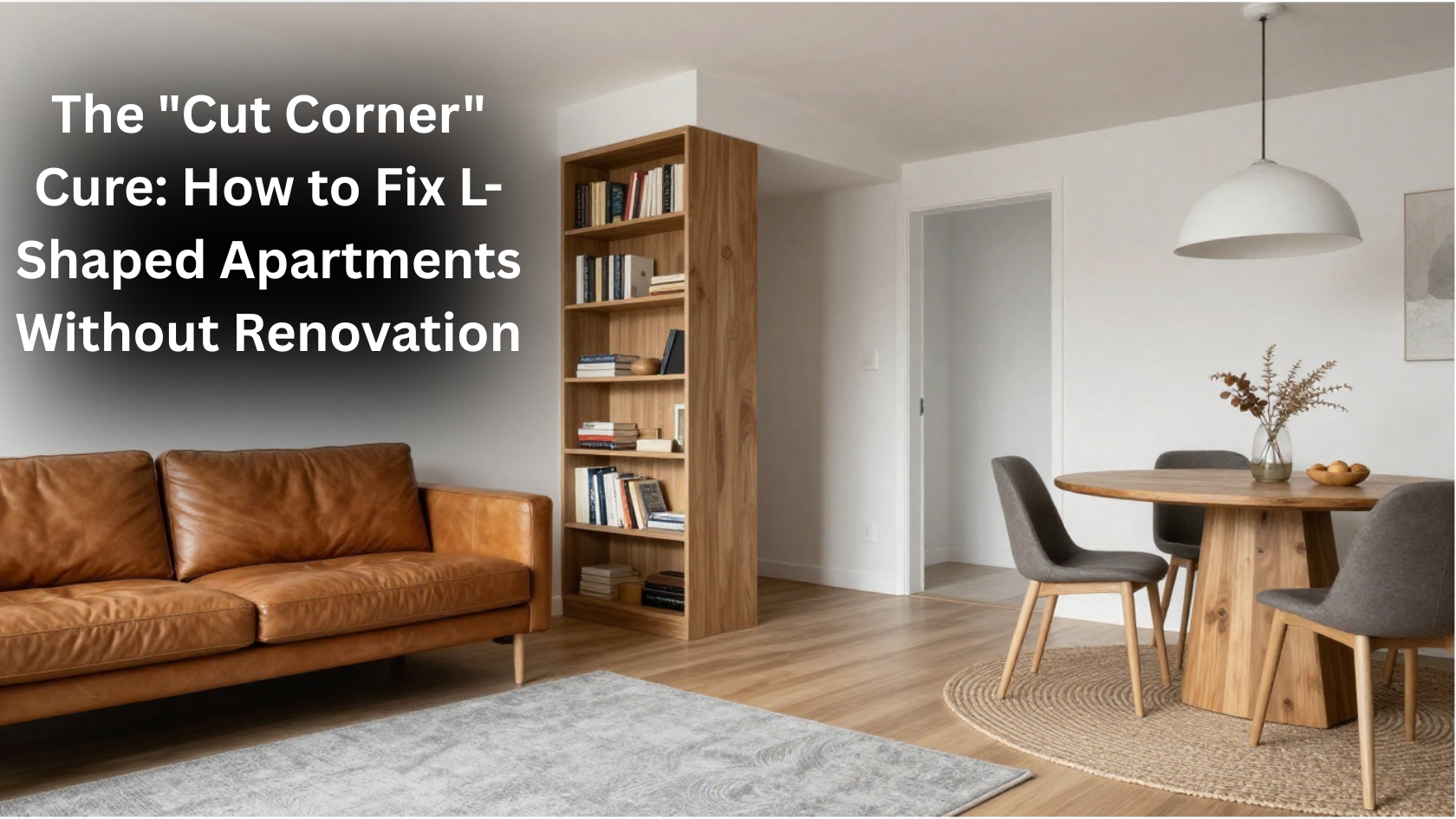
Have you ever walked into a room and felt like something was just… off? You can’t quite put your finger on it. The furniture is nice, the paint is fresh, but the energy feels like it’s leaking out of a hole in the wall. If you’re living in an L-shaped apartment, that “hole” isn’t a physical one—it’s a missing corner.
In the world of interior design and ancient spatial flow, L-shaped layouts are often called “missing corner” homes. To a floor plan, it looks like a neat geometric shape. To your daily life, it can feel like living in a giant “L” for “Lacking balance.”
But here’s the good news: you don’t need a sledgehammer or a construction crew to fix it. We’re going to look at how to trick the eye (and the mind) into feeling like your home is a complete, solid, and cozy sanctuary.
The Mystery of the Missing Corner: Why Your Layout Feels “Off”
Imagine sitting down to a nice dinner, but your table only has three legs. You can balance the plates if you’re careful, but you’re always a little bit on edge, waiting for things to slide off. That is exactly what an L-shaped apartment feels like to our subconscious.
The “Missing” Energy
In architecture, we talk about “visual weight.” A square or a rectangle feels stable because every corner supports the other. When you “cut” a corner out to create an L-shape, you create a void.
I remember helping a friend, Sarah, move into a beautiful L-shaped studio in the city. On paper, it was modern and sleek. But after two months, she told me, “I feel like I’m constantly squeezed into the skinny part of the ‘L’ and the rest of the room is trying to run away from me.”
Common “L-Shaped” Symptoms
If you live in one of these layouts, you might notice:
- The Dead Zone: One specific corner of the “L” becomes a graveyard for laundry piles or boxes you never unpacked.
- Traffic Jams: You find yourself bumping into the inner corner (the “point” of the L) constantly.
- Split Personalities: The room feels like two separate bunkers rather than one cohesive home.
Why It Happens
Most developers design L-shaped apartments to fit more units into a building or to wrap around an elevator shaft. They are thinking about square footage, not how it feels to actually drink a cup of coffee in that space. Our job is to take that “leftover” shape and give it a sense of wholeness.
Squaring the Circle: Simple Tricks to “Close” the Shape
The secret to fixing an L-shaped room isn’t about filling the space with more stuff. It’s about visual completion. We want to trick your brain into seeing a full rectangle instead of a broken “L.”
The “Anchor” Technique
The most effective way to “complete” the missing corner is to place something substantial where the corner should have been. Since you can’t build a wall, you use anchors.
- The Power of Plants: If you have a balcony or a small outdoor nook that creates the “cut” in your L-shape, place a tall, leafy plant (like a Fiddle Leaf Fig or a large palm) right at the edge. The height of the plant acts as a soft pillar, “filling” the invisible void.
- Lighting as a Boundary: Use a tall arc lamp. The base sits in your living area, but the light hangs over the “empty” space of the inner L. This “bridges” the gap and tells your eyes, “Everything under this light is part of the same room.”
Mirror Magic
Mirrors are the ultimate “space hackers.” If you place a large floor mirror on the wall that heads toward the missing corner, it reflects the rest of the room back.
Pro-Tip: Don’t just hang a small mirror. Go big. A leaning floor mirror creates an “illusion of depth” that makes the wall feel like it continues onward, rather than stopping abruptly at a corner.
Rugs: The Invisible Walls
Think of rugs as the “foundation” of your zones. In an L-shaped room, people often buy one giant rug and try to force it to fit. Don’t do this. Instead, use two different rugs to define two distinct rectangles.
- Rug A for the “long” part of the L (usually the living area).
- Rug B for the “short” part (the dining or office area).
By creating two solid rectangles on the floor, you stop the room from feeling like one long, awkward hallway.
3. Zoning Without Walls: How to Give Every Inch a Purpose
The biggest mistake people make in L-shaped apartments is trying to make the whole space do everything at once. When you don’t define your zones, the “point” of the L becomes a high-traffic collision zone.
Defining the “Elbow”
The “elbow” is that inner corner where the two parts of the L meet. This is usually the most awkward spot in the house.
The Solution: The Pivot Point. Instead of leaving the elbow empty, turn it into a transition. A small circular table, a pedestal with a sculpture, or even a cozy armchair set at a 45-degree angle can “soften” the sharp turn.
Creating “Rooms within Rooms”
Since you don’t have walls to separate your kitchen from your living room, you have to use furniture as “anchors.”
- The Sofa Back: Instead of pushing your sofa against the long wall, turn it so the back of the sofa faces the other part of the “L.” This creates a “soft wall” that tells your brain, “This side is for relaxing; that side is for eating.”
- Open Bookshelves: Use an open-backed shelving unit (like the IKEA Kallax style) as a room divider. It lets light through so the place doesn’t feel tiny, but it physically separates the “legs” of the L.
Real-Life Story: The “Home Office” Trap
I once worked with a client, Marcus, who had his desk right in the middle of the L-bend. He complained that he could never focus. Why? Because his back was to the “open” part of the L, and his eyes were staring at a sharp corner. We moved his desk to the very end of the short “L” leg, facing out. We put a bookshelf behind him to act as a “wall.” Suddenly, he felt tucked away and secure. The lesson? Always put your “focus” areas (bed or desk) at the ends of the L, never in the bend.
The “Color Bridge”: Using Paint and Decor to Create Unity
When you have an L-shaped space, the walls often feel like they are fighting each other. One long wall stretches on forever, while a short wall cuts it off abruptly. If you paint every wall the exact same flat white, the “missing corner” actually becomes more obvious because the shadows settle in the crooks of the “L,” making it look gloomy.
The “Continuous Line” Trick
One of the best ways to make an L-shaped apartment feel like a purposeful choice rather than an architectural accident is to use a wrap-around accent. Take one color—maybe a soft terracotta or a moody sage green—and paint a “stripe” or a section that travels from one leg of the L, across the corner, and onto the next wall. By carrying the color around the bend, you’re visually “stapling” the two rooms together. It tells the eye, “This is one continuous thought.”
Material Consistency
I once visited an apartment where the owner had used dark wood furniture in the living area (the long part of the L) and bright white plastic furniture in the dining area (the short part). It felt like two different houses had been glued together.
- The 60-30-10 Rule: Use 60% of a primary color, 30% of a secondary, and 10% for accents. Ensure these colors appear in both parts of the L.
- The Wood Connection: If your coffee table is oak, try to have oak legs on your dining chairs. These little visual “breadcrumbs” lead the eye through the space and make the “missing corner” disappear.
Avoiding the “Tunnel” Effect
Common mistake: Lining all your furniture up against the longest wall. This makes your home look like a bowling alley. The Fix: Break the line. If you have a long sofa on one wall, put a floating bookshelf or a console table on the opposite side, slightly offset. This creates a “slalom” effect for your eyes, making the room feel wider and more interesting.
Lighting the Voids: Bringing the “Dead Zones” to Life
In an L-shaped room, light is often your biggest enemy or your best friend. Usually, the “elbow” of the L is the darkest spot because it’s furthest from the windows.
Layering for Depth
If you only rely on one big overhead light, you’re going to end up with harsh shadows in the corners. This makes the “missing” part of your apartment feel even more hollow.
- The Three-Point System: You need a light at the end of each “leg” of the L and one bright, warm light at the “pivot point” (the elbow).
- Up-lighting: Place a small floor spotlight behind a plant or a chair in the inner corner. Shouting light up the wall makes the ceiling feel higher and pushes the walls “out,” fighting that cramped feeling.
The Mirror Window
If one part of your L-shape has no windows (common in “junior one-bedroom” layouts), hang a large, framed mirror that looks like a window. Position it so it reflects a window from the other side of the room. It’s an old trick, but it works every time—it brings the “outside” into the dark corner.
Traffic Flow: Stop Bumping Into Your Furniture
The “inner point” of the L-shape is a high-collision zone. It’s where you turn the corner to go from the kitchen to the sofa, and it’s usually where people bruise their hips on a sharp table edge.
Rounding the Corners
In an L-shaped space, you already have enough sharp 90-degree angles. You don’t need more.
- Go Round: Choose a circular dining table or an oval coffee table.
- Why? Because “flow” is literal. When you walk around a round table, your movement is fluid. When you have to navigate a square table in a tight L-bend, you’re constantly stopping and starting.
The “One-Foot” Rule
Make sure there is at least a 3-foot (approx. 90cm) wide path for walking through the “elbow” of the room. If your sofa sticks out just a little too far, it will make the whole apartment feel frustrated. Sometimes, moving a chair just six inches can change the entire “vibe” of the home from “cluttered” to “airy.”
Common Mistakes to Avoid
- The “Wall-Hugging” Syndrome: Pushing every piece of furniture against the walls. It highlights the awkward shape. Pull things a few inches away!
- Mismatched Flooring: If you’re a renter, you might have carpet in one part and linoleum in the other. This “chops up” the L-shape. Use a large area rug that bridges the two floor types to unify them.
- Ignoring the “Elbow”: Leaving the inner corner empty makes the room feel like it’s collapsing inward. Put a tall lamp or a piece of art there.
Conclusion: Embracing the “L”
Living in an L-shaped apartment doesn’t mean you’re living in an incomplete home. In fact, these layouts offer a unique opportunity to create “hidden” nooks and cozy corners that a standard boxy room just can’t provide. By using anchors, consistent colors, and smart lighting, you can turn that “missing corner” into a sense of mystery and depth.
Your home should feel like a hug, not a puzzle you can’t solve. With these non-permanent fixes, you can “square” your space and finally feel settled.
Actionable Takeaways:
- Define the Zones: Use two separate rugs to create two distinct “rooms.”
- Anchor the Void: Place a tall plant or an arc lamp where the “missing” corner would be.
- Soften the Bend: Use round furniture near the inner corner to improve traffic flow.
- Bridge the Gap: Use a consistent color palette or a “wrap-around” paint feature to connect the two wings of the L.
The “Cut Corner” Design Guide
| Style / Mood | Color Palette (The “Bridge”) | Furniture Must-Haves | The “Elbow” Solution |
| The Urban Sanctuary | Sage Green, Cream, & Light Oak. Use green on the “elbow” wall to ground the space. | A large L-shaped sectional that follows the wall, paired with a round oak coffee table. | A tall Fiddle Leaf Fig or a large potted palm to soften the 90-degree turn. |
| The Modern Industrial | Charcoal Grey, Cognac Leather, & Navy. Use navy accents in both the living and dining zones. | A leather sofa and a “floating” black metal bookshelf to act as a room divider. | A vintage-style tripod floor lamp that directs light into the dark inner corner. |
| The Airy Scandi | Soft White, Birch Wood, & Muted Blush. Keep walls light but use a “wrap-around” birch shelf. | Two identical low-profile rugs to define the zones without adding visual “weight.” | A curvy accent chair set at a 45-degree angle to invite flow between the two legs. |
| The Bold & Cozy | Deep Teal, Mustard Yellow, & Walnut. Use mustard yellow cushions and art in both areas. | A walnut dining table at the end of the short “L” leg to create a “destination” spot. | A large gallery wall that “turns the corner,” with frames continuing from one wall to the next. |
How to Use This Table for Your Layout
If you are struggling with a specific “dead zone,” try this:
- Pick your vibe: Choose the style from the left column that matches your personality.
- The “Elbow” First: Start by fixing the inner corner (the “Elbow” column). Once that feels “softened,” the rest of the room usually falls into place.
- Check the “Bridge”: Make sure at least one color from your chosen palette appears at both the far end of the living room and the far end of the kitchen/dining area.
The “Zone & Flow” Furniture Arrangement
| Zone | Main Furniture Piece | Strategic Placement | Why it works |
| The Long Leg (Living Area) | The “Floating” Sofa | Place it perpendicular to the long wall, facing the window. | It creates a “soft wall” that separates the living area from the rest of the L without blocking light. |
| The Short Leg (Dining/Office) | The Round Pedestal Table | Centered in the middle of the short leg’s floor space. | Round tables have a smaller footprint and prevent the “cramped hallway” feeling in the shorter wing. |
| The “Elbow” (Inner Corner) | The Statement Storage | An open-backed bookshelf (like an IKEA Kallax) placed at the bend. | It acts as a transparent room divider. You get storage, but you can still see through it, keeping the room “open.” |
| The Far End (Window Side) | The “Light Hitter” | A low-profile bench or two small armchairs. | Keeping furniture low near the windows ensures light travels all the way into the dark “elbow” of the L. |
3 “Pro-Moves” for Your Specific Layout:
- Avoid the “Perimeter Push”: Whatever you do, don’t push every piece of furniture against the walls. In an L-shaped room, this creates a giant, empty “no-man’s land” in the middle. Pull your sofa at least 6–12 inches off the wall.
- The Mirror Trick: If your “Short Leg” (the dining or office area) has no windows, hang a large mirror on the wall facing the “Long Leg’s” window. This “borrows” the light from the other room and reflects it back.
- The “Path of Least Resistance”: Walk from your front door to your kitchen. If you have to “zigzag” around a sharp corner of a table or a sofa arm, move that piece. Your path through the “elbow” of the L should be a straight or gently curved line.
Frequently Asked Questions (FAQs):
Where should I put my TV in an L-shaped room?
The Problem: Most people struggle with “the neck crane”—putting the TV in a spot where half the seats can’t see it comfortably.
The Fix: Wall-mount the TV on a swivel arm at the end of the longer leg of the “L.” This allows you to tilt the screen toward the “elbow” or the kitchen area if needed, keeping your floor space clear of bulky stands.
Is an L-shaped apartment bad luck/Vastu-deficient?
The Problem: Many homeowners worry that “missing corners” lead to energy loss or instability.
The Fix: You don’t need to rebuild. Most modern consultants suggest “curing” the space with mirrors on the walls bordering the missing corner to visually expand it, or adding a tall plant (like bamboo) to anchor the energy in the “cut” section.
How do I light a dark L-shaped corner?
The Problem: The “inner elbow” (the bend) is almost always the darkest spot because it’s farthest from the windows.
The Fix: Use layering. Don’t rely on the ceiling light. Place a tall arc lamp that “reaches” into the corner or use small “up-lights” behind furniture to wash the wall with light and push back the shadows.
Will an L-shaped sofa make my room look smaller?
The Problem: People fear a corner sofa will swallow the room or look like a giant “blob” in the middle.
The Fix: Actually, an L-shaped sofa is a space-saver. By “hugging” the corner, it opens up the center of the room. Just follow the 2/3 Rule: your sofa should only take up about two-thirds of the wall length it sits against.
About the Author Jagdish Vajpeyee is the founder of Vastu Dharma and a Vastu Shastra consultant with a specialized focus on Vedic Astrology. With a professional background in banking, Jagdish brings a unique, analytical approach to ancient wisdom, helping modern families and businesses correct their energy flow without unnecessary demolition. He is passionate about merging traditional Indian architecture with contemporary lifestyle needs.
Disclaimer: The information provided in this article is for educational and informational purposes only. Vastu Shastra is an ancient architectural and energetic system; while many individuals find value in its principles for creating a harmonious environment, these suggestions are based on traditional interpretations and personal research. This content is not intended to be a substitute for professional architectural, legal, financial, or medical advice. The author and this website do not guarantee specific outcomes—such as financial gain or health improvements—resulting from the application of these tips. Before making significant structural modifications to your home or basement, please consult with a licensed architect or structural engineer to ensure the safety and integrity of your property.