
The “Designer Home” Trap: House Shapes
I want you to picture this scenario.
You’ve worked hard for ten years. You’ve saved up, maybe taken a loan, and you finally have the budget to build your dream home. You hire a fancy architect—let’s call him Mr. Modern.
Mr. Modern shows you a design that looks like it belongs in a sci-fi movie. “Why build a boring square box?” he asks. “Let’s do something unique! Let’s make it circular! Or maybe a triangular ‘A-frame’ cottage!”
He shows you 3D renders. It looks stunning. It looks expensive. It looks like something that will make your neighbors jealous.
So, you build it.
But six months after moving in, things start to feel… off. Your business, which was booming, suddenly hits a roadblock. Payments get stuck. Your spouse, who is usually calm, starts picking fights over small things. You feel restless in your own living room.
You blame the economy. You blame stress. But you never think to blame the shape of your house.
In my years of studying Vastu Shastra, this is the most common and painful mistake I see. We get seduced by “curb appeal.” We want our homes to look unique on Instagram. But we forget that a house is not a sculpture to be looked at; it is a machine to be lived in.
Ancient texts like the Samarangana Sutradhara (written by the scholar-king Bhoja) are very strict about this. They don’t care about aesthetics; they care about energy. And they warn us that certain shapes act like a “sieve” for wealth—no matter how much money comes in, the shape of the house drains it out.
In this article, we aren’t just going to look at superstition. We are going to look at the geometry of wealth. I’m going to walk you through the five shapes that traditional Vastu Shastra explicitly forbids, and explain why living in them might be the reason your bank account is bleeding.
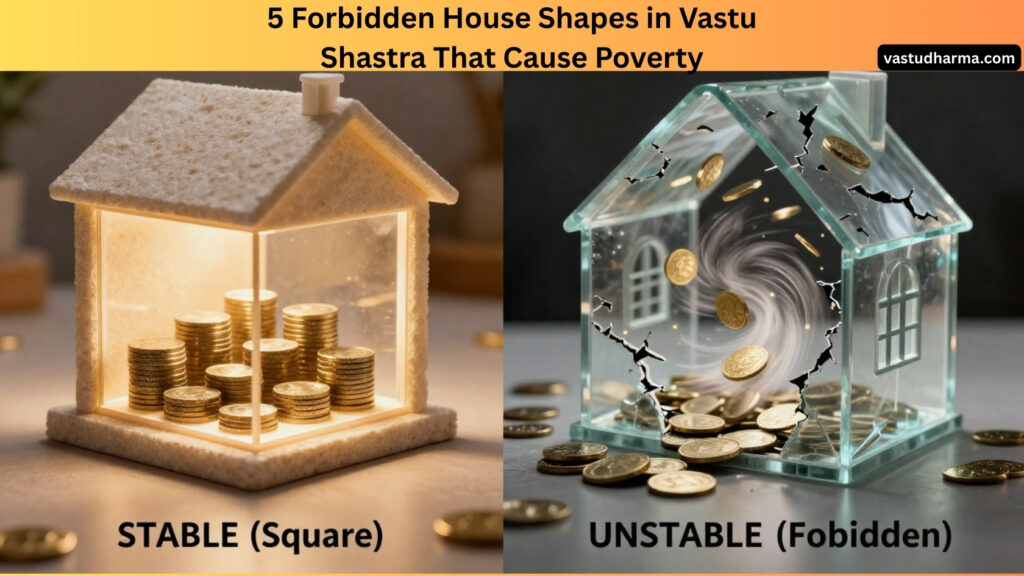
The Geometry of Wealth: Why “Boring” Squares Are Best
Before we look at the bad shapes, we have to answer a simple question: Why are almost all Vastu-compliant houses squares or rectangles?
It’s not because ancient architects lacked imagination. They built the Kailasa Temple; they knew how to carve complex shapes. They chose squares for homes on purpose.
To understand this, you have to understand the Vastu Purusha Mandala.
Imagine the spirit of your house (the Vastu Purusha) lying face down on the ground. To fit comfortably, he needs a stable, balanced space. In Vastu, the square represents the Earth Element (Prithvi Tattva).
Think about a cardboard box. It sits flat on the ground. It’s stable. You can stack things on it. It doesn’t roll away. Now think about a ball. It’s constantly moving. It requires effort just to keep it still.
The Four Corners Rule Wealth, in energy terms, is “heavy.” It needs a place to settle. In a house, the energy enters through the doors and windows, circulates, and then needs “corners” to accumulate.
- The Northeast corner brings in the energy.
- The Southwest corner holds the energy (like a heavy safe).
If your house shape cuts off these corners or distorts them, the energy acts like water in a broken cup—it leaks out.
A square or rectangular room with 90-degree angles allows the magnetic lines of force to flow smoothly from North to South and East to West. When you introduce weird angles, you create “arrows” of negative energy (called Shalya). These arrows pierce the vital energy points (called Marmas) of the house.
So, when Mr. Modern tells you that “boxes are boring,” just remember: Boring builds bank balances. Unique shapes build debt.
Forbidden Shape #1: The Circular House (Vritta or Chakra)
Let’s start with the most controversial one. The Circle.
In modern architecture, circular buildings are often seen as futuristic or eco-friendly (like yurts or domes). You might see a beautiful circular villa in a magazine and think, “Wow, that looks so harmonious.”
But the Samarangana Sutradhara calls this shape “Chakra” (Wheel) and explicitly links it to Daridrata (Poverty) for ordinary humans.
Why is it dangerous? A circle has no beginning and no end. But more importantly, it has no direction.
Vastu is entirely based on directions. North is wealth (Kuber). East is health (Surya). South is stability (Yama). In a circular house, where does the North wall end and the East wall begin? There is no clear demarcation.
Because there are no corners, the energy in a circular house is in a constant state of “spin.” It creates a vortex.
- For a Temple: This is fantastic. In a temple, we want high, swirling, divine energy. We visit for 10 minutes to pray and leave. That’s why the Parliament House is circular—it’s a place of debate and constant activity.
- For a Home: You need rest. You need stability. Living in a circular home is like trying to sleep inside a washing machine. The energy never settles, so your mind never rests. And if your mind is restless, your decision-making suffers, leading to bad financial choices.
The “Center Point” Problem In a square house, the center (Brahmasthan) is a calm, open space. In a circular house, all the structural stress often converges right in the center (like the pole of a tent). Placing a load on the Brahmasthan is a major Vastu defect known to destroy the owner’s prosperity.
The Exception: There is a tiny loophole. The texts say circular shapes are acceptable only if they are surrounded by a square boundary wall. But even then, why take the risk? If you want to stay wealthy, leave the domes for the gods and the kings. You stick to the rectangle.
Forbidden Shape #2: The Triangular House (Trikona)
This one is increasingly common in modern vacation homes and A-frame cottages. You see a triangular plot at a road junction, and to maximize space, the architect designs a house that tapers to a point.
In Vastu Shastra, the Triangle represents the Fire Element (Agni Tattva).
Now, fire is useful. We cook with it. It keeps us warm. But imagine living inside a fire.
The Samarangana Sutradhara warns that living in a triangular home leads to:
- Legal Trouble: It says the owner will face “Raj-danda” (Punishment from the King/Government). In modern terms, this often manifests as tax audits, lawsuits, or property disputes.
- Mental Instability: The sharp angles create “Shaar” (arrows) of energy. Residents of triangular homes often report feeling constantly on edge, prone to sudden anger outbursts, or suffering from high blood pressure.
The “Pinched” Energy
Look at the corners of a triangle. They are acute angles (less than 90 degrees). In Vastu, these tight corners squeeze the energy, making it aggressive. A home needs 90-degree corners to let energy “breathe.” A triangular house essentially suffocates the Vastu Purusha, and a suffocated house cannot hold onto wealth.
Forbidden Shape #3: The Winnowing Fan (Soop-aakar)
This is a specific shape that you might not know by name, but you have definitely seen.
A “Winnowing Fan” (or Soop in Hindi) is that traditional bamboo tray used to separate rice from husk. It is wide at the front and tapers narrowly to the back, or vice versa.
In real estate, we often call these “Shermukhi” (Lion Faced) or “Gaumukhi” (Cow Faced) plots, but the building itself should never imitate this shape extreme.
If your house looks like a fan—wide at the front and squeezing narrow at the back—the text says it causes Dhan-Naash (Destruction of Wealth).
The Logic: Think about what a winnowing fan does. Its only job is to shake things up and throw the useless husk away. It is a tool of separation. If your house is shaped like a fan, it mimics this energy. It “winnows” away your assets. You might earn well, but unexpected expenses will constantly blow your savings away, just like the husk in the wind.
Forbidden Shape #4: The Drum (Mridanga)
Imagine a traditional Indian drum (Mridanga or Dholak). It is wide at the two ends but narrow and pinched in the middle.
Sometimes, people buy two adjacent plots and build a house that spans both, but because of a tree or an obstacle in the middle, they narrow the construction in the center.
The Result: The ancient texts are very specific about this. A Mridanga shaped house is disastrous for the women of the household. It leads to eye diseases and loss of the wife or female lineage.
From a structural perspective, the “middle” of the house is the Brahmasthan (the stomach/navel of the Vastu Purusha). If you pinch the house in the middle, you are essentially starving the house. A house that is “thin” in the center has no gut strength. It collapses under financial pressure.
Forbidden Shape #5: The “Cut” Corner (Vidisha or L-Shape)
This is the most common “modern” mistake. We love L-shaped houses. We love wrapping the house around a garden or a pool.
But an L-shaped house is basically a square with a huge chunk missing.
In Vastu, every corner represents a specific element:
- Missing Northeast: No head. (Mental confusion, lack of clarity).
- Missing Southwest: No legs. (Instability, inability to hold money).
- Missing Southeast: No digestive fire. (Health issues, lethargy).
- Missing Northwest: No movement. (No support from friends/society).
When you build an L-shape, you are creating a “crippled” Vastu Purusha. You are literally living in a partial house. If the Southwest corner is the missing chunk (which happens often in L-designs), your “Wealth Corner” is technically floating in the garden outside. You will work hard, but the “container” for your money (the SW corner) just isn’t there.
Quick Reference: House Shapes & Their Effects
| Shape Description | Sanskrit Name | The Result (Effect) | The Remedy |
| Square / Rectangle | Chaturastra | ✅ Prosperity, Stability, Peace | None Needed (This is the ideal shape). |
| Circular | Vritta / Chakra | ❌ Poverty (Daridrata), Restlessness | Use only for public buildings or temples. |
| Triangular | Trikona | ❌ Legal Trouble (Raj-danda), Mental Stress | Partition the room to create a square; hide the sharp corners. |
| Winnowing Fan (Tapered) | Soop-aakar | ❌ Wealth Destruction (Dhan-Naash) | Build internal square walls to correct the geometry visually. |
| Drum Shaped (Pinched Middle) | Mridanga | ❌ Loss of Wife/Females, Eye Diseases | Structural correction is usually required to fill the “pinched” sides. |
| L-Shape / Cut Corner | Vidisha | ❌ Missing Energy (Depends on corner missing) | Copper Wire or Helix buried in the floor to “close” the energy loop. |
I’m Stuck in a Bad Shape—Now What? (Practical Remedies)
Okay, Jagdish, don’t panic.
If you are reading this and realizing, “Oh no, my apartment building is L-shaped,” take a deep breath. You don’t have to bulldoze your home.
While the best remedy is always structural correction, we can use “Virtual Corrections” to trick the energy into thinking the shape is a square.
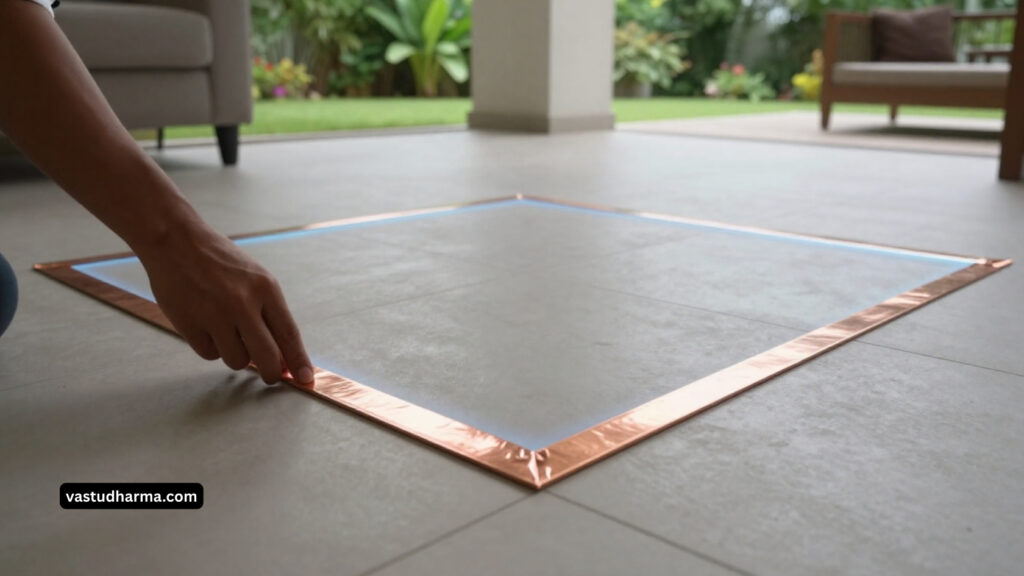
1. The Copper Wire Technique (For L-Shapes and Cuts) If you have a missing corner (like in an L-shape), you need to “complete” the square energetically.
- The Fix: Bury a thick copper wire or a Vastu helix rod along the missing boundary in the ground. If you live in an apartment, you can tape a copper strip on the floor or ceiling to “close” the missing box. This creates a virtual energetic wall, restoring the square shape.
2. The Mirror Trick (Visual Expansion) Mirrors create depth. If a wall is cutting into your space (making it irregular), placing a large mirror on that wall can visually “push” it back, making the room feel more square.
- Warning: Never place mirrors on the South or West walls. Only use this on North or East walls.
3. Partitioning (For Irregular Rooms) If you have a large, weirdly shaped living room (like a hexagon or a triangle), use furniture or drywall to “square it off.”
- The Fix: Build a straight wall to turn the weird point into a storage closet. Make the main living area a perfect square or rectangle, and hide the irregular “leftover” space behind a door.
Don’t Let Geometry Bankrupt You
Architecture is art, but a home is a sanctuary.
It is easy to get bored with “boxy” designs. We crave novelty. We want curves, angles, and drama. But remember, drama belongs in the movies, not in your bank account.
The ancient Rishis weren’t trying to kill creativity. They were trying to protect us. They understood that the universe operates on geometry. Planets are round, orbits are elliptical, but stability—the kind we need for a family and a bank balance—is found in the Square.
Your home is the container for your life’s energy. If the container is round, it rolls away. If it is triangular, it pricks you. If it is fan-shaped, it blows your luck away.
So, the next time you look at a floor plan, don’t look for “cool.” Look for “calm.” Look for the boring, stable, reliable square. Your wallet will thank you.
Actionable Takeaways (The Shape Checklist):
- Stick to 90 Degrees: Ensure all four corners of your main building are 90 degrees.
- The Ratio Rule: The best shape is a Rectangle where the length is not more than 2x the width (e.g., 20×30 is great; 20×80 is too long and becomes a “tunnel”).
- Check the Center: Never build a pillar, staircase, or wall exactly in the center (Brahmasthan) of the house.
- Fix the Cuts: If you have an L-shaped home, use copper strips or Pyramids to energetically “close” the missing corner.
- Avoid the “Style” Trap: If an architect suggests a round or triangular room, politely decline. Keep the art on the walls, not as the walls.
FAQs: House Shapes & Vastu Defects
Which shape of the house is best for wealth according to Vastu?
The most auspicious shape for a house is a Square (Chaturastra) or a Rectangle. These shapes align perfectly with the Vastu Purusha Mandala, ensuring that all four directional energies (North, South, East, West) are balanced, which brings stability and financial growth.
Is a circular house good for living?
No. According to the Samarangana Sutradhara, a circular shape (Vritta) is prohibited for residential homes as it causes poverty and constant restlessness. Circular structures are suitable only for public buildings, parliament houses, or temples where high, active energy is needed.
What are the disadvantages of an L-shaped house?
An L-shaped house is considered incomplete because it has a “missing corner” (usually the Northeast or Southwest). This creates a severe energetic imbalance. For example, a missing Southwest corner can lead to financial instability and relationship problems.
Why are triangular plots or houses considered dangerous?
A triangular shape (Trikona) represents the Fire Element. Living in a triangular house creates sharp, aggressive energy that can lead to legal disputes (Raj-danda), mental stress, and a fear of fire or accidents.
What is the “Winnowing Fan” shape in Vastu?
A Winnowing Fan (Soop-aakar) shape means the plot or house is wide at the front and very narrow at the back (or vice versa). This shape is highly inauspicious as it is believed to “blow away” wealth and cause the destruction of assets.
How do I fix a Vastu defect in an irregularly shaped house?
You do not always need to rebuild. For “cut” corners (like in L-shapes), you can bury a Copper Wire or Vastu Helix along the missing boundary to energetically “close” the square. Mirrors can also be used on specific walls to visually expand the missing area.
(Disclaimer: These are general Vastu principles. For specific defects in existing homes, always consult a Vastu expert for a personalized “Ayadi” calculation and remedy plan.)