

Just as the human body relies on a beating heart to circulate blood, your home relies on a central core to circulate energy. In Vastu Shastra, this sacred center is known as the Brahmasthan. It is not merely an architectural midpoint; it is the most potent energy vortex in your living space.
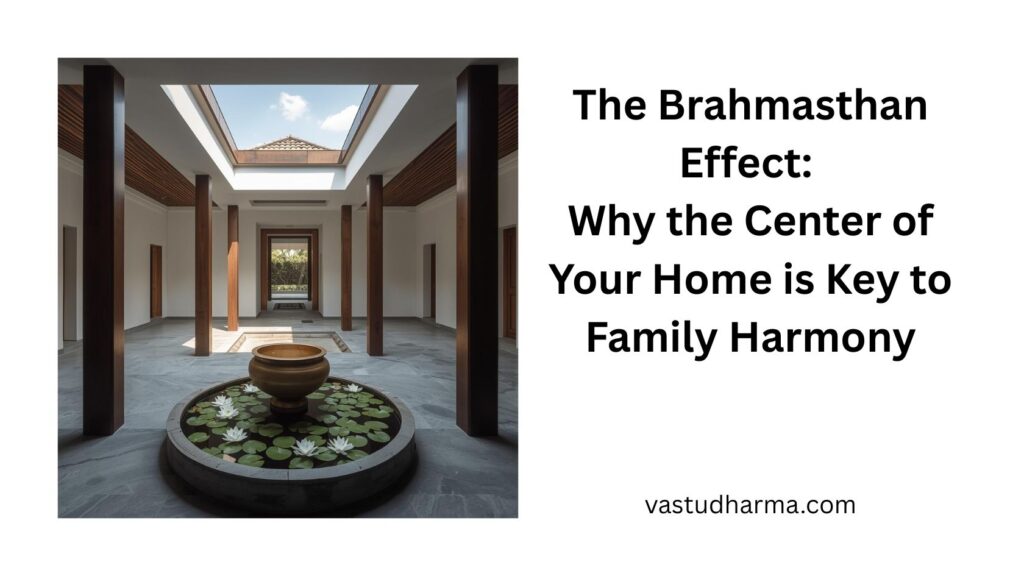
If you have ever walked into a house and immediately felt a sense of calm and clarity, it is highly likely that the Brahmasthan was balanced. Conversely, a blocked center can often be the invisible root cause of inexplicable family tension and health issues. Understanding this “heartbeat” of your home is the first and most critical step toward restoring family harmony.
Understanding the Vastu Purusha Mandala
To understand the power of the Brahmasthan, we must look at the Vastu Purusha Mandala, the metaphysical grid that maps the spirit of your home. According to ancient Vedic texts, the Vastu Purusha (the cosmic being) lies face down on the plot.
The central area corresponds to his navel—the source of life and creation—and is ruled by Lord Brahma, the creator of the universe. This area acts as the primary distribution hub for your home’s energy. Cosmic energy flows in from the Northeast, gathers in the Brahmasthan, and is then pumped outward to every other room. If this hub is cluttered or heavy, the life force (Prana) cannot reach the rest of the house, essentially starving the home of positivity.
How to Identify the Brahmasthan
Locating the Brahmasthan does not require a degree in architecture; it can be determined using a simple grid method known as the Peedha Vinyasa.
To find it, take the floor plan of your plot or house and divide the length and width into 9 equal parts. This creates a grid of 81 smaller squares (9×9).
The central 9 squares (the 3×3 block in the very middle) constitute the Brahmasthan. In a simpler sense, if you divide your room or house into three equal parts horizontally and vertically, the center rectangular area where they intersect is your Brahmasthan. This is the “Zero Point” of your property where the energy must remain stable.
The Golden Rules: Do’s and Don’ts
Because this area represents the navel of the Cosmic Man and the element of Space (Akash), it is governed by a strict “Zero Weight” policy. Treating this area correctly is often 50% of good Vastu.
The Do’s:
- Keep it Empty: Ideally, this space should be completely open to the sky (like the traditional courtyards of old Indian homes). In modern apartments, keep it as an open hallway or empty space.
- Keep it Clean: This area should be spotless to allow the “Space” element to expand.
The Don’ts (Major Defects):
- No Heavy Weight: Avoid placing pillars, staircases, or heavy furniture (like sofas or cabinets) here. Weight in the center creates pressure on the “stomach” of the house, suppressing growth.
- No Toilets or Septic Tanks: This is the most severe Vastu defect. A toilet here “flushes” away the positive energy generated by the house.
- No Fire (Kitchens): A kitchen in the center creates a “Brahma Dosh.” Fire in the center burns up the stability of the home, often leading to aggression and health issues for the residents.
Impact of a Blocked Brahmasthan on Family Harmony
When the heart of the home is under pressure, the residents feel the strain immediately. A defect in the Brahmasthan disrupts the Prana (life force) flow, manifesting in three specific areas of life:
- Health Struggles: Since the center corresponds to the navel of the Vastu Purusha, defects here often manifest as stomach disorders, digestive issues, or chronic fatigue. It strikes at the core vitality of the residents.
- Relationship Discord: A cluttered center leads to “cluttered” minds. You may find that family members are constantly irritable or that small misunderstandings escalate into major arguments. The sense of unity—the “glue” holding the family together—weakens.
- Financial Stagnation: The Brahmasthan is the distribution hub for opportunities. When it is blocked by heavy pillars or toilets, financial growth hits a glass ceiling. You may feel “stuck” in your career or business, unable to move forward despite hard work.
Modern Remedies for Existing Homes
In modern apartments, you cannot always tear down a wall or move a toilet. However, Vastu Shastra offers subtle energetic corrections to mitigate these defects:
- Lighting is Key: Darkness in the center is detrimental. Install a bright, beautiful Crystal Chandelier or use soft, upward-facing lights in this area. This “lifts” the energy and mimics the effect of an open sky.
- Color Therapy: Paint the ceiling and walls of the central area in White, Off-White, or very light Pastels. Avoid dark colors like grey, blue, or black in the center, as they constrict the space element.
- Crystal Corrections: Placing a Crystal Lotus in the center of the house can help neutralize negative energy. If there is a major defect (like a pillar), specific Vastu pyramids or copper helixes can be installed around the defect to redirect the energy flow (consult a Vastu expert for precise placement).
- Mirror Magic: If the center feels cramped, strategically placed mirrors (on the walls, never on the ceiling) can visually and energetically expand the space.
The Brahmasthan is the lungs of your house—it needs to breathe for your family to thrive. While perfect Vastu is rare in modern construction, keeping the center of your home clean, light, and respected is a powerful way to invite peace and prosperity into your life.
Take Action Today: Go to the center of your home right now. Is it cluttered? Is it dark? Clear the space and light a lamp there this evening. You might be surprised at how much lighter the whole house feels.
For a detailed analysis of your floor plan or to diagnose specific defects in your Brahmasthan, visit vastudharma.com to book a consultation.
Frequently Asked Questions (FAQs):
What exactly is the Brahmasthan in a home?
The Brahmasthan is the central point or “holy core” of a house, named after Lord Brahma, the creator. In Vastu Shastra, it is where all the energies of the eight directions meet. For a home to remain harmonious, this center must be kept open, light, and free from any structural obstructions.
Why is the center of the home called the “heart” of family harmony?
Because the Brahmasthan distributes energy to every other room, any defect here affects every family member. If the center is heavy or cluttered, it leads to communication breakdowns, frequent arguments, and a general sense of unease among residents. A clear center ensures a free flow of “Prana” (life force) through the entire household.
Can I have a wall or a pillar in the Brahmasthan?
This is one of the most searched “doshas” (defects). A pillar or a heavy wall in the exact center is considered a major Vastu violation. It acts like a “weight on the heart,” leading to health issues for the head of the family and constant friction between family members. Remedies often involve using Vastu pyramids or copper wires if the wall cannot be removed.
Is it okay to have a kitchen or toilet in the center of the house?
Google searches frequently warn against this. A toilet in the center drains the home’s positive energy, leading to financial and health crises. A kitchen (fire element) in the center can lead to hot tempers and constant domestic disputes. Ideally, the center should be empty or used as a living area where the family gathers peacefully.
What are the best remedies if my Brahmasthan is blocked?
If you cannot structurally change the center of your home, popular searched remedies include:
Keep it clean: Remove all heavy furniture and clutter immediately.
Light: Ensure the area is well-lit; a skylight is ideal, but a bright lamp also helps.
Crystals: Placing a Brahmasthan Lotus or clear quartz crystals can help neutralize negative energy.
Colors: Use neutral or light colors like white or cream in this zone to maintain purity.
About the Author Jagdish Vajpeyee is the founder of Vastu Dharma and a Vastu Shastra consultant with a specialized focus on Vedic Astrology. With a professional background in banking, Jagdish brings a unique, analytical approach to ancient wisdom, helping modern families and businesses correct their energy flow without unnecessary demolition. He is passionate about merging traditional Indian architecture with contemporary lifestyle needs.
Disclaimer: The information provided in this article is for educational and informational purposes only. Vastu Shastra is an ancient architectural and energetic system; while many individuals find value in its principles for creating a harmonious environment, these suggestions are based on traditional interpretations and personal research. This content is not intended to be a substitute for professional architectural, legal, financial, or medical advice. The author and this website do not guarantee specific outcomes—such as financial gain or health improvements—resulting from the application of these tips. Before making significant structural modifications to your home or basement, please consult with a licensed architect or structural engineer to ensure the safety and integrity of your property.