
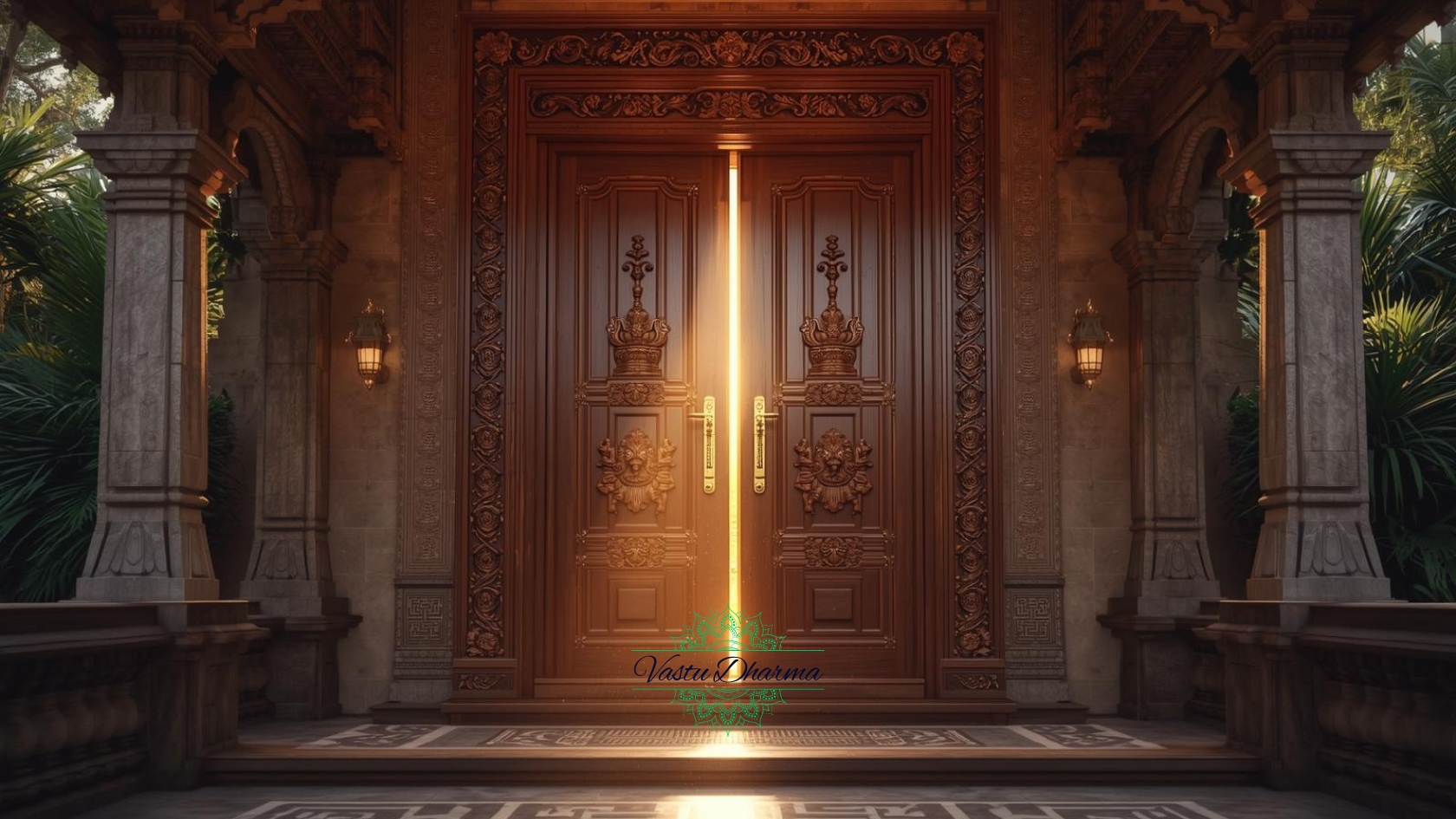
Why Your Door is More Than Just Wood and Hinges
Picture this for a moment.
You’ve been invited to a housewarming party. The house is massive—beautifully painted, manicured lawn, the works. But when you walk up to the entrance, something feels… off. The door feels tight, almost like it’s squeezing you as you walk through. You have to duck slightly, or maybe shuffle sideways because it’s too narrow.
Despite the grandeur of the building, you walk in feeling cramped and anxious.
Now, compare that to walking into an old temple or a heritage home. The door is heavy, tall, and wide. As you step across the threshold, you involuntarily take a deep breath. You feel expansive. You feel welcomed.
That feeling isn’t an accident. And it’s not just about aesthetics.
For thousands of years, traditional Indian architecture—Vastu Shastra—has treated the main door (the Simhadwar) as the most critical part of a structure. It is the mouth of the house. Just as you wouldn’t want to eat through a straw for the rest of your life, your home shouldn’t have to struggle to “breathe” in energy through a tiny, disproportionate opening.
But here is where most people get it wrong. They obsess over the direction (North is good, South is bad—which is a myth, by the way), but they completely ignore the dimensions.
This is where Mayasura comes in.
Mayasura was the legendary divine architect of the Asuras, known for building cities of illusion and impossible beauty. His text, the Mayamatam, lays out specific, non-negotiable rules for the “Gate.” These aren’t just superstitions; they are mathematical ratios designed to align your home with cosmic geometry.
In this guide, we are going to ditch the complicated jargon and look at the “Rules of the Gate” exactly how Mayasura intended. We’ll explore why size matters, the specific measurements you should aim for, and how to fix a door that breaks the rules without tearing down your wall.
Grab a measuring tape. Let’s get to work.
What Is It? Understanding the “Simhadwar”
Before we start throwing numbers around, we need to understand what we are actually dealing with.
In the world of Mayasura, a door isn’t just a hole in the wall to keep thieves out. It is a valve.
The Concept of the “Cosmic Mouth”
Think of your house as a living organism (the Vastu Purusha). The windows are the eyes, the ventilation is the nose, but the Main Door? That is the mouth.
The “Rules of the Gate” refer to a set of dimensional standards found in ancient texts like the Mayamatam and Manasara. These rules dictate that the height, width, and frame thickness of your main entrance must interact with each other in a specific ratio to ensure the flow of Prana (life force).
If the mouth is too small, the organism starves (energy stagnation). If the mouth is too big, the organism is overwhelmed (energy leakage).
Who Was Mayasura?
You might have heard of Vishwakarma, the architect of the Gods. Mayasura is his counterpart—the master architect of the Asuras (and often associated with the South Indian Dravidian style of architecture).
Why should you care about an ancient architect? Because Mayasura was a master of precision.
His rules focus heavily on:
- Ayadi Calculations: Mathematical formulas to determine if a specific measurement will bring luck or loss.
- Proportion: The relationship between the width and the height.
- Hierarchy: The rule that the main door must always be the largest opening in the house.
The Golden Ratio of Vastu
At its simplest level, Mayasura’s rule for door dimensions usually boils down to a relationship between width and height.
A standard modern door is usually 3 feet by 7 feet. But in Mayasura’s architecture, the dimensions are often derived from the size of the room or the house itself. The most basic rule you will hear is:
“The height should be twice the width.”
However, Mayasura allows for flexibility. The height can be double the width, or strictly adhering to specific “Padas” (zones). The goal is to create a portal that compresses energy as it enters and expands it as it fills your living space.
Why “Standard” Sizes Fail
Walk into a hardware store today, and you get “standard” sizes. These are based on factory efficiency, not energy flow.
- The Problem: A 6-foot tall door might be cheap to manufacture, but if you have 10-foot ceilings, that door is creating a “choke point.”
- The Solution: Customizing the frame (even by a few inches) to hit a “positive” digit on the Vastu measuring tape.
History or Background: The Architect of Illusions
To truly appreciate the “Rules of the Gate,” you have to understand the context. We aren’t talking about rules invented by a modern interior designer in a high-rise office. We are talking about geometry that dates back thousands of years.
The Legend of Mayasura
In Indian mythology, while Vishwakarma built the palaces for the Gods (Devas), Mayasura built for the Asuras and humans.
Don’t let the “Asura” part scare you. In the ancient context, Asuras were beings of intense material power and wealth. Mayasura was the master of Maya (illusion) and engineering. He is credited with writing the Mayamatam, a treatise on housing, architecture, and iconography.
He is the one who built the Mayasabha for the Pandavas in the Mahabharata—a palace so perfect, with floors that looked like water and pools that looked like glass, that it confused Duryodhana and set the stage for the great war.
From Palaces to Your Apartment
Historically, these dimensions weren’t just for kings. Whether it was a humble village hut or a massive temple Gopuram, the ratio of the door was sacred.
Ancient builders believed that every measurement carries a vibration.
- A “Good” Measurement: Resonates with the frequency of abundance.
- A “Bad” Measurement: Creates dissonance (like a guitar string tuned too tight).
Over the last century, as we moved toward mass housing and apartment complexes, we lost this custom. Builders started caring about how many 4×8 plywood sheets they could cut without waste. The door became a standardized factory product, disconnected from the unique energy needs of the home.
Reclaiming Mayasura’s rules is about reclaiming that lost connection.
How It Works: The Mathematics of the Door
Now, let’s get into the mechanics. How do you actually apply Mayasura’s rules? It’s not about magic; it’s about Ratio and Ayadi (income vs. expenditure of energy).
Here are the core principles of how the Main Door dimensions work.

1. The Golden Ratio: Height vs. Width
The most fundamental rule in the Mayamatam is the relationship between the width (Vyasa) and the height (Ayama).
If your door is a square, it’s a problem. If it’s too skinny, it’s a problem. Mayasura suggests a specific elongation to compress and accelerate energy.
The Golden Formula:
Height = (Width x 2) OR Height = (Width x 2) + Generous Breathing Room
Ideally, the height should be at least double the width.
Example:
- If your door width is 3.5 feet, your height should ideally be 7 feet.
- If you want a grander entrance with a 4-foot width, you should aim for an 8-foot height.
Why? This 1:2 ratio mimics the standing human form. It creates a sense of authority and upward movement. A squat, wide door suppresses energy (and tall people!).
2. The Rule of Odds and Evens
This is a nuanced rule that many modern Vastu consultants miss.
Mayasura often emphasizes the stability of even numbers for dimensions but odd numbers for components.
- Dimensions: It is often considered auspicious if the measurements (in traditional cubits or feet) end in even numbers or specific favorable fractions.
- Shutters: The main door should ideally have two shutters (double doors) opening inside. This represents openness and welcoming with both hands. Single shutter doors are acceptable for smaller rooms, but for the Simhadwar, two is powerful.
3. The “Ayadi” Check (The Vitality Test)
This is the advanced level. In traditional Vastu, you don’t just pick “7 feet” because it sounds nice. You check the dimension against a formula called Ayadi Shadvarga.
Without getting too bogged down in algebra, the logic works like this:
- Take the perimeter of the door frame.
- Multiply it by a specific “Nakshatra” or “Dhana” factor.
- Divide it by a constant (usually 8 or 12).
- The remainder tells you the “luck” of that dimension.
Practical Tip: You don’t need to be a mathematician. Mayasura provides pre-calculated “auspicious” measurements.
- Good: Dimensions that result in a remainder associated with “Income” (Aya).
- Bad: Dimensions that result in a remainder associated with “Debt” (Vyaya).
4. The Hierarchy of Openings
This is the easiest rule to follow and the most important. The Main Door must be the largest opening in the house.
It works on the principle of air pressure.
- If your back door is bigger than your front door, energy (and luck) walks in the front and runs out the back.
- If your front door is the biggest, it commands the flow.
The Checklist:
- Is your main door taller than your bedroom doors? (It should be).
- Is it wider than your bathroom door? (It must be).
- Is the frame thicker than the internal frames? (Ideally, yes).
Benefits: Why Size Really Matters
You might be thinking, “Okay, so I follow the rules and make my door taller. What do I actually get out of it?”
It’s a fair question. Renovation is expensive, and custom carpentry isn’t cheap. But following Mayasura’s dimension rules isn’t just about ticking a spiritual box. It brings tangible shifts to the way your home functions and feels.
Here are the four major benefits of aligning your main door with these ancient ratios.
1. The “Venturi Effect” of Energy
In fluid dynamics, the Venturi effect describes how fluid speeds up when it flows through a constricted section of a pipe. Mayasura’s geometry works similarly for Prana (energy).
When the door dimensions are mathematically perfect (specifically the 1:2 ratio), the entrance acts as a compressor. It takes the scattered, chaotic energy from the street and organizes it as it enters your home.
- The Result: The home feels calmer. You don’t feel that “rushed” or “chaotic” vibe when you step inside. The energy is smooth, not turbulent.
2. Status and Psychological Authority
There is a reason why banks, courts, and palaces have massive doors. A large, well-proportioned door commands respect.
According to the Mayamatam, a Simhadwar that is the largest opening in the house establishes the homeowner’s authority.
- Subconscious Impact: When guests arrive, they instinctively treat the space with more respect.
- Self-Image: For you, the resident, walking through a grand entrance every day reinforces a mindset of abundance. It is hard to feel small when you walk through a “King’s Gate.”
3. Improved Ventilation and Light
This is the practical, scientific side of Vastu. Mayasura’s recommendation for taller doors (often 7 feet or 8 feet) wasn’t just symbolic.
- Hot Air Rises: In tropical climates (like India), heat accumulates near the ceiling. A taller door allows for better circulation, letting hot air escape more easily when the door is open, or allowing a larger volume of fresh air to displace the stale air.
- Light Penetration: A wider door frame captures more sunlight, illuminating the foyer—which is often the darkest part of modern apartments.
4. Financial Stability (The “Aya” Factor)
In Vastu, the door is the entry point for Lakshmi (wealth). If the door is too small, it is said to “strangulate” financial opportunities. If it is disproportionately wide but short, it causes financial instability (money comes in and rolls right out).
- The Benefit: A balanced ratio is believed to stabilize income. It doesn’t mean you’ll win the lottery tomorrow, but it helps plug the “leaks” in your financial bucket.
Problems & Myths: Don’t Fall for These Traps
When it comes to Vastu and door dimensions, there is a lot of fear-mongering out there. Let’s clear the air and separate the authentic rules of Mayasura from modern internet myths.
Myth #1: “The Bigger, The Better”
The Reality: False. You cannot just slap a 10-foot door on a tiny 500-square-foot cottage. Mayasura emphasizes Proportion. If your door is huge but your ceiling is low, the door will dominate the room, creating a sense of heaviness. The door must be in harmony with the volume of the house.
- The Rule: The door should be grand, but not grotesque. It should fit the scale of the structure.
Myth #2: “South-Facing Doors are Always Bad”
The Reality: This is the biggest myth in Vastu Shastra. Mayasura does not condemn the South. In fact, for certain professions (like banking, law, or administration), a South-facing door can be incredibly powerful—IF the dimensions are correct.
- The Problem: A South door with wrong dimensions is dangerous.
- The Fix: If you have a South entrance, adhering to the strict “Golden Ratio” of height-to-width is even more critical to harness that fierce fire energy safely.
Myth #3: “You Must Demolish Your Wall to Fix It”
The Reality: Not necessarily. I hear this from clients all the time: “My door is the wrong size, do I have to break the concrete?” Often, no.
- The Fix: You can often correct the “energy” of the dimensions by adding a threshold (to change the height ratio) or adding a secondary frame (to adjust the width).
- Visual Correction: Sometimes, adding a distinct border of paint or wood molding around the door can trick the eye and the energy into “seeing” the correct proportion, mitigating the negative effects of a wrong size.
Myth #4: “Odd Numbers are Unlucky”
The Reality: It depends on where. People often panic if their door width is 3 feet (an odd number).
- The Truth: In dimensions, fractions matter more than just “odd vs. even.” For example, 3 feet might be bad, but 3 feet 3 inches might be a “Dhana” (Wealth) dimension.
- Don’t Guess: This is why using a specific Vastu measuring tape (or consulting the Ayadi table) is better than blind superstition.
The “Dwar Vedha” Problem (Door Obstruction)
While we are talking about dimensions, we must mention obstruction. Even if your door is the perfect size—7ft by 3.5ft, made of teak, perfectly calculated—it will fail if it has “Vedha.”
- What is it? A tree, a pole, or a wall directly in front of the door, within a distance equal to twice the door’s height.
- Why it matters: It blocks the energy you just worked so hard to invite in. No amount of perfect dimensioning can fix a blocked path.
Expert Insights: Beyond the Measuring Tape
As someone who has analyzed hundreds of floor plans, I can tell you that applying Mayasura’s rules in the 21st century requires a bit of nuance. We aren’t building stone temples anymore; we are building concrete apartments and suburban homes.
Here are three insights you won’t find in generic Vastu articles.
1. The “Threshold” is Part of the Dimension
Many people measure the door from the floor to the top of the frame. This is a mistake. According to the Mayamatam, the vertical dimension starts above the threshold.
The threshold (or Umbertha) acts as an energy dam. It holds the positive energy inside the house.
- The Insight: If you have a 7-foot opening but no threshold, energy leaks out. If you install a 2-inch wooden threshold, your effective “energy height” changes.
- Pro Tip: Always account for the threshold height when calculating your “Golden Ratio.” If your door feels too short, adding a substantial, high-quality wooden threshold can physically and energetically ground the entrance, improving the ratio.
2. Material Weight Impacts “Dimensional Integrity”
Mayasura places huge importance on the stability of the Simhadwar. In modern homes, I often see doors that are the correct size (e.g., 8 feet tall) but are made of hollow core engineered wood. They feel light and flimsy.
- The Insight: A door with “Grand Dimensions” needs “Grand Weight.” If you build a tall door, it must be heavy (Teak or Solid Wood). A tall, flimsy door vibrates every time it closes. This vibration creates “sonic clutter” or Ashubh (inauspicious) sound.
- The Rule: If you go big on dimensions, you must upgrade your hinges and material density. The door should close with a solid “thud,” not a rattle.
3. The “Frame” is the Battery
The door shutter is the moving part, but the frame (Chaukhat) is the battery that holds the charge. Mayasura suggests that the frame thickness should be proportional to the door width.
- Modern Mistake: Using thin, metallic 2-inch frames for a massive 4-foot wide door.
- The Fix: For a main door, the frame should be thick, prominent, and solid wood. The frame defines the “territory” of the house. A weak frame equals weak boundaries (i.e., people walking all over you).
Case Studies: Real Fixes for Real Homes
Theory is great, but let’s look at how this actually works in practice. Here are two examples based on common scenarios I’ve encountered.
Case Study 1: The “Stuck” Career (The Short Door Problem)
The Scenario: Rajesh, a software architect, lived in an older apartment complex in Bangalore. He felt his career had plateaued. Despite being skilled, he was being overlooked for promotions. He also complained of constant lethargy.
The Diagnosis: His main door was a standard builder-grade installation, barely 6 feet 4 inches tall. Worse, he had installed a false ceiling that dropped the visual height even lower immediately inside the entrance. According to Mayasura, the entry was “compressing” him. Every time he walked in, he subconsciously ducked. The “Mouth” of the house was too small to feed the energy required for his career growth.
The Solution: We couldn’t tear down the concrete lintel to make the door taller.
- Visual Elongation: We removed the heavy curtain pelmet above the door that was visually cutting the height.
- The “Torana” Fix: We installed a vertical wood carving (an elongated Torana) above the door frame that extended up to the ceiling. This tricked the eye and the energy into perceiving a higher archway.
- Threshold: We added a solid 3-inch brass-inlaid wooden threshold to define the base.
The Result: Within three months, Rajesh reported feeling “lighter” when entering his home. The lethargy dissipated. Six months later, he didn’t get the promotion—he got a better offer from a competitor. The “compression” was gone.
Case Study 2: The “Cash Flow” Leak (The Disproportionate Width)
The Scenario: The Mehra family moved into a trendy, architect-designed villa. The main entrance was a massive, pivoting glass door—5 feet wide but only 7 feet tall. It looked modern, but it defied the Golden Ratio (Width should be roughly half the height).
The Diagnosis: The door was “squat.” It was too wide for its height. In Vastu, excessive width without corresponding height leads to Vyaya (excessive expenditure). The “mouth” was gaping open. The family reported that money was coming in fast but leaving even faster. Unexpected expenses were constant.
The Solution: The glass door was too expensive to replace.
- Restrict the Opening: We placed two tall, heavy potted plants on either side of the exterior, effectively narrowing the “walkable” width of the approach.
- Vertical Lines: We added tall, vertical metallic handles that ran from the very bottom to the very top of the door. This drew the eye upward, emphasizing verticality over width.
- Color Therapy: We used a dark, grounding rug just inside the door to “slow down” the rushing energy.
The Result: The chaotic “rushing” feeling at the entrance stopped. The family noted that while their income remained the same, the random, unexpected expenses (car breakdowns, medical bills) slowed down significantly.
Step-by-Step Guide: How to “Audit” Your Main Door
You don’t need to hire an expensive consultant to do a basic check. Here is a simple 5-step process to audit your Simhadwar right now.
What You Need:
- A measuring tape (preferably a steel one)
- A notebook
- A calculator
Step 1: Measure the “Clear Opening”
Ignore the frame for a second. Open the door wide. Measure the actual space you walk through.
- Action: Measure the exact width from the inside of the left frame to the inside of the right frame.
- Why: This is the “throat” of the door. If this is less than 3 feet (36 inches), your entrance is considered “constricted.”
Step 2: Check the Golden Ratio
Now, measure the height from the finished floor level to the bottom of the top frame.
- The Math: Take your Width and multiply it by 2.
- The Check: Is your Height close to that number?
- Example: Width 3.5 ft x 2 = 7 ft.
- If your height is 7 ft, you are in the “Golden Zone.”
- If your height is only 6 ft, you have a “Squat Door” (Low energy).
Step 3: Inspect the “Vedha” (Obstructions)
Stand in the center of your doorway looking out.
- Action: Look straight ahead. Is there a staircase, a lift door, a large tree, or a pole within a distance of twice your door’s height?
- The Fix: If yes, you cannot move the pole. You must place a convex Vastu mirror or a specific Bagua mirror above your door to deflect that “poison arrow” energy.
Step 4: The Sound Test
Open and close your door. Listen.
- Action: Does it squeak? Does it scrape the floor? Does it rattle?
- Why: Mayamatam states that a door that “cries” (squeaks) brings quarrels to the family.
- The Fix: Oil the hinges immediately. If it scrapes, call a carpenter to plane the bottom.
Step 5: The Hierarchy Check
Walk around your house.
- Action: Is any other door in the house bigger (wider/taller) than your main door?
- The Fix: If your bedroom door is bigger, add a decorative molding to the Main Door frame to visually “bulk it up” and re-establish its dominance.
FAQs: Your Questions Answered
Here are the top 10 questions I get asked about Mayasura’s door rules.
Can I just use a standard 3×7 door?
Yes, but customize the frame. A standard 3×7 door is functional, but ensuring the frame is thick (4-5 inches) and made of solid wood adds the necessary “weight” to make it a true Simhadwar.
My door faces South. Does the size change?
The ratio (1:2) remains the same, but the precision matters more. South is the zone of Yama (Lord of Death/Justice). A disproportionate South door brings legal trouble. Keep it strictly rectangular and heavy.
Is an arched door good?
Mayasura prefers rectangles. An arch distorts the energy flow at the top corners (the “shoulders” of the door). If you love arches, add a rectangular frame inside the arch to square off the energy.
What is the best wood for the main door?
Teak (Sagwan) is the gold standard. It holds vibration well and resists pests. Avoid metal doors (unless it’s a security gate outside the main door) as metal cuts magnetic fields differently than wood.
Should the door open inwards or outwards?
Always inwards. You want to invite energy in. A door that opens outwards pushes energy away from you.
Does the number of panels on the door matter?
Yes. Avoid a plain, flat flush door. Panel doors (with squares or rectangles carved in) are better. They add structural stability and aesthetic grounding.
Can I have a window next to the main door?
Yes, this is excellent! A window (especially on the right side as you enter) acts as a “secondary lung,” bringing in more light and air to the foyer.
What if my door is too small and I can’t renovate?
Use “Expansion” remedies. Place a large mirror on the side wall inside the foyer (not facing the door directly) to visually double the space. Keep the area brightly lit 24/7.
Is a double door better than a single door?
Energetically, yes. Two shutters opening represent two hands welcoming abundance. However, for apartments with narrow entries (less than 4ft wide), a single shutter is more practical and acceptable.
What color should the door be?
It depends on the direction, but natural wood polish is universally safe and auspicious. It represents the “Earth” element, offering stability.
Conclusion: Opening the Way to Abundance
We live in a world of smart homes and automated locks. It is easy to think that ancient texts like the Mayamatam are outdated.
But ask yourself: How do you feel when you walk into your home?
Do you feel expanded? Do you feel a sense of relief? Or do you feel a subtle tightness?
The “Rules of the Gate” by Mayasura aren’t about superstition. They are about Geometry, Airflow, and Psychology. A door built with the correct dimensions is a promise you make to yourself and the universe: I am ready to receive.
You don’t need to tear down your house tomorrow. Start small. Fix the squeaky hinge. Add a beautiful threshold. Clear the clutter from the entrance. Treat your Main Door with the reverence of a temple gate, and watch how the energy of your entire home shifts.
Your door is the handshake your home offers to the world. Make sure it’s a firm, confident one.
Ready to Unlock Your Home’s Potential?
Don’t let a blocked entrance hold you back. Grab your measuring tape today and run the “Step-by-Step Audit” above.
Found this guide helpful? Share it with a friend who is renovating or moving into a new place. And if you have a specific dimension you are stuck on, drop a comment below—let’s solve it together!