
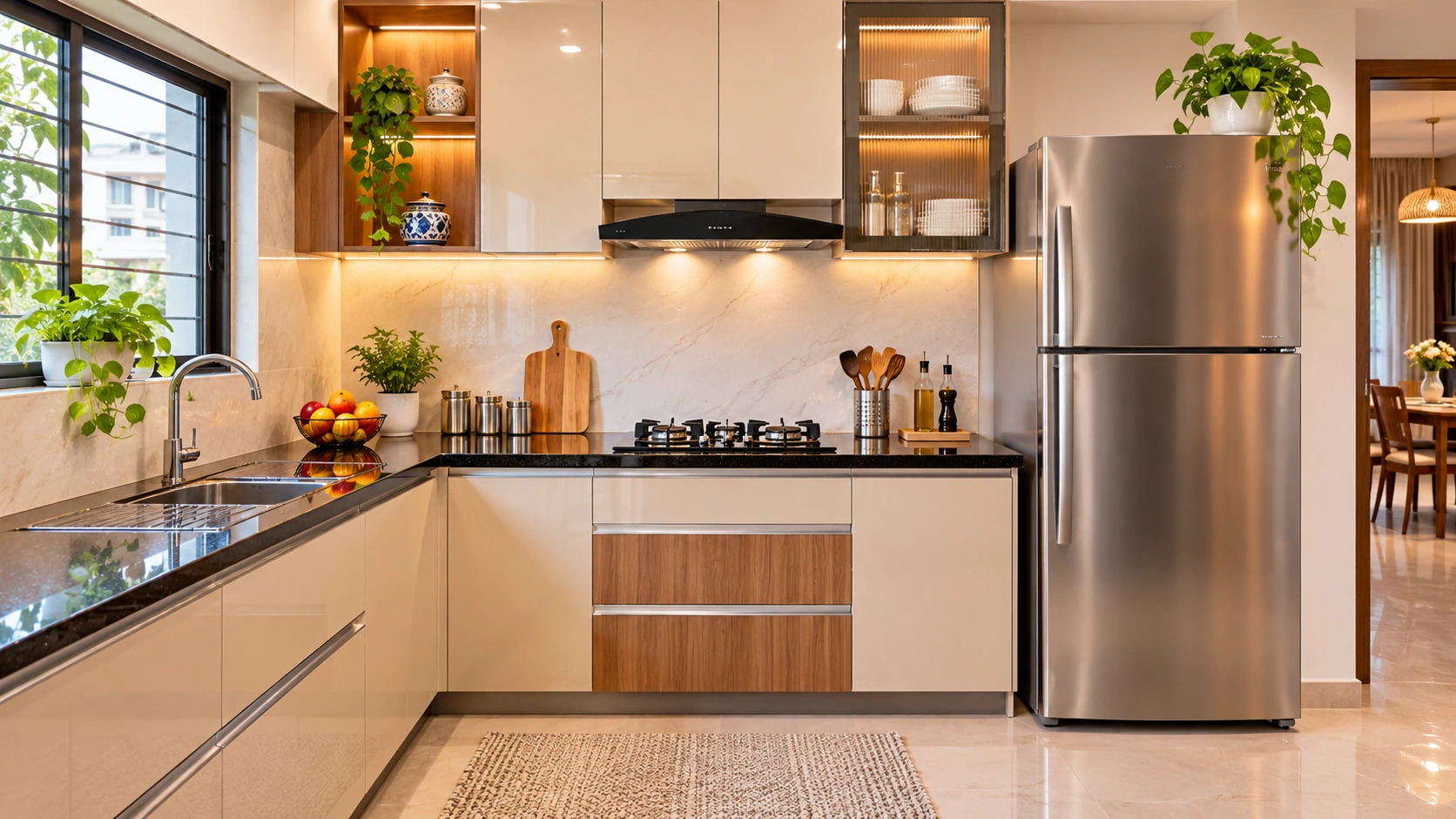
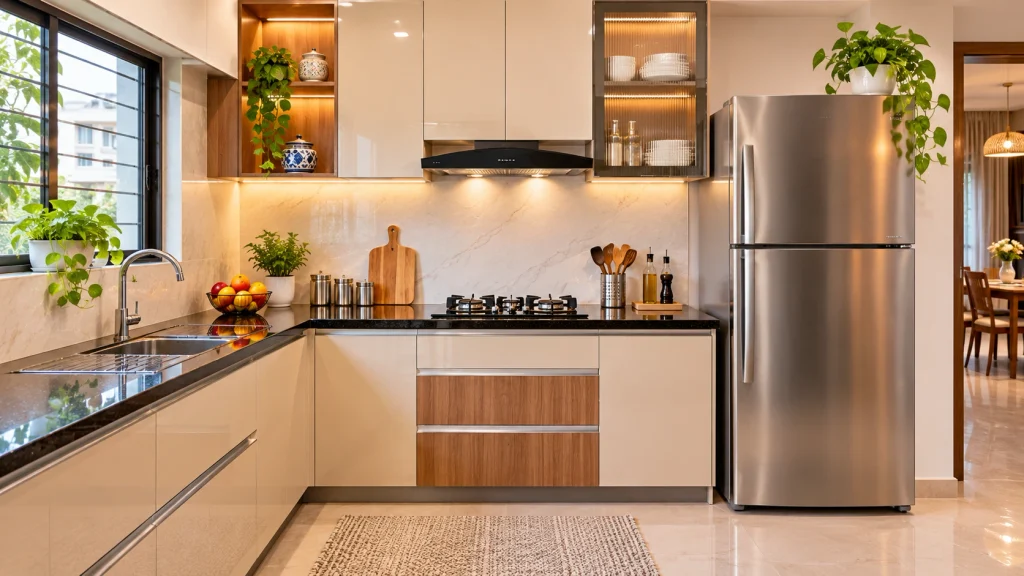
The refrigerator is one of the most frequently used appliances in an Indian home. Whether you’re planning a new modular kitchen, buying a refrigerator for your 2BHK flat, or rearranging a compact kitchen, you may wonder where the fridge should be placed according to Vastu Shastra.
Is the south-west corner best for a refrigerator? Can you keep a fridge in the south-east alongside other electrical appliances? Is the north-east really unsuitable? And what should you do if your builder has already fixed the refrigerator space?
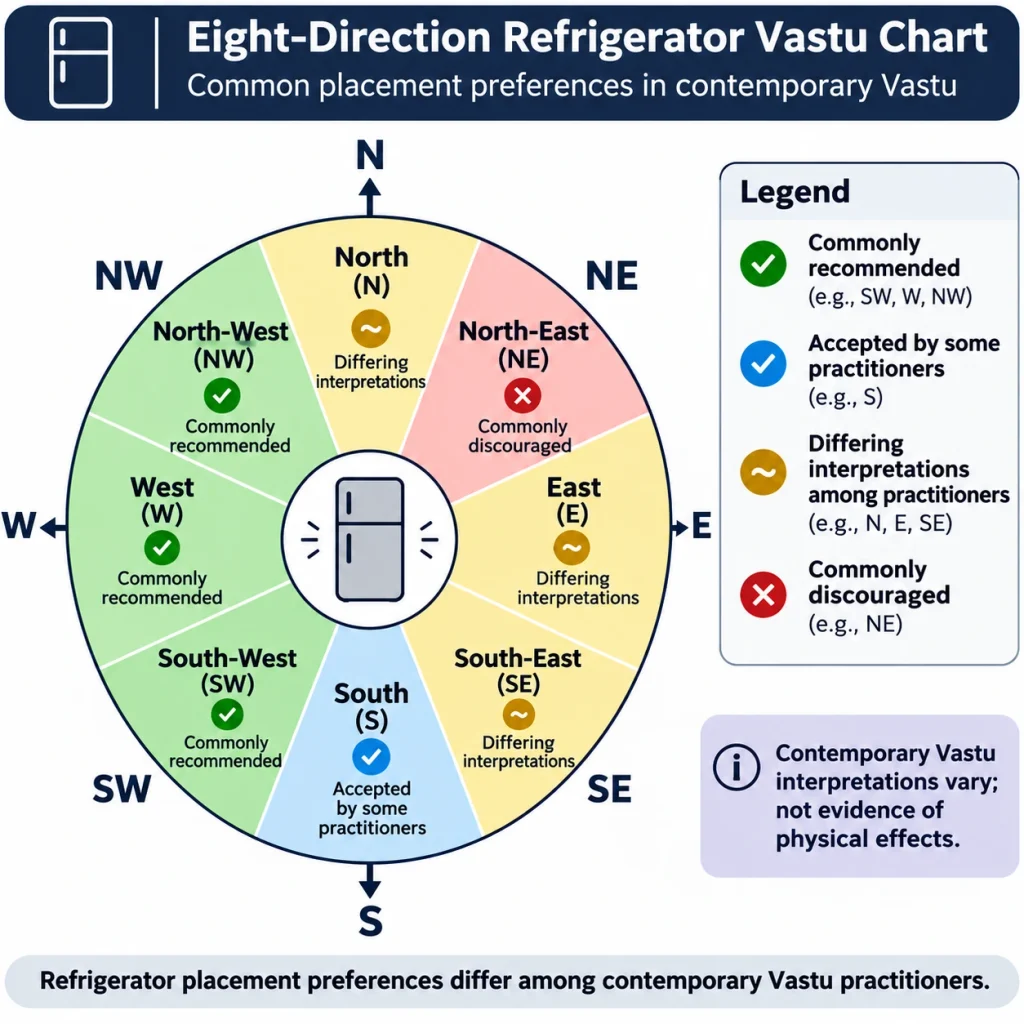
Contemporary Vastu practitioners commonly recommend the south-west, west, or north-west areas for refrigerator placement, although recommendations vary between schools.
Beyond these traditional preferences, the position of your fridge affects ventilation, electricity use, access, and food storage.
This comprehensive guide explains refrigerator direction as per Vastu, examines different interpretations, and provides practical placement advice for modern Indian kitchens, including 1BHK and 2BHK apartments.
Quick Answer: Which Direction Is Best for a Refrigerator as per Vastu?
The south-west, west, and north-west are among the most commonly recommended refrigerator locations in contemporary Vastu practice. South is also accepted by some practitioners. Opinions differ on the south-east, while north-east is often discouraged.
These recommendations are cultural and symbolic rather than scientifically established rules.
For actual installation, choose a location with adequate ventilation, a firm and level floor, safe electrical access, sufficient door-opening space, and suitable distance from heat and moisture. Always follow your refrigerator manufacturer’s installation manual.
1. Refrigerator Direction as per Vastu: Complete Direction Chart
Different Vastu practitioners sometimes recommend different positions for refrigerators. The following table summarises frequently encountered contemporary interpretations.
| Direction | Common Vastu interpretation | Practical advice |
|---|---|---|
| South-west (SW) | Frequently preferred for heavy appliances | Suitable if access and ventilation are adequate |
| West (W) | Commonly recommended | Often convenient along a kitchen side wall |
| North-west (NW) | Accepted or preferred by several schools | Can work well near an accessible kitchen entrance |
| South (S) | Acceptable in several interpretations | Check for heat exposure and circulation space |
| South-east (SE) | Disputed between practitioners | Avoid crowding the cooking hob or exposing the fridge to heat |
| North (N) | Mixed recommendations | Use if practical and safely installed |
| East (E) | Mixed recommendations | Protect from direct sunlight and nearby heat |
| North-east (NE) | Commonly discouraged | No proven harmful effect if it is the only safe location |
Important: This is not a universally authenticated refrigerator chart from an ancient Sanskrit text. Modern refrigerator placement recommendations are contemporary adaptations of Vastu ideas.
2. What Does Vastu Shastra Say About Refrigerators?
Vastu Shastra is a traditional Indian body of knowledge associated with architecture, spatial planning, orientation, and the use of buildings.
Classical architectural works include the Mayamata, Mānasāra, and Samarāṅgaṇasūtradhāra.
However, modern electrical refrigerators did not exist when these works were composed.
Consequently, claims that an ancient text explicitly requires a modern refrigerator to stand in a particular kitchen corner should be treated cautiously.
No authenticated classical passage establishing a specific placement rule for a present-day electric refrigerator was identified during research for this article.
Why do modern Vastu practitioners recommend particular directions?
Contemporary practitioners often interpret refrigerator placement through directional symbolism.
For example:
- South-west is commonly associated with stability and heavier storage.
- West is frequently regarded as a suitable area for storage or household appliances.
- North-west is linked symbolically with movement and circulation.
- South-east is associated with Agni, the fire element, in popular Vastu practice.
- North-east, or Ishanya, is often treated as a space to keep relatively open or uncluttered.
Some practitioners classify refrigerators as heavy objects, while others emphasise their electrical components or their purpose as food-storage appliances.
That difference helps explain why their recommendations are not always identical.
Traditional beliefs versus scientific evidence
There is no reliable scientific evidence that a refrigerator placed in the north-east causes financial losses or that moving it to the south-west creates prosperity.
Nevertheless, practical kitchen design does affect measurable conditions such as heat exposure, ventilation, electricity consumption, food preservation, and ease of movement.
These practical factors deserve priority.
3. South-West Refrigerator Placement: Is It the Best Direction?
South-west, also called Nairutya in traditional directional terminology, is among the most frequently recommended zones for heavy household objects in contemporary Vastu.
Many practitioners therefore consider it a suitable refrigerator location.
Why is south-west preferred?
In popular Vastu interpretations, south-west is associated with stability and grounding.
Because a refrigerator is relatively heavy and normally remains in one place, some practitioners assign it to this zone.
This is a symbolic interpretation, not evidence that the appliance influences the stability of family relationships or finances.
When south-west works well
A south-west kitchen location may be practical if:
- The floor is firm and level.
- The refrigerator door can open sufficiently.
- Surrounding cabinets do not obstruct ventilation.
- The fridge is conveniently accessible from the food-preparation counter.
- The position does not block the kitchen entrance.
Example
Imagine a rectangular kitchen with the cooking hob on an eastern counter and the sink along the northern counter.
A free-standing refrigerator can fit beside the western end of the southern wall without blocking any doors.
If this location falls in the south-west portion of the kitchen and meets the manufacturer’s installation requirements, it may be a good arrangement.
However, if the south-west corner is occupied by a gas cylinder cabinet, a doorway, or tightly fitted cabinetry, do not force the refrigerator into that space.
A safe location on another wall is preferable to an unsafe south-west installation.
4. Is the West Direction Good for a Refrigerator?
Yes. The west is widely accepted in contemporary refrigerator Vastu guidance.
It is particularly useful in kitchens where the south-west corner is unavailable.
Advantages of a west-side location
From a design perspective, placing a refrigerator near one end of a counter can make it easy to unload groceries and transfer ingredients to a preparation area.
The fridge should not obstruct the natural movement between the entrance, sink, counter, and cooking hob.
What about west-facing sunlight?
A refrigerator located near a west-facing window may be exposed to strong afternoon sunlight.
This can be a disadvantage regardless of its symbolic directional suitability.
Use an appropriate interior position or suitable window shading to reduce direct heat exposure.
A west-wall refrigerator is not automatically well positioned simply because it follows a Vastu preference.
5. North-West Refrigerator Placement as per Vastu
North-west is another frequently accepted refrigerator zone.
Known traditionally as Vayavya, north-west is associated with Vayu, or wind, in Hindu directional symbolism.
Some modern practitioners consider it suitable for appliances used frequently throughout the day.
Is north-west better than south-west?
There is no universally accepted answer.
One practitioner may favour south-west because of the refrigerator’s weight. Another may favour north-west because of its functional use and association with movement.
Both are contemporary interpretations.
In a real kitchen, assess which position provides better ventilation, access, and available space.
North-west refrigerator placement in an L-shaped kitchen
A north-west location may work well in an L-shaped kitchen if the refrigerator can stand at the end of the counter, away from the cooking flame.
Make sure nearby drawers and cabinets can open independently of the refrigerator door.
Do not place the fridge where its open door blocks the only safe route out of the kitchen.
6. Can We Keep a Refrigerator in the South-East Direction?
This is one of the most disputed questions in modern refrigerator Vastu.
South-east, traditionally called Agneya, is commonly associated with fire.
Many Vastu practitioners recommend the south-east part of a kitchen for the cooking hob.
However, refrigerator recommendations differ.
Some contemporary guides include south-east among acceptable refrigerator positions because the appliance uses electricity.
Others discourage it because the refrigerator cools food and because the south-east is already associated with cooking activity.
Is a refrigerator in south-east harmful?
There is no scientific evidence that the south-east compass direction itself harms a refrigerator or its occupants.
What matters physically is whether the appliance is exposed to excessive heat.
A refrigerator located too close to a gas stove, oven, or other major heat source can face unfavourable operating conditions.
Manufacturers such as LG and Samsung advise against unsuitable heat exposure and insufficient ventilation.
What if the refrigerator is already in south-east?
Check whether the appliance has sufficient ventilation, operates correctly, and is away from the cooking hob.
Inspect the door swing, surrounding cabinets, and electrical connection.
If the position is safe and appropriate for your model, there is no evidence-based reason to relocate the appliance solely because it is in the south-east.
If you prefer another Vastu interpretation and have a better available location, relocation is an optional household choice.
7. Why Is the North-East Often Avoided for Refrigerators?
North-east, or Ishanya, is frequently associated with prayer, clarity, and openness in contemporary Vastu interpretation.
Some practitioners therefore prefer not to place tall or heavy objects in this zone.
A large refrigerator may also visually dominate a small north-east corner.
However, visual openness is a design consideration. It does not establish a supernatural or medical effect.
Does a north-east refrigerator cause financial problems?
No reliable scientific evidence supports that claim.
Neither a refrigerator’s compass direction nor its orientation can establish why someone experiences debt, illness, stress, or relationship difficulties.
What if your fridge must remain in the north-east?
Consider the following:
- Confirm that the fridge has adequate ventilation.
- Check the door-opening space.
- Keep the surrounding floor and passage clear.
- Avoid stacking unstable items above the appliance.
- Maintain the refrigerator and its electrical connection.
If all these conditions are met, there is no need for expensive changes based solely on directional anxiety.
8. What About Refrigerators in the North, East and South?
Refrigerator in the north
Contemporary Vastu opinions about north-side refrigerator placement are mixed.
Some practitioners discourage placing heavy appliances in the north, while others consider it acceptable.
If the north side provides the safest and most convenient installation, use it rather than compromising ventilation or electrical safety.
Refrigerator in the east
An east-side location can work well in some kitchen layouts.
However, check for direct morning sunlight entering through nearby windows.
The refrigerator should not be exposed to unnecessary heat, and its door should not block access to the preparation area.
Refrigerator in the south
South is accepted by several contemporary Vastu guides.
It may also provide a convenient location in a kitchen where the southern wall has sufficient uninterrupted space.
Again, the actual conditions matter more than the compass label.
9. Kitchen Direction vs Refrigerator Direction: Understand the Difference
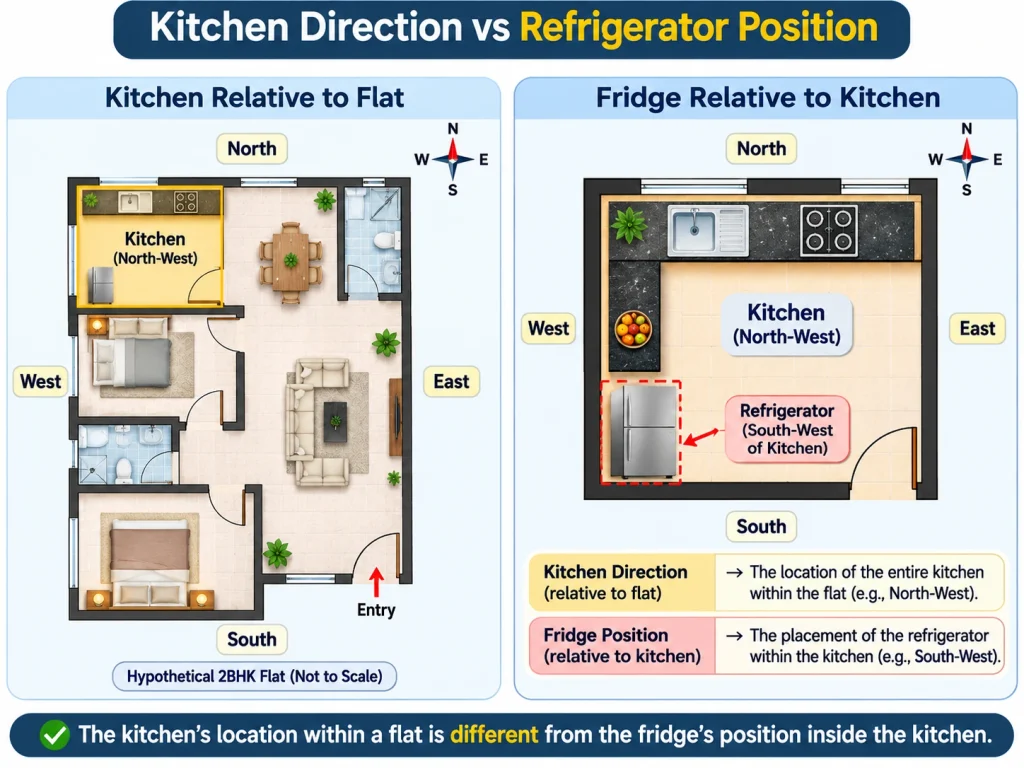
A common mistake is confusing the location of the entire kitchen within the home with the location of the refrigerator inside that kitchen.
These are separate questions.
Kitchen location within the flat
This describes where the kitchen is situated in relation to the whole apartment.
For example, a kitchen may be in the north-west corner of a 2BHK flat.
Refrigerator location inside the kitchen
This describes the particular part of the kitchen occupied by the fridge.
For example, the refrigerator may stand in the south-west part of that north-west kitchen.
Both descriptions can be correct simultaneously.
Hypothetical example
Consider a rectangular apartment with north at the top.
Its kitchen occupies the north-west portion of the overall floor plan.
Within that kitchen, a refrigerator is positioned in the south-west corner relative to the kitchen’s own boundaries.
The refrigerator is therefore:
- In a north-west kitchen relative to the flat.
- In the south-west area relative to the kitchen itself.
Some Vastu approaches evaluate appliance locations using room-level zones, while others place greater emphasis on the overall floor-plan grid.
These approaches should not be mixed without explanation.
If you are following a particular Vastu system, establish which reference frame it uses before interpreting the position.
For help identifying the directions, refer to our Compass Guide for Checking Vastu Directions in a Flat.
10. How to Find the Correct Refrigerator Direction
You can identify the approximate direction of a refrigerator using a floor plan and compass.
Step 1: Obtain the apartment floor plan
Use a reliable floor plan with a confirmed north reference.
Do not automatically assume that north is at the top of a plan.
Step 2: Check compass orientation
Use a suitable compass or a calibrated smartphone compass.
Take readings away from large metallic objects and electrical appliances that could influence the measurement.
Step 3: Identify the kitchen boundaries
Mark the north, south, east, and west sides of the kitchen.
For an irregular kitchen, note that simple rectangular subdivisions are only approximations.
Step 4: Locate the refrigerator
Record where the appliance stands relative to the chosen kitchen reference frame.
Do not confuse the wall behind the refrigerator with the direction its door faces.
Step 5: Check practical suitability
Measure the available space and compare it with your refrigerator’s installation instructions.
Door clearance, ventilation, electrical access, and floor conditions should be satisfactory.
Step 6: Choose the most suitable arrangement
If more than one location is safe, you can use your preferred Vastu interpretation to decide between them.
There is no need to undertake structural changes for a refrigerator direction alone.
11. Refrigerator Placement in Different Kitchen Layouts
The shape of your kitchen can matter more than its compass orientation.
A. Straight or single-wall kitchen
Straight kitchens are common in compact urban apartments.
The refrigerator may stand at one end of the kitchen counter, provided enough space remains for door opening and food preparation.
Avoid installing it immediately beside the cooking hob.
If the only available space is on the north wall, that may still be preferable to placing the appliance in a cramped, poorly ventilated south-west corner.
B. L-shaped kitchen
An L-shaped layout offers two working counter runs.
The refrigerator can often be positioned at the end of one run.
This may preserve useful preparation space while maintaining a reasonably convenient relationship with the sink and cooking area.
Check whether nearby drawers, cabinet shutters, and the refrigerator door can operate without collisions.
C. Parallel or galley kitchen
A parallel kitchen has working surfaces along opposite sides.
The refrigerator must not obstruct the passage when its door is open.
If the entrance is narrow, an oversized double-door refrigerator may create a practical problem regardless of its Vastu position.
Choose a suitable appliance location and door arrangement that preserves access.
D. U-shaped kitchen
U-shaped kitchens have more countertop and cabinet space, but corners can become congested.
Avoid trapping a refrigerator between deep cabinets where ventilation or full door opening is restricted.
An end-of-run location can sometimes work better than a tight corner.
E. Open kitchen
In open kitchens connected to the living or dining room, the refrigerator may be integrated near the edge of the kitchen area.
This can allow convenient access without requiring family members to enter the cooking zone.
Choose a location that does not block circulation between rooms.
12. The Most Important Practical Rules for Refrigerator Placement
Vastu preferences are optional, but basic installation and operating requirements are essential.
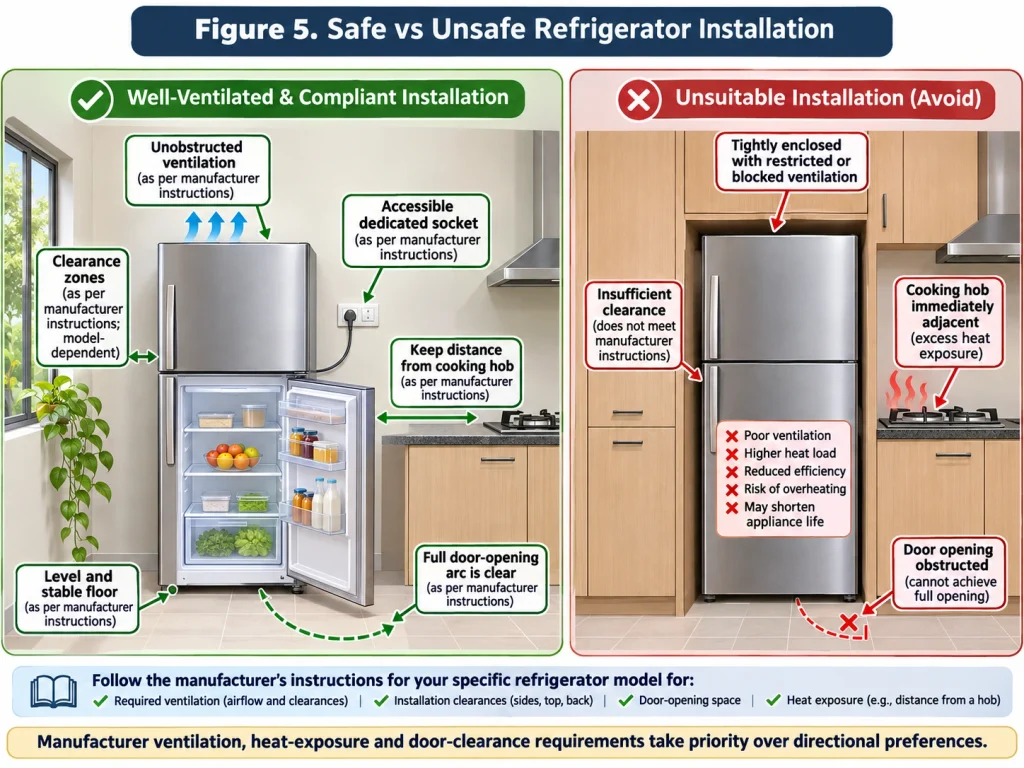
12.1 Allow adequate ventilation
Refrigerators release heat during normal operation.
If surrounding walls or cabinets restrict ventilation, cooling performance may be affected.
Samsung India specifically identifies poor ventilation and inadequate installation space as possible contributors to low cooling.
Do not assume that a universal gap of one inch, three inches, or one foot applies to every refrigerator.
Installation clearances depend on the model and its design.
Consult the manufacturer’s installation manual for the required side, rear, and top spacing.
12.2 Keep the refrigerator away from major heat sources
Avoid locating it unnecessarily close to a gas hob, oven, or other strong heat source.
Also consider direct sunlight through kitchen windows.
A nominally preferred Vastu direction is not worth increased heat exposure.
12.3 Use a suitable electrical connection
The refrigerator should be connected according to the manufacturer’s electrical requirements.
Proper earthing is important.
Avoid overloaded sockets, unsuitable extension boards, and damaged wiring.
Samsung India advises proper grounding and warns against shared extension connections that may create electrical hazards.
If a socket needs to be relocated, use a qualified electrician.
Never remove or bypass the grounding connection.
12.4 Check door-opening clearance
A refrigerator door may need to open beyond a right angle to allow drawers and shelves to be removed.
The required opening depends on the appliance design.
Measure the door swing before purchasing or relocating the fridge.
LG India specifically advises checking door-opening requirements for the selected refrigerator model.
12.5 Choose a firm and level floor
A refrigerator should stand on a stable surface and be levelled according to its installation instructions.
An unsuitable floor can affect stability and operation.
Do not attempt unsafe improvised adjustments to compensate for uneven flooring.
12.6 Keep moisture away from electrical connections
Ensure that water from the sink, wet cleaning, leaks, or other sources cannot compromise the refrigerator’s electrical connection.
Investigate leaks promptly.
If the appliance gives an electric shock, develops an electrical fault, or shows other signs of unsafe operation, stop using it and seek qualified assistance.
12.7 Maintain access for cleaning and servicing
The refrigerator should not be permanently trapped inside a custom cabinet that prevents routine inspection or necessary servicing.
Make sure a technician can access it when required.
13. How Much Gap Should Be Left Around a Refrigerator?
This is one of the most important practical questions.
Some Vastu websites recommend specific distances from the wall, but those measurements should not be treated as universal engineering rules.
The correct clearance is model-dependent.
For example, LG India’s installation guidance requires adequate gaps around the appliance and provides additional instructions for door and cabinet clearance.
Different models may require different arrangements.
What should you measure?
| Measurement | Why it matters |
|---|---|
| Refrigerator width | Ensures the appliance fits its intended position |
| Refrigerator depth | Prevents unexpected projection into a passage |
| Refrigerator height | Confirms compatibility with overhead storage |
| Rear clearance | Supports model-specific ventilation and connections |
| Side clearance | Allows ventilation and door movement |
| Top clearance | Supports the required installation arrangement |
| Door swing | Allows drawers, shelves and doors to function |
| Service access | Makes maintenance and repair possible |
Measure both the appliance and the actual space available.
A built-in-looking installation is not necessarily suitable for a freestanding refrigerator.
If the manufacturer requires ventilation around the cabinet, decorative panelling must not block it.
14. Which Direction Should the Refrigerator Door Face?
Many homeowners confuse refrigerator position with refrigerator door orientation.
Suppose a refrigerator has its back near the west wall.
If its front points towards the east, you stand facing west when looking directly into the open fridge.
These are different directional descriptions.
Is a north-facing refrigerator door auspicious?
Some modern Vastu interpretations recommend arranging the refrigerator so that its front opens towards north or east.
However, this is not a universally established classical refrigerator rule.
There is no scientific evidence that the direction of the fridge door changes financial or family outcomes.
What should determine door orientation?
Prioritise:
- Full and convenient opening.
- Safe movement through the kitchen.
- Access to shelves and drawers.
- Space to load and unload groceries.
- Compatibility with adjoining furniture.
Some refrigerator models permit door-hinge reversal, while others do not.
Only reverse a door if the specific model supports it, following the manufacturer’s instructions or authorised service procedure.
15. Can the Refrigerator Be Kept Outside the Kitchen?
Yes. In many Indian apartments, the kitchen is too small for a large refrigerator.
A fridge may be placed in a dining area, adjoining utility space, or appropriate portion of the living room if installation requirements are satisfied.
Refrigerator in the dining room
A dining room can be a practical alternative.
It may provide convenient access to drinking water, fruit, dairy products, and other frequently used food.
Choose a location away from heat and moisture, with adequate ventilation and an appropriate electrical outlet.
Refrigerator in the living room
In a compact 1BHK apartment, a refrigerator may need to stand just outside the kitchen.
From a contemporary Vastu perspective, some practitioners would prefer a west or south-west zone.
However, the actual room layout may make another position preferable.
Do not block entrance doors, passages, ventilation openings, or essential access.
Refrigerator on a balcony
A balcony is not automatically suitable.
Direct sunlight, rain, humidity, dust, and unsuitable ambient temperatures can create problems.
Use a balcony location only if the refrigerator manufacturer explicitly permits the environmental conditions and the installation can be made safe.
An uncovered or wet balcony should not be treated as an ordinary refrigerator location.
16. Refrigerator Placement in a 1BHK Flat
Small 1BHK apartments often have limited kitchen space.
The builder may have fixed the sink, countertop, gas connection, and electrical sockets.
The refrigerator position may therefore be constrained.
Hypothetical example: Compact Pune apartment
Imagine a 1BHK flat with a small parallel kitchen.
The west counter is occupied by the gas hob and preparation area.
The south-west corner is too narrow for a refrigerator.
However, a suitable location is available near the kitchen entrance on the north side.
In this example, the north-side location may be more practical.
It avoids unnecessary proximity to the hob and allows the fridge to open properly.
The decision should be based on the actual dimensions and the refrigerator’s installation instructions.
There is no need to compromise appliance safety to satisfy a preferred Vastu zone.
For broader no-demolition arrangements, read Vastu for 1BHK and 2BHK Homes Without Demolition.
17. Refrigerator Direction for a 2BHK Flat
A 2BHK apartment may have a separate kitchen, an open kitchen, or a kitchen with an attached utility area.
The refrigerator location should be evaluated within the actual layout rather than selected by direction alone.
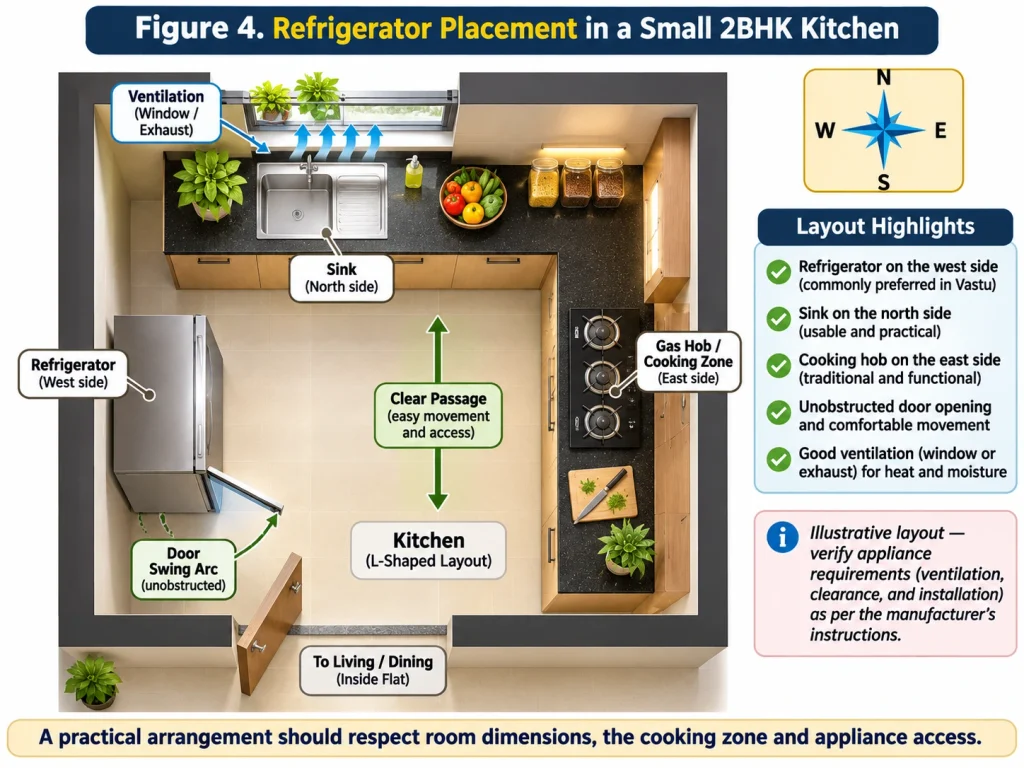
Hypothetical example: 2BHK with an L-shaped kitchen
Consider a 2BHK flat where:
- The kitchen is in the south-east portion of the apartment.
- The hob is installed on the eastern counter.
- The sink is on a northern counter.
- The west wall contains a suitable area for a refrigerator.
- The entrance to the kitchen remains unobstructed.
In this hypothetical arrangement, a refrigerator on the west side of the kitchen may work well.
Its placement should still be checked for adequate ventilation, full door movement, and electrical safety.
The fact that the kitchen occupies the south-east portion of the flat does not mean the refrigerator must stand in the south-east corner of the kitchen.
See our 2BHK Flat Vastu Plan: Ideal Room Directions and Layouts for broader room-planning guidance.
18. Single-Door vs Double-Door Refrigerator: Does Vastu Differ?
There is no verified classical Vastu requirement that a single-door, double-door, side-by-side, or French-door refrigerator must occupy a different compass direction.
The differences are mainly practical.
Single-door refrigerator
A compact single-door refrigerator can be useful in small flats and kitchens with limited floor space.
Check the door swing, ventilation, and the ability to access the freezer compartment.
Double-door refrigerator
A double-door refrigerator may require more width or depth than a compact model.
It should not be forced into a small kitchen corner where opening the doors becomes difficult.
Side-by-side refrigerator
Side-by-side refrigerators require careful door-opening and surrounding-space checks.
The fact that the appliance has two doors does not create a separate Vastu restriction.
Large-capacity refrigerator
A larger fridge can be useful for a larger household, but should be selected after checking the kitchen’s physical dimensions.
Its location must accommodate installation, access, and servicing.
The best refrigerator is one that suits the household’s actual requirements and available space.
19. Does Refrigerator Colour Matter as per Vastu?
Contemporary Vastu colour advice varies between practitioners.
Some suggest silver, white, or neutral finishes, while others associate particular colours with directional elements.
No universally authenticated classical refrigerator-colour rule has been established.
White refrigerator
White is a common choice for kitchens with light-coloured cabinets.
It can create a clean and simple visual appearance.
Silver or stainless-steel refrigerator
Silver and metallic finishes suit many contemporary modular kitchens.
Choose an easy-to-maintain surface that fits the surrounding interior.
Black refrigerator
A black refrigerator is not inherently harmful.
There is no evidence that its colour creates negative outcomes.
A black finish may complement light cabinets, darker countertops, or modern kitchen designs.
Red or colourful refrigerator
Coloured refrigerators can be used as an interior-design feature.
Some Vastu interpretations connect red with the fire element, but this does not establish a health, financial, or mechanical effect.
Choose refrigerator colour primarily for appearance, maintenance, availability, and personal preference.
20. Refrigerator Vastu Remedies Without Demolition
What if your fridge is already in a direction that a Vastu practitioner discourages?
Start by determining whether there is any actual problem.
A refrigerator that operates correctly, is safely installed, and has sufficient ventilation does not require structural alteration because of its direction.
Problem 1: Refrigerator in north-east
If you prefer another Vastu interpretation, consider an alternative location only when it is genuinely suitable.
Otherwise, focus on maintenance, access, and organisation.
Problem 2: Refrigerator near the stove
Check the manufacturer’s heat-exposure guidance.
If necessary, obtain professional advice about a safer arrangement.
Do not modify gas piping or electrical systems without qualified assistance.
Problem 3: Refrigerator blocks the kitchen entrance
Rearrange nearby freestanding furniture where possible.
If the fridge itself must be moved, plan the move according to the manufacturer’s handling instructions.
Problem 4: Refrigerator is tightly enclosed
Review the appliance’s ventilation requirements.
If the surrounding cabinetry is unsuitable, consult the appliance manufacturer or an appropriate installer.
Problem 5: Refrigerator is overcrowded or poorly maintained
Remove expired food and unnecessary items.
Clean appropriate surfaces according to the manual.
Ensure that interior air circulation is not obstructed.
Are Vastu pyramids, crystals, or colour strips necessary?
Some contemporary practitioners recommend symbolic objects, colours, or rituals.
These are matters of cultural preference.
There is no credible scientific evidence that such objects correct refrigerator ventilation, electrical faults, food spoilage, or household financial difficulties.
Do not substitute symbolic remedies for necessary maintenance or repairs.
21. Common Refrigerator Placement Mistakes
Mistake 1: Choosing the direction without checking heat
A refrigerator placed beside a hot cooking area can have an unsuitable operating environment even when its compass direction is preferred.
Mistake 2: Ignoring the manufacturer’s ventilation clearances
A cabinet arrangement that looks attractive may restrict airflow.
Mistake 3: Positioning the fridge where the door cannot open fully
Door-opening space affects everyday usability, access to food, and maintenance.
Mistake 4: Using an unsuitable electrical extension
Incorrect electrical connections can introduce safety risks.
Mistake 5: Placing a fridge on an unstable floor
The appliance needs a suitable, level installation surface.
Mistake 6: Confusing kitchen direction with fridge direction
A south-east kitchen can contain a west-side refrigerator. These descriptions use different reference areas.
Mistake 7: Treating all Vastu practitioners as agreeing
Refrigerator recommendations differ, particularly for the north, north-west, and south-east.
Mistake 8: Assuming relocation will solve financial or health problems
No reliable evidence supports that expectation.
Mistake 9: Ignoring food-storage temperatures
The real purpose of a refrigerator is to preserve food safely.
FoodSafety.gov recommends maintaining refrigerator temperature at or below 4°C and freezer temperature at or below −18°C.
Use an appliance thermometer when necessary to verify the actual temperature.
Mistake 10: Making expensive changes to a working kitchen
A refrigerator should not be relocated at substantial cost without a good practical reason.
22. Refrigerator Placement: Traditional Preference vs Practical Reality
| Situation | Contemporary Vastu preference | Practical decision |
|---|---|---|
| SW corner is open and suitable | Often favoured | Use if manufacturer requirements are met |
| Only west-side space is available | Commonly acceptable | Check heat, ventilation and door movement |
| NW gives better access | Accepted by many schools | A reasonable choice |
| SE space is close to the stove | Interpretations conflict | Avoid unsuitable heat exposure |
| Fridge is already in NE | Often discouraged symbolically | No need to move solely for symbolic reasons |
| Kitchen is too small | Preferences vary | Consider a suitable adjoining room |
| Fridge does not fit its cabinet | No directional remedy solves it | Correct the installation |
| Electrical socket is unsafe | Not a Vastu issue | Arrange qualified electrical assessment |
23. Refrigerator Placement Checklist for Indian Homes
Before finalising your refrigerator location, use this practical checklist.
- Identify the kitchen’s actual compass orientation.
- Decide whether you are evaluating the whole flat or the kitchen itself.
- Check south-west, west, and north-west options if following common modern Vastu preferences.
- Compare other available positions rather than forcing a preferred one.
- Confirm refrigerator dimensions and manufacturer’s required installation clearances.
- Check that the doors and drawers open adequately.
- Keep the appliance away from unsuitable heat and direct sunlight.
- Ensure proper earthing and electrical safety.
- Select a firm, level, appropriately dry installation surface.
- Keep ventilation openings unobstructed.
- Preserve safe access and kitchen circulation.
- Make cleaning and service access possible.
- Verify the refrigerator’s operating temperature.
- Avoid unnecessary demolition or expensive symbolic remedies.
24. Frequently Asked Questions
1. Which direction is best for a refrigerator as per Vastu?
South-west, west, and north-west are among the commonly recommended directions in contemporary Vastu practice. However, different practitioners give different priorities to these zones. The safest practical location is one that meets the refrigerator manufacturer’s requirements for ventilation, heat exposure, electrical safety, and door access.
2. Can we keep the refrigerator in the south-east corner?
Yes, provided the location is suitable for the appliance. Some modern Vastu interpretations accept the south-east, while others discourage it. A refrigerator should not be crowded against a hot cooking appliance. Actual heat exposure and ventilation are more important than the symbolic directional classification.
3. Is the refrigerator in the south-west direction good?
South-west is frequently considered suitable for refrigerators by contemporary Vastu practitioners because of its symbolic association with heavy objects and stability. However, there is no scientific evidence that this placement improves wealth or relationships. Use the position when it is safe and convenient.
4. Can a fridge be placed in the north-east?
Yes, if the appliance can be installed safely. North-east is discouraged in many contemporary Vastu systems, but there is no evidence that a refrigerator in this area causes illness, debt, or misfortune. If it is your only suitable location, you need not make costly alterations solely for Vastu reasons.
5. Which direction should the refrigerator door face?
Some practitioners suggest north or east, but there is no universal classical rule governing the direction of modern refrigerator doors. Prioritise ease of opening, safe access, and compatibility with nearby cabinetry. Door-hinge changes should only be made when supported by the manufacturer.
6. Can the fridge be kept in the living room as per Vastu?
Yes. This is sometimes necessary in compact Indian apartments. The refrigerator should be installed on a stable floor in a well-ventilated area with appropriate electrical access. Avoid direct sunlight, unsuitable heat, moisture, and locations that obstruct movement.
7. Is west a good direction for a refrigerator?
West is commonly considered acceptable in contemporary Vastu advice. It can also be a useful location at the end of a modular kitchen counter. Check for exposure to afternoon sunlight, adequate ventilation, and sufficient space for the refrigerator doors.
8. Can a refrigerator and gas stove be on the same wall?
They can be located along the same wall if their installation arrangements are safe and meet the relevant manufacturer instructions. Avoid placing the refrigerator too close to heat sources. The appropriate separation depends on the appliances, kitchen design, and applicable safety requirements rather than one universal Vastu measurement.
9. Which refrigerator colour is best according to Vastu?
White, silver, and neutral colours are commonly suggested in contemporary decorating advice. However, no verified universal classical rule requires a particular refrigerator colour. Choose a finish that fits the kitchen, is easy to maintain, and suits your preferences.
10. Can a refrigerator be placed under a staircase?
Only if the installation environment meets the refrigerator manufacturer’s requirements. A staircase recess may have inadequate ventilation, unsuitable access, or other limitations. Do not assume it is suitable merely because the appliance physically fits.
11. What if my 2BHK kitchen has no space in the south-west?
You can consider the west or north-west if available, or another practical position that satisfies installation requirements. There is no evidence-based requirement to reconstruct a kitchen to position a refrigerator in the south-west.
12. Does a refrigerator in the wrong Vastu direction cause financial loss?
There is no reliable scientific evidence that refrigerator direction causes financial loss. Treat directional recommendations as optional cultural preferences. Financial decisions and household safety should be addressed through appropriate practical measures rather than appliance positioning.
What Is the Best Refrigerator Position for Your Kitchen?
According to commonly followed contemporary Vastu recommendations, south-west, west, and north-west are among the preferred locations for a refrigerator.
South is also accepted by some practitioners, while the recommendations for south-east, north, and east vary. North-east is frequently discouraged for symbolic reasons.
However, no refrigerator direction has been scientifically shown to determine health, wealth, or family relationships.
For modern Indian homes, the best position is one that combines your preferred traditional arrangement with adequate ventilation, safe electricity, proper door clearance, stable flooring, and convenient everyday access.
If your refrigerator is already safely installed and operating correctly, you do not need to rebuild your kitchen simply because a Vastu guide recommends another direction.
A thoughtful kitchen arrangement should make your home safer, more functional, and easier to maintain.
For more ways to organise your apartment without major renovation, explore our 30-Day Vastu Declutter & Energy Reset Guide.
Editorial disclaimer: Vastu is a cultural and traditional system of interpretation. The directional recommendations above do not establish scientifically proven causes of health, financial, or personal outcomes. Appliance installation, electrical work, and kitchen modifications should follow manufacturer instructions and appropriate professional safety requirements.