
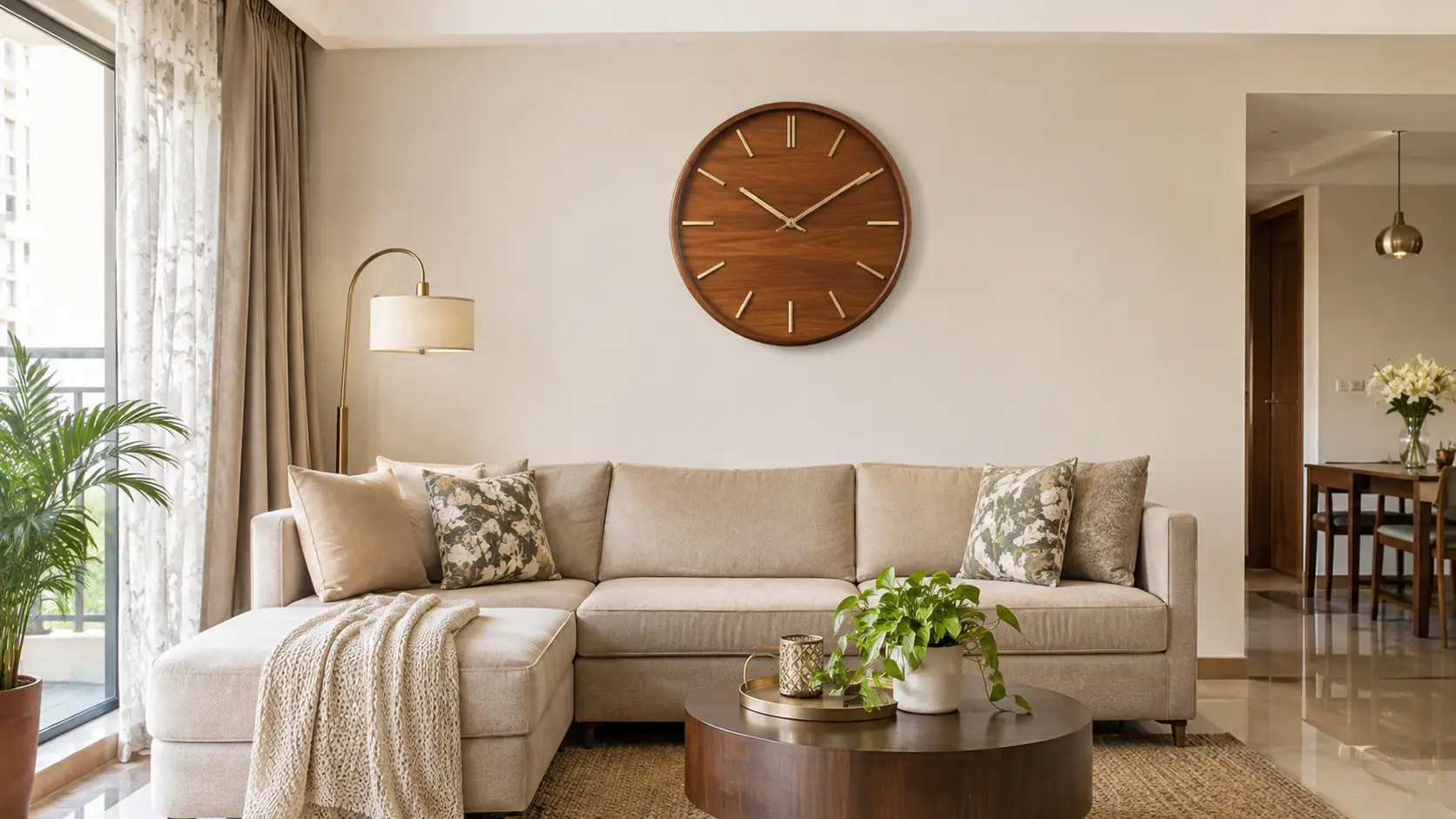
A wall clock is one of the most useful objects in an Indian home. We check it before leaving for work, while preparing meals, when studying, and throughout our daily routines. But if you follow Vastu Shastra, you may also wonder whether the direction of your wall clock matters.
Should you hang it on the north wall or the east wall? Is a clock on the south wall considered inauspicious? Does the shape, colour, or material make a difference?
Contemporary Vastu advice often recommends particular directions for clocks, but the guidance can become confusing when applied to small apartments where windows, wardrobes, and doors occupy the available walls.
This guide explains commonly followed wall clock Vastu recommendations, their traditional interpretations, and practical ways to apply them in Indian homes without unnecessary alterations.
You’ll also learn how to identify the correct wall, choose a suitable clock, and avoid placement mistakes.
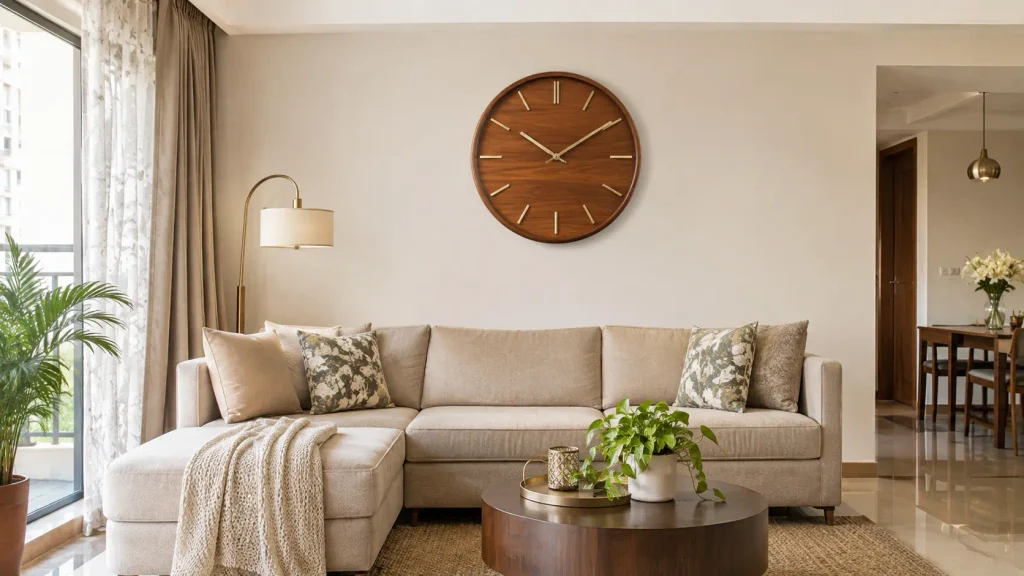
Which Direction Is Best for a Wall Clock as per Vastu?
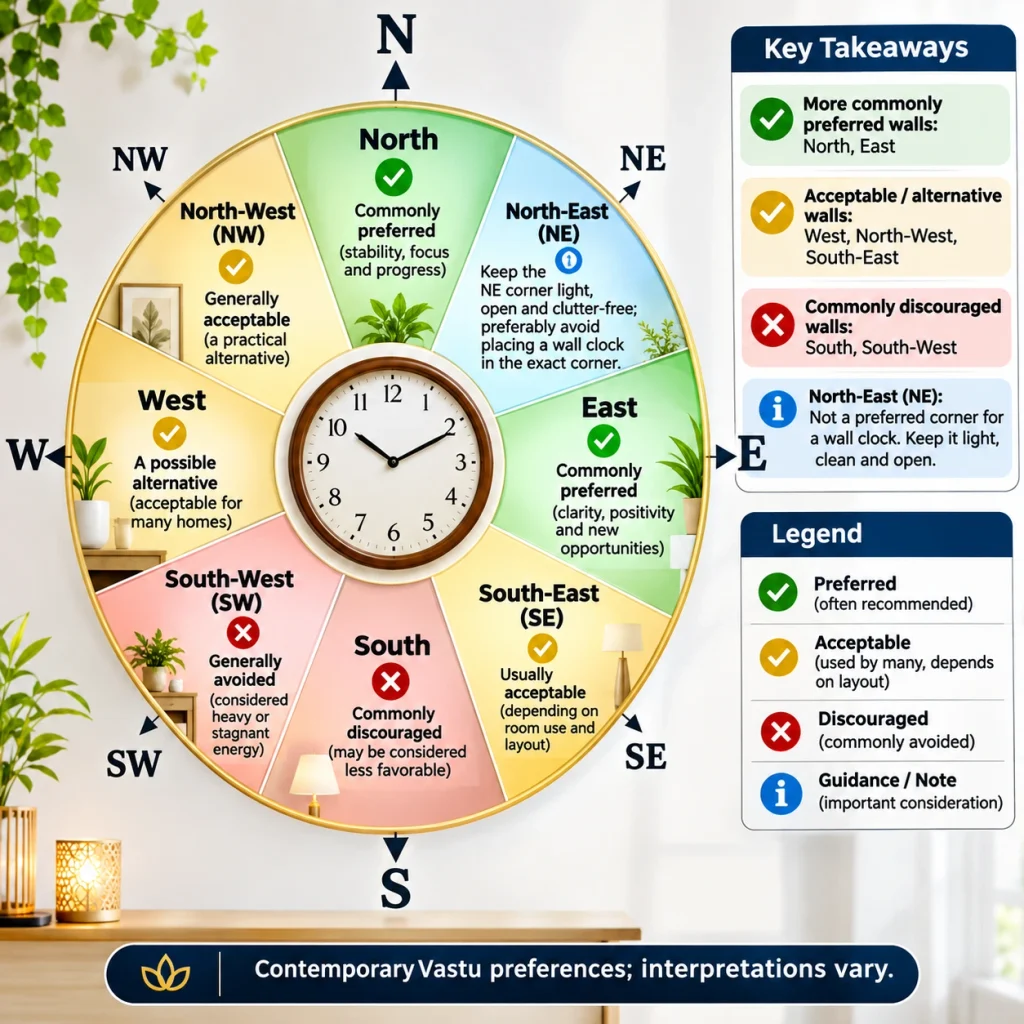
The north or east wall is generally considered the best direction for a wall clock according to contemporary Vastu recommendations. The north is traditionally associated with Kubera, the deity of wealth, while the east is associated with the rising sun, new beginnings, and activity.
Some practitioners also recommend the north-east portion of a room. The west wall is commonly accepted as an alternative, although opinions differ.
The south and south-west are frequently discouraged in modern Vastu practice.
These directional preferences are symbolic and cultural. There is no established scientific evidence that hanging a clock in a particular direction directly changes your finances, health, relationships, or success.
Wall Clock Direction Chart
| Direction or zone | Common Vastu preference | Practical guidance |
|---|---|---|
| North | Highly preferred | Good if clearly visible and securely mounted |
| East | Highly preferred | Suitable for living rooms, bedrooms and studies |
| North-east | Often preferred | Use an available section of the north or east wall |
| West | Alternative | Acceptable where north and east are unsuitable |
| North-west | Practitioner-dependent | Consider visibility and available wall space |
| South-east | Practitioner-dependent | Avoid heat, cooking fumes and moisture |
| South | Commonly discouraged | No proven harmful effect; relocate only if practical |
| South-west | Often discouraged | Prioritise safe installation over symbolic rules |
Important: The chart describes commonly followed modern recommendations, not a universally agreed set of instructions from a single ancient Sanskrit text.
1. Why Does Wall Clock Direction Matter in Vastu?
Vastu Shastra is a traditional Indian body of knowledge concerned with the arrangement and design of buildings and spaces.
Classical works such as the Mayamata, Mānasāra, and Samarāṅgaṇasūtradhāra address architectural planning, proportions, orientation, and other aspects of construction.
Modern wall-clock placement recommendations belong largely to contemporary Vastu practice. A specific, authenticated classical passage prescribing today’s battery-operated wall clocks on north or east walls has not been established in the sources reviewed for this guide.
This distinction matters because modern decorative advice is sometimes presented as an exact ancient rule.
In contemporary Vastu interpretation, clocks symbolise the movement of time and the continuity of everyday life. A properly functioning clock is therefore associated with order, routine, and forward movement.
These associations may have cultural or personal meaning, but they should not be confused with scientifically demonstrated effects.
From a practical perspective, a well-positioned clock can help everyone in a household keep track of appointments, school schedules, cooking times, and daily activities.
2. North Wall Clock Placement as per Vastu
The north wall is among the most widely recommended locations for a wall clock.
In traditional Hindu directional symbolism, north is associated with Kubera, a deity connected with wealth and resources.
This association is one reason contemporary Vastu practitioners frequently recommend keeping clocks on a north-facing section of a room.
How to place a clock on the north wall
Choose a section of the north wall that is easy to see from your usual seating or working position.
In a living room, this might be a clear portion of wall beside a bookshelf or above a low console.
Select a clock whose numbers and hands are visible from a comfortable distance. Avoid squeezing it between oversized paintings or decorative shelves.
There is no need to purchase an expensive clock solely because of its direction.
Practical example: In a rectangular living room with the sofa against the south wall and a clear north wall opposite it, a medium-sized clock on the north wall offers convenient visibility and follows the commonly recommended direction.
Does a clock on the north wall attract money?
Some Vastu interpretations associate the north with prosperity. However, there is no credible scientific evidence that placing a wall clock on the north wall increases income, eliminates debt, or creates wealth.
It is reasonable to follow this placement as a cultural preference, while making financial decisions based on budgeting, saving, investing, and sound judgment.
3. East Wall Clock Placement as per Vastu
The east wall is another popular recommendation.
East is associated with sunrise and the beginning of daily activity. In symbolic Vastu interpretations, this direction is linked to renewal, growth, and fresh opportunities.
A clock placed on an east wall may therefore appeal to households that prefer a traditional directional arrangement.
Best situations for east-wall placement
An east-wall clock can work particularly well in a study, home office, dining area, or bedroom.
For instance, a person working at a desk may benefit from having a clock within a natural line of sight rather than turning repeatedly to check the time.
In a kitchen, a clock on the east wall can also be convenient if it is sufficiently far from cooking heat and steam.
Choose a location that allows easy cleaning and battery replacement.
A clock on the east wall is a good Vastu-inspired option, but it is not automatically better than a safer or more functional position elsewhere.
4. Is North-East a Good Direction for a Wall Clock?
The north-east, known as Ishanya or Ishana in traditional directional terminology, is often treated as an important part of a home in Vastu discussions.
Some contemporary practitioners recommend placing a clock in this zone.
However, there is an important difference between a north-east area and a north-east wall.
In an ordinary rectangular room, the north-east is a corner where the north and east walls meet. It is not a separate diagonal wall.
Therefore, you can place a clock:
- On the eastern portion of the north wall.
- On the northern portion of the east wall.
Both choices locate the clock near the north-east corner while retaining a normal, secure mounting surface.
Do not force a clock into a tight corner simply to satisfy a directional preference. It should remain readable and safely supported.
5. Can We Hang a Wall Clock on the West Wall?
Yes. The west wall is a commonly accepted alternative when a north or east wall is unavailable.
Recommendations vary between contemporary Vastu practitioners. Some regard the west as acceptable, while others prefer to avoid it.
This difference is worth acknowledging rather than presenting one interpretation as universally binding.
For example, consider a living room where:
- The north wall contains a large window.
- The east wall is occupied by a television unit.
- The west wall has an unobstructed area.
- The south wall contains the entrance.
In this situation, placing a clock on the west wall may be the most sensible arrangement.
A secure, easy-to-read clock is more useful than an awkwardly installed clock chosen solely for its compass direction.
There is no established evidence that a west-wall clock creates difficulties in life.
6. Why Is the South Wall Often Avoided in Vastu?
Many modern Vastu guides advise against hanging a wall clock on the south wall.
South is associated with Yama in Hindu directional symbolism. Some contemporary interpretations connect this direction with endings, restraint, or stability rather than the forward movement symbolised by a clock.
This is the cultural background behind the recommendation.
However, claims that a south-wall clock causes illness, unemployment, financial losses, relationship problems, or bad luck are unsupported.
What if your clock is already on the south wall?
You do not need to panic or make expensive changes.
If you prefer following the traditional recommendation, identify a suitable north or east wall and move the clock using appropriate mounting hardware.
If no suitable wall exists, keeping a safely installed, functioning clock on the south wall is a reasonable practical choice.
A wall-clock position is not a reliable explanation for personal or financial difficulties.
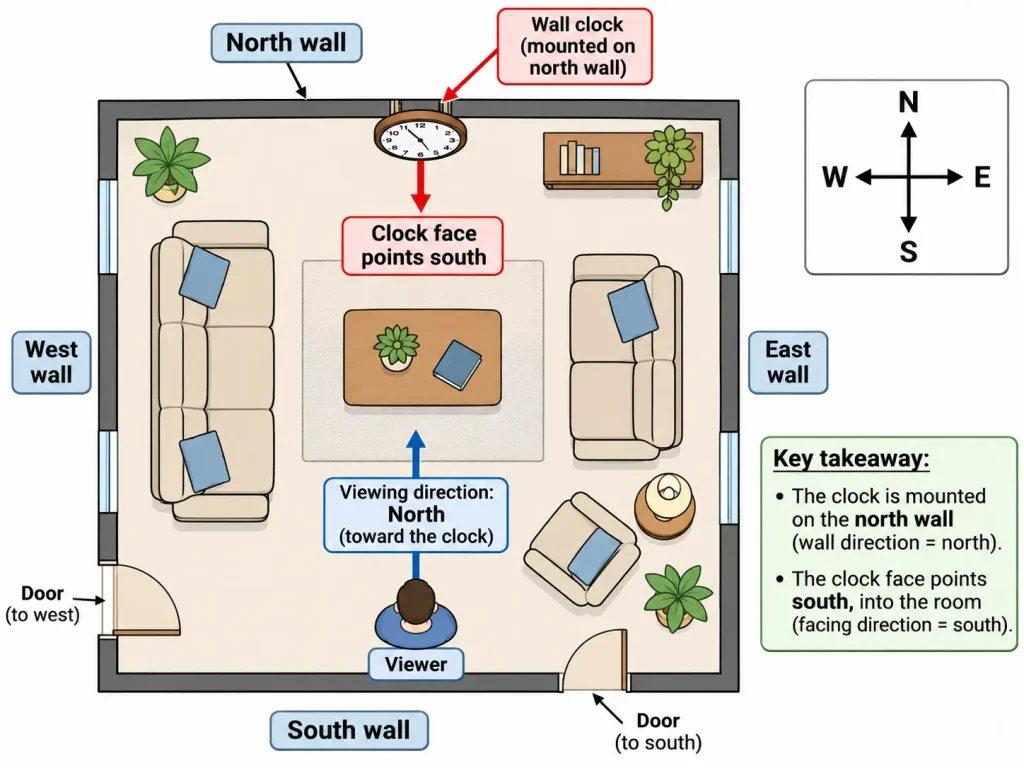
7. Clock on the Wall vs Direction the Clock Faces
One of the most common sources of confusion is the phrase “the clock should face north.”
Does that mean the clock should hang on the north wall, or should the front of the clock physically point north?
These are different arrangements.
Understand the difference
| Wall holding the clock | Direction the clock face points into the room | Direction a person faces when looking directly at it |
|---|---|---|
| North wall | South | North |
| East wall | West | East |
| South wall | North | South |
| West wall | East | West |
Suppose you install a clock on the north wall of your living room.
Its front faces towards the south side of the room. A person standing opposite it looks north to read the time.
Most contemporary Vastu articles that recommend a “north wall clock” are referring to the wall on which the clock is installed, not the direction in which its front points.
This distinction is especially important when interpreting advice about wall clocks, mirrors, paintings, and furniture.
8. How to Find the Correct Wall Direction in Your Home
Before installing your clock, identify the actual direction of each wall.
Do not assume that the wall behind your main entrance is north or that your building is aligned perfectly with the four cardinal directions.
Step-by-step method
Step 1: Find a reliable compass reading.
Use a compass or a calibrated smartphone compass application.
Take readings away from large metal cupboards, magnetic objects, and electrical equipment that could influence the measurement.
Step 2: Identify north.
A compass generally indicates magnetic north. Depending on the application and its settings, it may display a corrected true-north bearing.
Magnetic declination is the angular difference between magnetic north and true north. It varies with location and time.
For a simple furniture-placement decision, a reasonable directional estimate is usually sufficient.
Step 3: Determine the direction of each wall.
In a rectangular room aligned with the compass directions:
- The wall along the northern edge is the north wall.
- The wall along the eastern edge is the east wall.
- The wall along the southern edge is the south wall.
- The wall along the western edge is the west wall.
Step 4: Check the available space.
Inspect the walls for windows, switches, wardrobes, door openings, existing fixtures, and possible concealed utilities.
Step 5: Choose the safest practical position.
Prefer a north or east wall when doing so does not compromise accessibility, visibility, or installation safety.
What about apartments built at an angle?
Many modern housing societies have floor plans rotated away from the cardinal directions.
In such apartments, a physical wall may face north-east or north-west rather than due north or east.
Do not force a precise classification without a reliable plan and clear measurement method.
For ordinary clock placement, use the nearest reasonable direction and prioritise functionality.
Different Vastu schools may classify angled walls or directional sectors differently.
For further apartment guidance, see our 2BHK Flat Vastu Plan: Ideal Room Directions and Layouts.
9. Wall Clock Direction in the Living Room
The living room is usually the most practical location for the main wall clock in an Indian home.
Family members, children, and visitors may all rely on it.
Recommended placement
Contemporary Vastu guidance generally favours the north or east wall.
Choose a location where people can read the time without frequently turning their heads or looking behind furniture.
A clock should complement the room rather than dominate it.
Choosing a suitable design
For a compact living room, consider a reasonably sized round clock with a clear dial and contrasting hands.
For a spacious room, a larger clock may be appropriate if its weight can be safely supported.
Wooden, metal, and modern minimalist designs can all work well, provided they are suitable for the surroundings.
Places to avoid
Avoid placing a heavy clock directly above a doorway, over a frequently used passage, or above seating where a mounting failure could cause injury.
Also avoid locations where reflections or poor lighting make the time difficult to read.
A large decorative clock may look attractive above a sofa, but its mounting must be suitable for the wall material and the clock’s weight.
10. Best Wall Clock Direction for the Bedroom
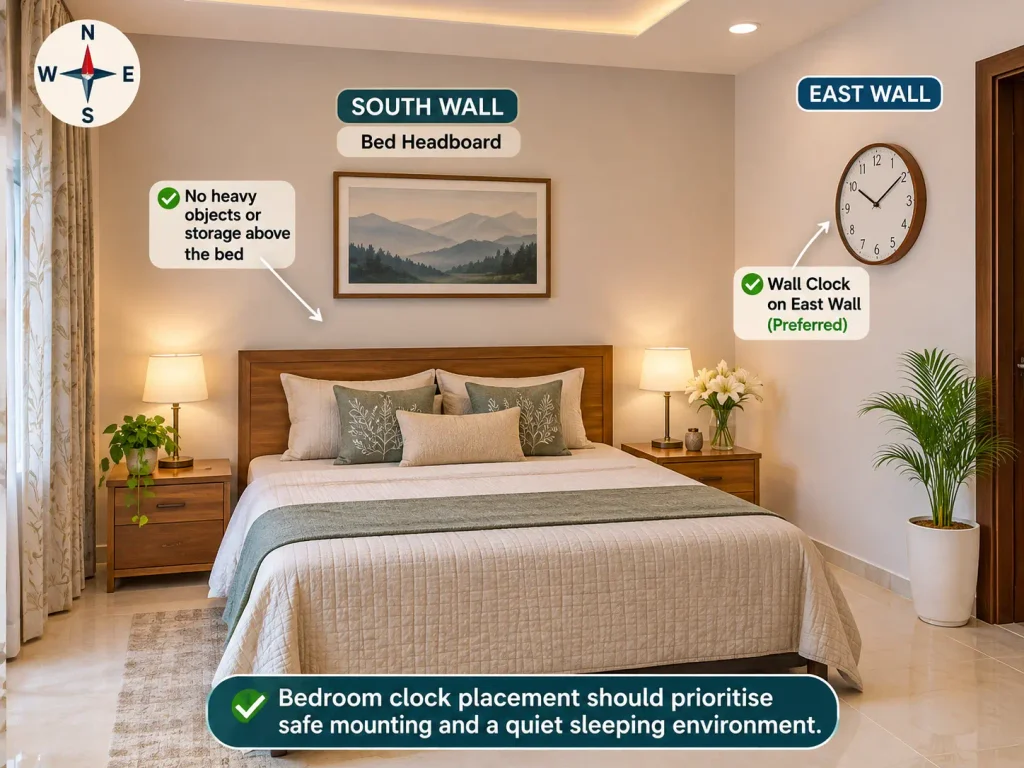
According to commonly followed Vastu advice, a bedroom clock may be placed on the north or east wall.
However, bedroom placement requires additional consideration.
Choose a quiet clock
A loud ticking sound can disturb people who are sensitive to noise while sleeping.
A silent or low-noise clock is often a better option.
If you choose a digital clock, make sure its display can be dimmed sufficiently or switched off at night.
The US Centers for Disease Control and Prevention advises maintaining a dark, quiet, cool, and comfortable sleeping environment.
Avoid hanging a clock above the bed
This is sensible from both a practical and a decorative perspective.
A clock directly above the headboard may be inconvenient to maintain, and a falling object could cause injury.
Place the clock on a separate wall where it is easy to see and securely installed.
Should a clock face the bed?
There is no scientific reason that a clock facing the bed would itself be harmful.
However, a bright display or a clock positioned where it encourages repeated checking of the time may be undesirable for some sleepers.
Choose the placement that allows you to rest comfortably.
For other traditional bedroom arrangements, read our Bedroom Direction as per Vastu guide.
11. Wall Clock Placement in the Kitchen
The kitchen is another place where a clock has a clear practical purpose.
It helps with cooking schedules, timing meals, and managing morning routines.
A north or east wall can be selected when suitable.
But kitchens introduce additional factors that should take priority over decorative preferences.
Avoid heat and moisture
Do not hang a clock directly above a gas burner, beside a hot chimney outlet, or in a location regularly exposed to steam.
Excessive heat, humidity, grease, and moisture can damage clock components or make cleaning difficult.
Avoid installing the clock on a wall section where drilling could damage concealed electrical wiring, gas lines, or plumbing.
In a small modular kitchen, an existing clear wall section may be more suitable than the theoretically preferred direction.
A compact clock with a wipe-clean surface is often a practical choice.
12. Wall Clock Direction for a Study Room or Home Office
In a study or home office, the purpose of a clock is to support time management.
North and east remain commonly recommended according to modern Vastu interpretations.
However, the best practical position depends on the desk layout.
A clock should be visible when needed without becoming a constant visual distraction.
For students
Place the clock where the student can check the time during a scheduled study session.
Avoid a very large, illuminated, or noisy display directly beside the study desk if it becomes distracting.
A simple clock can help with planned breaks, homework periods, and examination practice.
For people working from home
Choose a clock that is visible from the workstation.
If your north wall contains a bookshelf and your east wall is behind the computer, a west-wall clock may be easier to use.
Avoid relocating your desk solely to accommodate a clock.
The clock should support the room’s function, not dictate its entire layout.
13. Wall Clock in the Dining Room, Hallway and Entrance
A dining room clock can be useful for family schedules and meal timings.
North or east may be selected if you wish to follow common Vastu preferences.
In a hallway, ensure the clock does not project dangerously into a narrow passage.
Can you hang a clock above the main entrance?
Contemporary Vastu advice commonly discourages placing a clock directly above the main entrance.
There is also a practical reason to avoid this arrangement: installing a clock high above a doorway can make reading and maintenance inconvenient.
Choose an accessible side wall instead.
What if the clock is opposite the main door?
Some Vastu sources discourage clocks directly facing an entrance, but this is not a universally agreed rule.
There is no demonstrated harmful effect.
If the clock is safe, visible, and aesthetically appropriate, there is no need for costly changes.
14. Which Wall Clock Shape Is Best as per Vastu?
Clock shape is frequently discussed alongside directional placement.
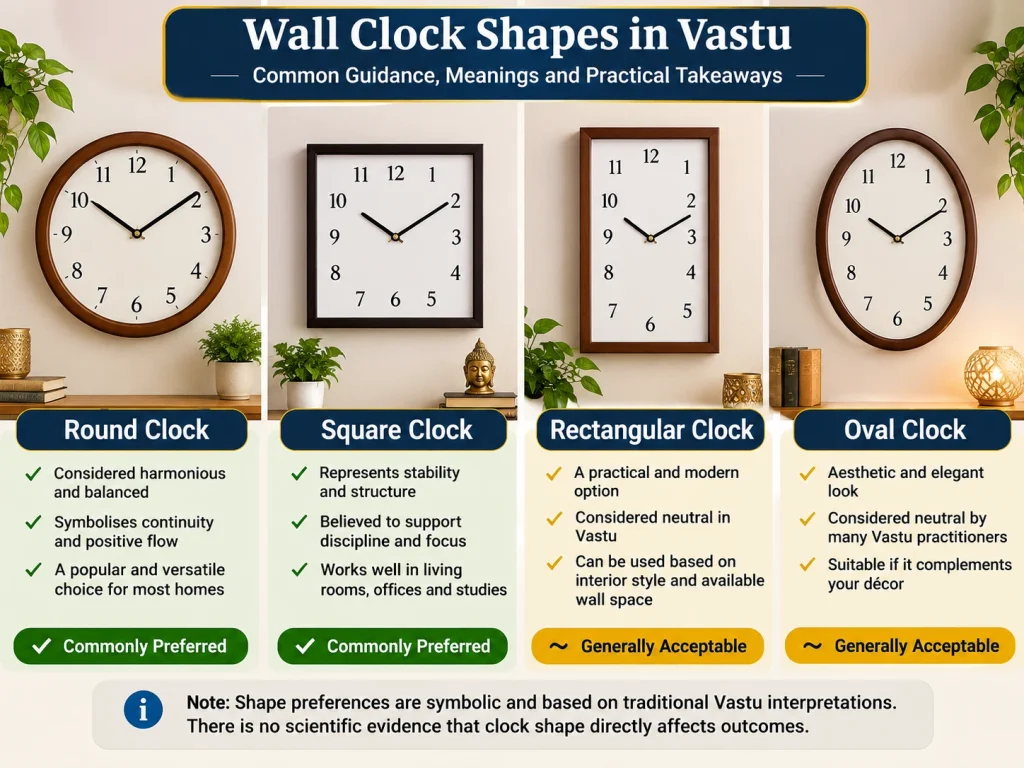
Round and square clocks are among the most commonly recommended designs in contemporary Vastu guides.
Their popularity is partly connected with symbolic interpretations of harmony, continuity, balance, and stability.
Round wall clocks
Round clocks are a straightforward choice.
Their shape can symbolise continuity and the passing of time, and they fit many interior design styles.
A simple circular clock with clearly marked numbers is particularly practical for shared rooms.
Square wall clocks
Square clocks are also commonly accepted.
They may appeal to homeowners who prefer geometric or minimalist interiors.
From a usability perspective, the clarity of the dial matters more than the shape of its frame.
Rectangular wall clocks
Rectangular clocks can be suitable for offices, studies, kitchens, and contemporary living rooms.
There is no verified universal classical prohibition against rectangular modern clocks.
Triangular or irregular-shaped clocks
Some contemporary practitioners discourage sharply triangular or irregular clock designs because of symbolic associations with instability or angularity.
These restrictions vary between sources.
There is no scientific evidence that a triangular clock creates conflict or misfortune.
Choose a design that remains easy to read and safely mounted.
Clock shape comparison
| Shape | Common modern Vastu interpretation | Practical suitability |
|---|---|---|
| Round | Harmony and continuity | Versatile for most rooms |
| Square | Balance and stability | Suitable for modern interiors |
| Rectangular | Generally acceptable | Useful for studies and offices |
| Oval | Usually acceptable | Decorative and space-efficient |
| Triangular | Discouraged by some practitioners | Mainly a design preference |
| Irregular artistic design | Opinions vary | Check readability and secure mounting |
Best overall choice: A simple round or square wall clock is an uncomplicated option for homeowners who want a design consistent with common Vastu preferences.
15. Best Wall Clock Colours as per Vastu
Modern Vastu guides sometimes associate colours with directional zones or traditional elements.
These recommendations are not uniform across different schools.
For example, light blue and green are sometimes suggested for north-related interiors, while white, cream, or light green are recommended for east-facing areas.
However, there is no authenticated universal colour chart for modern wall clocks.
Practical colour recommendations
| Wall direction | Commonly suggested colours | Interior-design consideration |
|---|---|---|
| North | Light blue, green, silver | Use sufficient contrast against the wall |
| East | White, cream, light green | Avoid pale numbers on a pale dial |
| West | Neutral, metallic or earthy tones | Coordinate with furniture and finishes |
| South | No change required for scientific reasons | Choose a finish that suits the room |
These combinations are optional styling suggestions rather than mandatory corrections.
Can we use a black wall clock?
Yes.
There is no scientific basis for believing that a black wall clock causes misfortune.
Some contemporary Vastu practitioners prefer lighter shades, while others accept black as a neutral or modern design choice.
A black clock against a white wall can provide excellent readability.
Similarly, a white clock with dark numbers may work well in a darker room.
Colour contrast, visibility, and personal preference are sensible factors when selecting a clock.
16. Wooden, Metal or Plastic Wall Clock: Which Is Better?
Many Vastu-related decorating articles connect different materials with the five traditional elements, or Pancha Mahabhutas.
These associations are interpretive, and there is no single universally accepted rule requiring every clock frame to match a directional element.
Wooden clocks
Wooden clocks offer a warm appearance and may complement bedrooms, living rooms, and study spaces.
They work particularly well with natural or traditional interior styles.
Avoid prolonged exposure to moisture or excessive heat, which may affect certain finishes.
Metal clocks
Metal-framed clocks are popular in contemporary homes.
They can work well in modern living rooms, offices, and dining areas.
Check the weight before installation, particularly with oversized decorative models.
Plastic or composite clocks
Lightweight plastic and composite clocks are often convenient for rented flats, kitchens, and children’s rooms.
They can be easy to clean and are available in many styles.
The safest choice is a clock with a reliable mechanism, appropriate materials, a readable dial, and mounting hardware suited to its weight.
17. Analog, Digital and Pendulum Clocks as per Vastu
Analog clocks
An analog clock displays time using hands moving around a dial.
It is a practical option for living rooms and studies, especially when its markings are clear.
Some homeowners prefer analog clocks for their traditional appearance.
Digital clocks
Digital clocks are not inherently unsuitable according to any verified universal rule of Vastu.
They may be convenient for offices, kitchens, and bedrooms.
For bedrooms, choose a display with adjustable brightness and minimal disruptive sound.
Pendulum clocks
Pendulum clocks have a traditional decorative appeal and may suit large living rooms or halls.
Some contemporary Vastu interpretations view their movement symbolically.
However, they may require additional maintenance and secure installation.
A heavy pendulum clock needs suitable wall support and clearance for its moving parts.
If the ticking or chime is disturbing, choose a quieter mechanism.
18. What Is the Correct Height for a Wall Clock?
There is no verified universal Vastu rule requiring every wall clock to be installed at a particular measurement above the floor.
Some decorating advice recommends eye-level positioning, but the appropriate height depends on the room and how the clock will be viewed.
Living room
Position the clock where it can be read comfortably from the main seating arrangement.
Bedroom
Choose a location that remains visible without placing a heavy object over the bed.
Kitchen
Select a position away from heat, steam, and splashes, while keeping the clock within a comfortable viewing angle.
Study room
Choose a position that does not require repeated neck movement.
For installation, use hardware recommended for the particular clock and wall material. Brick, concrete, plasterboard, and other surfaces may require different fixings.
If the wall contains concealed services or you are unsure of the appropriate installation method, seek professional assistance.
Do not rely on a small adhesive hook for a heavy clock unless the product and fixing manufacturer’s instructions specifically support that application.
19. Is a Stopped or Broken Clock Bad According to Vastu?
A stopped clock is often interpreted symbolically in contemporary Vastu as representing stagnation or interrupted movement.
For this reason, many practitioners recommend keeping clocks working and removing irreparably broken ones.
From a practical perspective, the advice is straightforward.
A clock displaying the wrong time is unreliable. A cracked glass cover can create a safety hazard, and a loose frame may fall.
What should you do?
Replace an exhausted battery promptly.
If the clock continues to lose time, inspect or replace its mechanism.
Repair damage where safe and economical.
Remove a clock that cannot be securely mounted or repaired.
Do not intentionally set a clock several minutes ahead or behind based on claims that doing so will change luck. If you use such a setting as a personal time-management habit, remember that it does not alter the actual time.
Keeping clocks accurate helps everyone follow a consistent schedule.
20. Common Wall Clock Vastu Mistakes
Several common mistakes are easy to avoid.
Mistake 1: Confusing the clock’s facing direction with the wall direction.
A clock mounted on the north wall faces into the room towards the south. Identify the wall itself before applying a recommendation.
Mistake 2: Hanging a heavy clock above a bed.
Choose a safer wall rather than positioning a heavy decorative object directly above a sleeping person.
Mistake 3: Assuming the south wall causes financial problems.
This is not an evidence-based conclusion. A clock’s position does not determine income or debt.
Mistake 4: Using a loud clock in a quiet bedroom.
Select a mechanism suited to the room’s purpose.
Mistake 5: Ignoring mounting requirements.
A clock must be attached securely using fixings appropriate for the wall and its weight.
Mistake 6: Choosing a decorative clock that is difficult to read.
Large ornamental hands, reflective glass, or low-contrast numerals can reduce usability.
Mistake 7: Ignoring the real layout of the room.
Windows, built-in furniture, electrical fittings, and structural limitations may make the recommended wall unsuitable.
Mistake 8: Buying costly products to correct a supposed defect.
An ordinary, functioning clock placed safely on a suitable wall is sufficient. There is no verified need for expensive ritual objects or specialised clock materials.
21. Practical Wall Clock Placement Examples for Indian Apartments
Example 1: A compact 1BHK rental flat
Imagine a rented apartment with a living room containing a television on the east wall and a large window along the north wall.
The south wall has the entrance, leaving a clear west wall.
Although north and east are commonly preferred in Vastu, neither is suitable here.
A clock on the west wall is a sensible compromise.
Choose a lightweight design, confirm the permitted fixing method with the property owner, and avoid damaging concealed services.
Example 2: A modern 2BHK flat
Consider a 2BHK apartment with a rectangular living room.
The north wall has enough space for a clock between a bookshelf and an interior doorway.
The east wall contains the main television unit.
In this hypothetical arrangement, the north wall is a convenient choice that also follows common Vastu preferences.
The bedroom clocks can be positioned independently according to each room’s actual layout.
You do not have to use the same wall direction for every clock in the home.
For more apartment arrangements, see our Vastu for 1BHK and 2BHK Homes Without Demolition.
Example 3: A bedroom with a south-wall headboard
Imagine a bedroom where the bed’s headboard is against the south wall.
The north wall contains a wardrobe, while the east wall has a clear section away from the bed.
A small silent clock on the east wall may work well.
It follows a commonly preferred direction, avoids hanging a clock above the headboard, and can remain visible without adding bright light.
These examples are hypothetical illustrations, not records of consultations or measured outcomes.
22. Do You Need Vastu Remedies for a Clock in the Wrong Direction?
Wall-clock placement is a relatively simple decorative decision.
If you follow Vastu traditions and wish to change a clock’s position, the most straightforward approach is to move it to a suitable wall.
There is generally no reason to pursue expensive alterations.
Low-cost, reversible options
If the current clock is on a south wall, consider moving it to a north or east wall where installation is safe.
If the north wall is occupied, assess the east or west wall.
If the clock is broken, repair or replace it.
If the bedroom clock is noisy, use a silent clock or remove it from the sleeping area.
If the clock is positioned awkwardly, relocate it to improve readability.
You do not need to demolish walls, rebuild a room, or purchase special objects to address a clock’s direction.
More broadly, a tidy and functional living space is easier to maintain. Our 30-Day Vastu Declutter and Energy Reset guide explores practical organisation strategies for 1BHK and 2BHK homes.
23. Wall Clock Vastu Checklist Before Installation
Use this checklist when selecting a position for your clock.
- Identify the room’s actual north and east walls.
- Check whether either wall offers suitable space.
- Consider the west wall if needed.
- Avoid mounting heavy clocks directly above beds or passageways.
- Ensure the clock can be read comfortably.
- Choose a clock shape and colour that suit the room.
- Select a quiet mechanism for sleeping areas.
- Check for moisture, heat, wiring, and concealed utilities.
- Use appropriate wall fixings.
- Set the correct time and maintain the clock regularly.
- Prioritise safety and comfort when a traditional recommendation is impractical.
24. Frequently Asked Questions About Wall Clock Vastu
1. Which is the best direction for a wall clock as per Vastu?
The north and east walls are the most commonly recommended directions in contemporary Vastu practice. Some practitioners also favour the north-east portion of a room. West is a frequently accepted alternative. Choose a secure, readable position rather than forcing the clock onto an unsuitable wall.
2. Can we place a wall clock on the south wall?
Yes, you can physically place a clock on the south wall. Many contemporary Vastu practitioners discourage this direction for symbolic reasons, but there is no scientific evidence that doing so causes financial loss, illness, or misfortune. Relocation is optional.
3. Which direction is best for a wall clock in the living room?
North or east is usually preferred in modern Vastu advice. However, a west-wall position may be more practical when the preferred walls contain windows, television units, or other fittings. The clock should be visible, secure, and appropriate for the room.
4. Which wall is best for a clock in the bedroom?
A north or east wall is a common Vastu-inspired choice. More importantly, avoid hanging a heavy clock directly above the bed. Use a quiet mechanism and avoid bright digital displays that disturb sleep.
5. Which shape of wall clock is best as per Vastu?
Round and square clocks are frequently recommended by contemporary Vastu practitioners. Rectangular and other shapes are also used. There is no reliable evidence that a clock’s frame shape directly influences health, finances, or relationships. Prioritise readability and secure installation.
6. Is a black wall clock good as per Vastu?
A black wall clock is not inherently harmful. Some modern Vastu colour schemes prefer lighter shades for particular directions, but these recommendations differ. A black clock can provide excellent contrast on a light wall and may suit a modern interior.
7. Can a wall clock be placed above the main door?
Many Vastu sources recommend avoiding this arrangement. It can also be inconvenient or unsafe, especially if the clock is heavy or poorly fixed. A nearby wall at a comfortable viewing height is generally more practical.
8. Is it bad to keep a stopped clock at home?
Contemporary Vastu practice often treats a stopped clock as a symbol of stagnation. There is no scientific evidence that it creates bad luck. Nevertheless, repairing or removing a non-functioning clock is sensible because an inaccurate clock is not useful.
9. Can we place a wall clock in the north-east corner?
Yes, some modern Vastu interpretations recommend the north-east area. In a typical rectangular room, this means using an appropriate portion of the north or east wall near the corner. Do not compromise safe mounting or readability merely to position the clock at an exact corner.
10. Is a digital wall clock acceptable as per Vastu?
Digital clocks are suitable for ordinary use. No verified universal classical rule prohibits them. Choose a reliable model and consider display brightness, battery requirements, and noise. A dimmable clock may be particularly useful in a bedroom.
11. Which direction should a wall clock face?
This depends on whether “face” refers to the wall’s location or the direction in which the clock’s front points. A clock hung on the north wall physically faces south into the room. Most recommendations for a “north wall clock” refer to the wall holding it.
12. Is one wall clock enough for a 2BHK flat?
Yes. There is no evidence-based requirement to install clocks in every room. One clearly visible clock in a living room may be sufficient for many households. Additional clocks can be placed in bedrooms, kitchens, or studies when they serve a practical purpose.
Choose a Direction That Works for Your Home
According to commonly followed contemporary Vastu recommendations, the north and east walls are preferred for wall clocks, with west often serving as an acceptable alternative. South and south-west are usually discouraged in these traditions.
Round and square designs are popular choices, while the most suitable colour and material depend largely on your home’s interior style and practical needs.
Traditional Vastu can provide a meaningful cultural framework for arranging a home, but clock placement should not be treated as a cause of financial, medical, or personal outcomes.
A well-chosen wall clock should be accurate, clearly visible, securely mounted, and appropriate for the room.
The best arrangement is one that respects your preferences without compromising safety, comfort, or everyday usefulness.
For a broader overview of evaluating a home, explore our Apartment Vastu Buying Checklist.
Editorial note: Vastu recommendations in this article are presented as traditional or contemporary cultural preferences. They are not substitutes for qualified architectural, electrical, structural, medical, or financial advice.